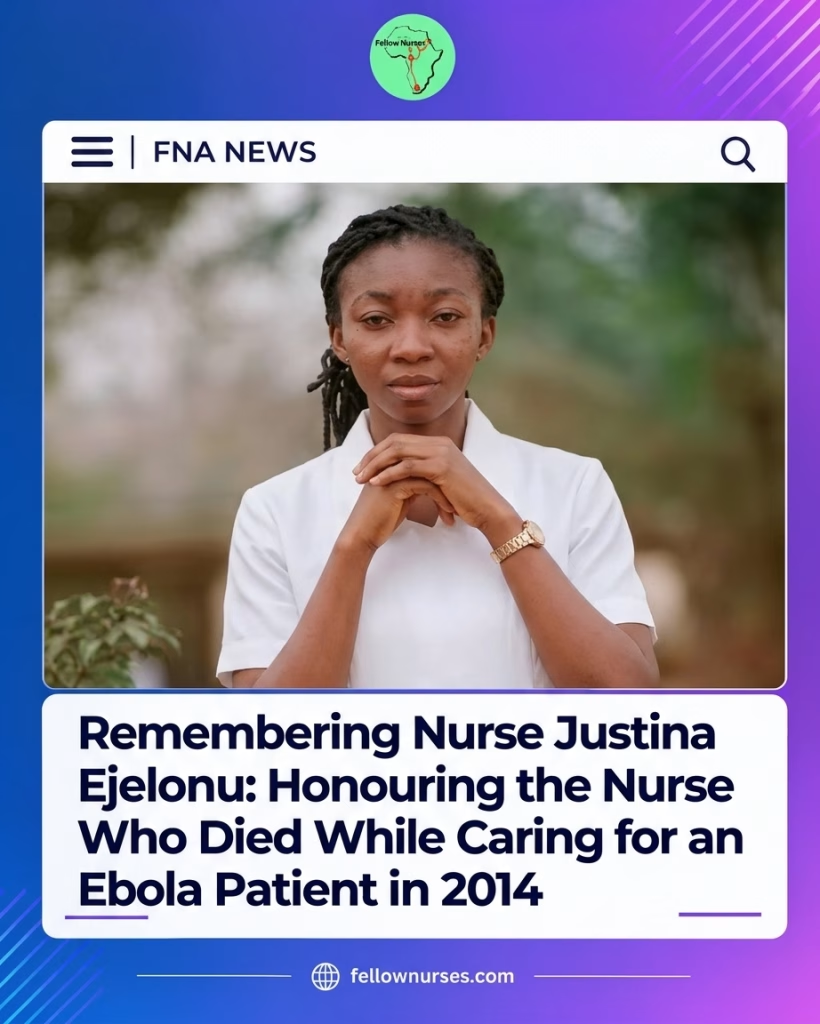
Remembering Nurse Justina Ejelonu: Honouring the Nurse Who Died While Caring for an Ebola Patient in 2014
By Fellow Nurses Africa
👉 Join Fellow Nurses Africa on WhatsApp
Some heroes are celebrated for the lives they save. Others deserve to be remembered for the lives they risked saving. Nurse Justina Obioma Ejelonu belongs to the latter category.
In 2014, as Nigeria confronted its first recorded Ebola Virus Disease outbreak, Ejelonu was among the healthcare workers who came into contact with the infection while caring for the country’s index patient. She contracted the virus and died, leaving behind a story of professional dedication, personal loss and a sacrifice that continues to resonate within Nigeria’s nursing community.
More than a decade later, her story remains a powerful reminder of the risks healthcare workers face while caring for patients during infectious disease emergencies.
A Nurse on the Frontline of Nigeria’s Ebola Outbreak
Nigeria’s Ebola outbreak began in July 2014, when Patrick Sawyer, a Liberian-American diplomat infected with the Ebola virus, arrived in Lagos. He was admitted to First Consultants Medical Centre in Obalende, where healthcare workers provided care before the infection was confirmed.
Ejelonu, a 25-year-old nurse who had recently joined the hospital, was among those who attended to Sawyer. According to contemporary reports and accounts from Ebola survivor Dr Ada Igonoh, Ejelonu was exposed to the virus while caring for the patient.
The encounter would change the course of her life.
As the outbreak unfolded, Ejelonu tested positive for Ebola and was admitted to an isolation facility in Lagos. She was pregnant at the time and had been looking forward to building a family with her fiancé.
She did not survive the infection.
Her death was one of the painful losses recorded during an outbreak that tested Nigeria’s public health preparedness and placed extraordinary pressure on healthcare professionals working to contain the disease.
The Human Cost of Nursing Care
👉 Join Fellow Nurses Africa on WhatsApp
Ejelonu’s story is not simply a record of a nurse who contracted a dangerous infection. It is also the story of a young professional whose working life had barely begun, whose personal future held promise, and whose commitment to patient care placed her in the path of a deadly disease.
Nurses are central to the management of infectious diseases. Their responsibilities often involve close patient contact, monitoring symptoms, administering treatment and supporting patients through frightening and uncertain circumstances. During outbreaks, these duties can expose them to significant occupational risks, particularly when infection prevention measures are difficult to implement or when the nature of an emerging disease is not yet fully understood.
Nigeria’s 2014 Ebola response ultimately contained the outbreak, with public health authorities and healthcare teams working together to trace contacts, isolate cases and prevent wider transmission. Yet the outcome came at a human cost.
Ejelonu was among those who did not return home.
Her experience underscores why protecting healthcare workers must remain an essential part of emergency preparedness. Appropriate protective equipment, infection prevention training, clear clinical protocols and institutional support are not optional extras; they are fundamental to safe patient care.
Remembering the Nurse Behind the Headlines
In the public memory of Nigeria’s Ebola response, some figures have received more attention than others. Dr Ameyo Adadevoh, whose actions helped prevent Sawyer from leaving the hospital despite concerns about his condition, became widely recognised for her role in containing the outbreak.
Ejelonu’s story, however, deserves its own place in that history.
Her sacrifice has been acknowledged by members of the nursing community, and the Nigerian Universities Nursing Students Association named her its 2020 Nurse of the Year posthumously. Her recognition reflected continuing efforts to ensure that her contribution would not disappear from the profession’s collective memory.
Remembering Ejelonu does not diminish the contributions of other healthcare workers. Rather, it broadens the story of the outbreak to include the nurses whose work and losses were integral to Nigeria’s response.
Behind every public health emergency are professionals whose names may not become household knowledge but whose actions shape the outcome.
A Legacy the Nursing Profession Must Preserve
For nurses in Nigeria and beyond, Justina Ejelonu’s story is both an inspiration and a call for reflection.
It speaks to the courage involved in caring for people during a public health crisis, but it also raises an enduring question: how well do healthcare institutions protect the professionals they depend on?
Celebrating nurses should extend beyond appreciation messages and commemorative occasions. It should include safer working environments, adequate protective resources, effective occupational health policies and meaningful recognition of those who have lost their lives in the line of duty.
Ejelonu was more than a name associated with Nigeria’s first Ebola outbreak. She was a nurse, a young woman with hopes for her future, and a healthcare professional who became one of the human casualties of a national emergency.
Her life was cut short, but her story remains part of the history of Nigerian nursing.
As the profession continues to confront infectious diseases and other healthcare emergencies, her memory should remind the country of a simple truth: those who care for the sick must not be forgotten when the crisis passes.
Nurse Justina Obioma Ejelonu, your sacrifice will not be forgotten.
Fellow Nurses Africa honours her memory and the healthcare workers who risked and lost their lives while caring for others during Nigeria’s 2014 Ebola outbreak.
👉 Join Fellow Nurses Africa on WhatsApp
Fellow Nurses Africa is the independent voice of African nursing, we educate, inform and support nurses across Africa

Durowoju Abisola is a registered nurse, nurse writer and On-Air Correspondent at Fellow Nurses Africa (FNA), passionate about nursing leadership, health education and advocacy.
Through journalism, storytelling and content creation, she amplifies important conversations around nursing, healthcare and the experiences of nurses in Nigeria. She is committed to using her voice and professional knowledge to educate the public, challenge misconceptions and inspire the next generation of nurses.