
I Feel Bad Telling Others Not to Do Nursing, Do You?
By Kenny Oluwatosin, RN, MSc.
Fellow Nurses Africa| Lagos, Nigeria| 12th April, 2026
You know the moment all too well.
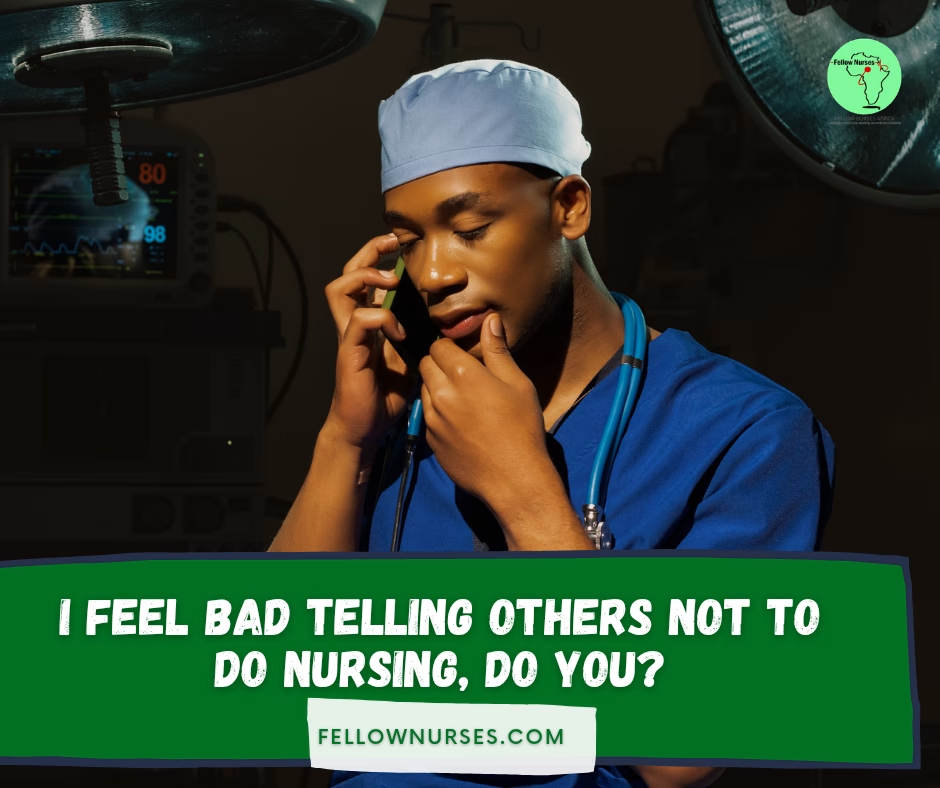
A bright young person,perhaps a college student, a cousin fresh from secondary school, or a colleague’s daughter looks at you with genuine excitement and says, “I want to be a nurse… just like you.”
Your first instinct is to smile and welcome them into the fold. After all, nursing gave you purpose, moments of profound connection, and the quiet pride of knowing you made a difference on someone’s hardest day.
But then the other voice,the honest, battle-tested one whispers: Are you sure?
And the guilt arrives like clockwork. Because who are we to dim that light? We entered this profession for the same reasons they have. Yet here we stand, many of us quietly steering passionate young people away.
👉 Join our Whatsapp channel Here
If you’ve ever felt that tug-of-war in your chest, you’re not alone. You’re not ungrateful. You’re simply telling the truth.
The Realities We Rarely Say Out Loud
Let’s speak plainly, as colleagues who have lived it.
The data from 2025 is unequivocal. In the landmark Beyond the Bedside: The State of Nursing in 2025 survey (Cross Country Healthcare in partnership with Florida Atlantic University), 65% of nurses reported high levels of stress and burnout, while only 60% said they would choose nursing again if given the chance. The primary drivers? Chronic short staffing, unsustainable workloads, inadequate support, and the emotional weight of caring for patients in systems that too often fail them.
Globally, the picture is consistent. A 2024 systematic review and meta-analysis of 85 studies involving nearly 289,000 nurses across 32 countries found that nurse burnout is strongly linked to poorer patient safety outcomes,including higher rates of medication errors, patient falls, hospital-acquired infections, missed care, and lower patient satisfaction.
Here in Nigeria and across many parts of Africa, the stakes feel even more immediate. A 2025 study of Nigerian nurses revealed 70.6% experiencing high job burnout and a staggering 89.3% with a strong intention to emigrate,the now-familiar “japa” phenomenon. Inadequate decent work conditions (reported by 75% of respondents), low wages, frequent night duties, and doctor-nurse conflicts were key predictors.
These aren’t abstract statistics. They are the 14-hour shifts that bleed into family time. The moral injury of rationing care because there simply aren’t enough hands. The quiet exhaustion that follows you home and makes you hesitate before encouraging the next generation and the lack of basic resources to work with.
Why We Feel Guilty Saying It Anyway
Because nursing still delivers moments no other profession can.
We’ve all lived them: the patient who squeezed your hand in silent gratitude after you stayed late to explain a diagnosis. The family who found comfort in your calm voice during a crisis. The life saved because you noticed the subtle change in a monitor that everyone else missed. The dignity you helped preserve for someone at the end of life.
We chose this path to matter,to be the steady presence in chaos, the bridge between science and humanity. And we still do. That sacred privilege is why discouraging bright, compassionate people feels like a betrayal.
Yet silence isn’t kindness. Naïve idealism meets reality quickly, and the consequences are real for the nurse, for their patients, and for the profession.
What We Should Tell Aspiring Nurses
We don’t have to say “Don’t do it.” We can—and must—say something far more respectful and empowering:
“Go in with your eyes wide open. This profession can be extraordinary, but it demands preparation, resilience, and advocacy.”
Share the full truth:
- The rewards are unmatched. Flexible schedules, global opportunities, specialisation pathways (critical care, education, research, advanced practice), genuine job security in most markets, and human connections that stay with you forever.
- The challenges are systemic. Short staffing is not a personal failing,it’s a structural issue we must continue to fight. Burnout is real; self-care, boundaries, and supportive environments are non-negotiable.
- Advocacy matters. The next generation must enter equipped to demand safe staffing ratios, fair compensation, mental health resources, and leadership that listens.
Remind them that many of us,despite the exhaustion still wouldn’t trade this calling. We simply want them to choose it fully informed, not idealistic. We want them to advocate louder than we could. We want them to help fix what needs fixing.
The 2025 survey also showed something hopeful: even amid the pressures, the majority of nursing students remain genuinely excited about their future. That hope is what sustains us all.
A Call to Our Colleagues: Honesty Is Advocacy
Fellow nurses, we owe the next generation our candour. Telling the truth isn’t discouragement,it’s protection. It’s how we ensure the profession attracts resilient, informed, passionate professionals who will stay and drive change.
We must also turn that honesty inward. We are not failures for feeling worn down. We are human beings doing one of the hardest, most sacred jobs on earth. The system,not our dedication has often failed us.
Together, we can push for better: safe staffing legislation, fair pay, mental health support, and environments where compassion doesn’t come at the cost of our own well-being.
If you’re a nurse reading this after yet another demanding shift,thank you. Your presence still matters more than you know.
And if you’re the student, the cousin, or the friend considering nursing: we see your fire. We’re rooting for you. Just promise us you’ll guard your heart, your boundaries, and your voice.
We’ve got each other. And perhaps, by being honest today, we can make the path a little clearer and a little safer for those who follow.
What about you? Have you had “the conversation” lately? How did it feel? Share your thoughts. I’d love to know I’m not the only one wrestling with this.
👉 Join our Whatsapp channel Here
Fellow Nurses Africa is the independent voice of African nursing, we educate, inform, and support nurses across Africa

Kehinde Oluwatosin is one of the many editors here at Fellow Nurses Africa and fellownurses.com.
He is a registered nurse with a Master of Science degree in healthcare leadership from the University of Hull, United Kingdom. Kehinde is passionate about advancing the nursing profession across Africa. As Co-Founder of Fellow Nurses Africa, he plays a key role in shaping editorial direction, ensuring our content educates, informs, and empowers nurses continent-wide.
With expertise in leadership, patient flow, and healthcare operations, Kehinde brings valuable insights to nursing news, career development, and policy discussions. He is committed to amplifying the voice of African nurses and driving positive change in the profession.