Redeemer’s Health Village Completes First Robotic-Assisted Surgery in Nigeria
FNA NEWS, 18th Of September, 2026
The Ogun State-based hospital says the milestone is part of a wider plan to expand advanced surgical care, train Nigerian healthcare professionals and reduce the need for overseas treatment.
👉 Join Fellow Nurses Africa on WhatsApp
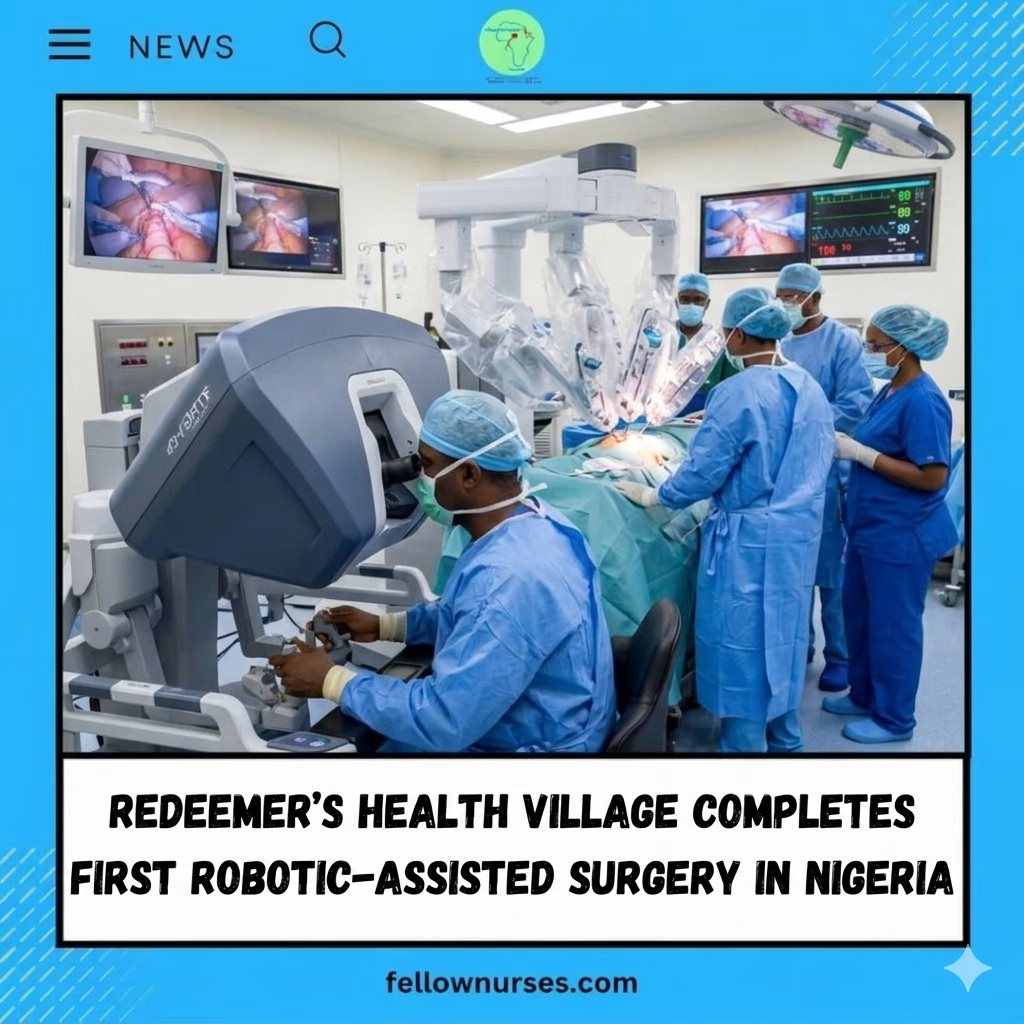
Redeemer’s Health Village (RHV), a 300-bed multispecialty hospital in Ogun State, has successfully completed its first robotic-assisted surgery, marking a new stage in the hospital’s move into advanced minimally invasive surgical care.
The procedure, performed on a middle-aged man with localised prostate cancer, was carried out by a team involving urology specialists, RHV’s in-house medical team and robotic surgeons from RoboMed Global Inc., a US-based organisation.
The development was announced on September 17, 2026, by RHV Chief Executive Officer, Dr Adedamola Dada, who said the hospital’s partnership with RoboMed Global was designed not only to provide access to advanced surgery but also to develop the specialist workforce needed to sustain the technology in Nigeria.
RHV’s first robotic-assisted procedure
According to the News Agency of Nigeria (NAN), the surgery involved the removal of cancer that was confined to the prostate and had not spread to other parts of the body.
Prof. Obi Davies-Ekwenna, co-founder of RoboMed Global and a professor of urology, said robotic surgery can be particularly useful in appropriately selected patients with localised prostate cancer.
He explained that the technology allows surgeons to work through smaller incisions and provides greater precision in tissue manipulation. Potential benefits include less postoperative pain and a reduced risk of wound infection compared with some forms of open surgery.
However, robotic surgery does not mean that a robot independently performs the operation.
The surgeon remains responsible for controlling the procedure, while the robotic system provides enhanced visualisation, dexterity and instrument control. At RHV’s programme launch, former Health Minister Senator Adeleke Mamora similarly described robotic surgery as an advanced tool designed to enhance the surgeon’s capabilities rather than replace the surgeon.
A wider robotic surgery programme
The successful operation follows RHV’s launch of a dedicated robotic surgery programme in August 2026 in partnership with RoboMed Global.
At the launch, RHV said the programme would initially cover several surgical specialties, including urology, general surgery, gynaecological surgery, colorectal surgery, thoracic surgery and hepatobiliary surgery.
The hospital also disclosed that it had acquired two robotic systems — one intended for clinical services and another for training.
The Federal Ministry of Health and Social Welfare welcomed the programme, describing robotic surgery as an opportunity to strengthen Nigeria’s capacity for advanced and minimally invasive surgical care. The ministry also highlighted the importance of training Nigerian professionals alongside the introduction of the technology.
RHV plans robotic surgery training academy
👉 Join Fellow Nurses Africa on WhatsApp
For RHV, the project extends beyond acquiring robotic equipment.
Dada said the hospital plans to establish a robotic surgery training academy to create a pipeline of Nigerian professionals who can perform and support robotic procedures.
The proposed training initiative is expected to involve partnerships with Nigerian academic and professional institutions, including Redeemer’s University and the National Postgraduate Medical College.
RHV’s programme launch also outlined a structured training pathway involving didactic education, laboratory training, human training, examination and credentialing.
This workforce component is significant because robotic surgery requires more than a surgeon and a robotic platform. Anaesthesia professionals, perioperative nurses, surgical assistants, biomedical engineers and other members of the theatre team must understand the equipment, workflow and safety requirements associated with robotic procedures.
For nurses in particular, the expansion of robotic surgery could create demand for additional competencies in robotic theatre preparation, patient positioning, equipment checks, intraoperative assistance and postoperative care.
Can robotic surgery reduce medical tourism?
One of the central arguments behind RHV’s programme is that Nigerians should be able to access advanced surgical treatment without travelling abroad.
Dada told NAN that the partnership was intended to bring specialised medical skills to Nigeria and reduce some of the difficulties and additional costs associated with overseas treatment.
The Federal Ministry of Health has similarly presented the programme as part of efforts to strengthen domestic healthcare capacity and reduce the economic burden associated with seeking specialised treatment outside the country.
But access will depend on more than the presence of robotic equipment.
At the programme’s launch, Mamora cautioned that establishing a sustainable robotic surgery service requires trained personnel, maintenance systems, clinical governance and appropriate financing.
That distinction is important. A robotic surgical system can expand what a healthcare facility is capable of offering, but its long-term value depends on whether hospitals can maintain the technology, train sufficient professionals and make appropriate procedures accessible to patients.
RHV is not Nigeria’s first robotic surgery provider
The RHV milestone should not be confused with Nigeria’s first-ever robotic surgery.
Nigeria’s robotic surgery journey predates RHV’s programme. In November 2025, Nisa Premier Hospital in Abuja commissioned the country’s first Toumai Pro robotic surgery platform. The hospital said the platform was intended to support advanced surgical care and training for healthcare professionals in Nigeria and across Africa.
RHV’s achievement therefore represents its first robotic-assisted surgery, rather than the first robotic surgery performed in Nigeria.
The distinction matters as more Nigerian hospitals begin investing in robotic and other advanced surgical technologies.
What this means for Nigeria’s healthcare workforce
The more significant question may ultimately be what happens after the technology arrives.
Nigeria’s adoption of robotic surgery creates an opportunity to develop a workforce with expertise in a rapidly evolving area of surgical care. RHV has explicitly linked its programme to professional training and the development of local manpower.
For nurses and other healthcare professionals, this could mean new opportunities for specialist education and expanded roles within advanced operating-room teams.
The success of such programmes, however, will depend on sustained training, appropriate credentialing, equipment maintenance and strong clinical governance.
RHV’s first robotic-assisted procedure is therefore more than a single operation. It is an early test of whether Nigeria can build the people, systems and infrastructure needed to make advanced robotic surgery a sustainable part of local healthcare.
👉 Join Fellow Nurses Africa on WhatsApp
Fellow Nurses Africa is the independent voice of African nursing, we educate, inform and support nurses across Africa.

Durowoju Abisola is a registered nurse, nurse writer and On-Air Correspondent at Fellow Nurses Africa (FNA), passionate about nursing leadership, health education and advocacy.
Through journalism, storytelling and content creation, she amplifies important conversations around nursing, healthcare and the experiences of nurses in Nigeria. She is committed to using her voice and professional knowledge to educate the public, challenge misconceptions and inspire the next generation of nurses.