
FNA NEWS | SPECIAL REPORT | 22 OCTOBER 2026
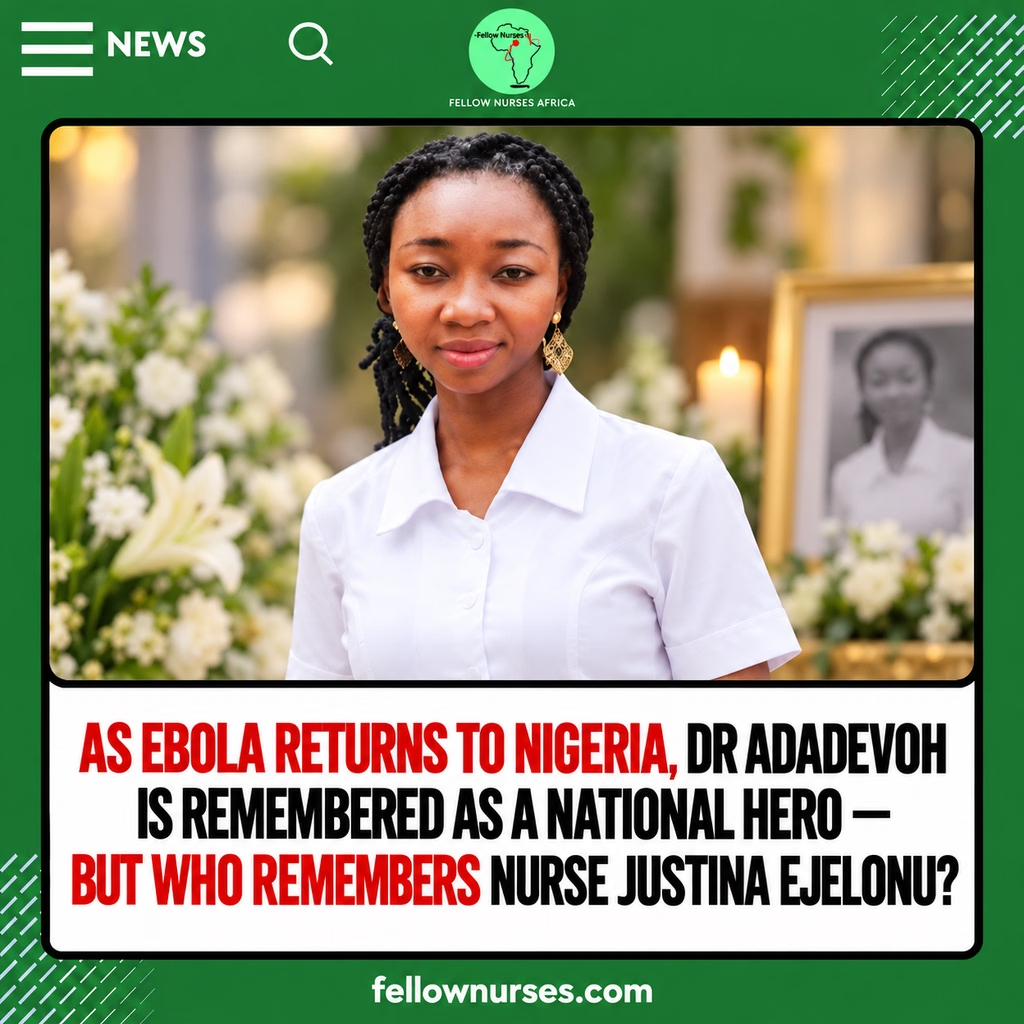
As Ebola Returns to Nigeria, Dr Adadevoh Is Remembered as a National Hero — But Who Remembers Nurse Justina Ejelonu?
As Nigeria confirms a new Ebola case after 12 years, Fellow Nurses Africa revisits the heartbreaking story of a pregnant nurse who died caring for the country’s first Ebola patient in 2014. While her supervising doctor became a nationally celebrated heroine, Justina’s loved ones have questioned why her sacrifice and those of other healthcare workers received far less attention.
FNA NEWS | SPECIAL REPORT
Twelve years ago, Nigeria lost two remarkable healthcare professionals to Ebola.
One was a respected physician whose courage would become a defining chapter in Nigeria’s public health history.
The other was a young nurse who had barely begun a new job, was expecting a child and was preparing to build a family with the man she loved.
Both worked at the same hospital.
Both encountered the same deadly patient.
Both contracted Ebola.
Both died in the line of duty.
Yet, more than a decade later, their names occupy very different places in Nigeria’s national memory.
👉 Join Fellow Nurses Africa on WhatsApp
Dr Ameyo Stella Adadevoh became a nationally celebrated heroine. Nurse Justina Obioma Ejelonu, despite receiving recognition within the nursing profession, has remained far less prominent in the story of Nigeria’s victory over Ebola.
Now, with a new Ebola case confirmed in Abuja, Fellow Nurses Africa believes there could hardly be a more important time to revisit their sacrifices.
Not to diminish the extraordinary courage of Dr Adadevoh, but to ask a difficult question:
When nurses and doctors make the ultimate sacrifice together, why are their contributions not always remembered with equal prominence?
Ebola Returns: Twelve Years After Nigeria’s Historic Victory
On 20 October 2026, the Federal Ministry of Health and Social Welfare confirmed an imported case of Ebola Bundibugyo virus disease in Abuja.
According to the World Health Organization (WHO), the patient, a woman with recent travel history to Uganda, developed symptoms on 7 October and sought medical attention at a private healthcare facility on 11 October.
Laboratory tests confirmed Ebola on 20 October.
The patient was placed in isolation and received medical care. At the time of the announcement, authorities had identified 44 contacts for monitoring.
The development comes exactly 12 years after the WHO declared Nigeria free of Ebola on 20 October 2014, following an outbreak that recorded 20 cases and eight deaths.
Nigeria’s successful containment of that outbreak attracted international praise.
But the victory came at a painful human cost.
Among those who died were Dr Ameyo Stella Adadevoh and Nurse Justina Ejelonu.
Their stories deserve to be remembered together.
Dr Ameyo Stella Adadevoh: The Doctor Who Became a National Hero
When Patrick Sawyer, a Liberian-American traveller infected with Ebola, arrived at First Consultants Medical Centre in Lagos in July 2014, Nigeria was facing a public health threat unlike anything it had previously encountered.
Dr Ameyo Stella Adadevoh, a senior consultant physician at the hospital, played a decisive role in recognising the danger and preventing Sawyer from leaving the facility despite pressure to release him.
Her professional judgement and determination helped stop a potentially catastrophic chain of transmission.
But while protecting others, she became infected.
On 19 August 2014, Dr Adadevoh died from Ebola.
Her death devastated Nigeria and prompted widespread tributes.
Over the years, she became a symbol of courage, patriotism and professional sacrifice.
Her name was celebrated in newspapers, documentaries, public speeches and international publications.
In 2016, the Nigerian film 93 Days brought the country’s Ebola response to the screen, with actress Bimbo Akintola portraying Dr Adadevoh.
In October 2018, Google celebrated what would have been her 62nd birthday with a special Google Doodle recognising her contribution to preventing the spread of Ebola.
In February 2020, a road in Abuja was named Ameyo Adadevoh Way in her memory.
In May 2022, she received the National Productivity Order of Merit posthumously.
Five months later, on 11 October 2022, the Federal Government conferred on her the prestigious national honour of Officer of the Order of the Niger (OON).
Her legacy also lives on through the Dr Ameyo Stella Adadevoh Health Trust, an organisation working to strengthen public health preparedness, infection prevention and disease outbreak response.
These honours reflect the extraordinary importance of her contribution.
👉 Join Fellow Nurses Africa on WhatsApp
Dr Adadevoh deserved to be celebrated. She deserved to be honoured. She deserved to be remembered.
But she was not the only healthcare worker who gave her life during Nigeria’s battle against Ebola.
And that is where the story of Nurse Justina Ejelonu demands renewed attention.
Nurse Justina Ejelonu: A Young Woman Whose Dreams Ended on Duty
Justina Obioma Ejelonu was a young nurse working at First Consultants Medical Centre in Lagos.
She was pregnant.
She was engaged to Dennis Akagha.
She was looking forward to marriage, motherhood and a promising nursing career.
According to a deeply emotional account shared by her fiancé in August 2020, Justina experienced morning sickness on the day she was due to resume work at the hospital.
The couple initially considered postponing her resumption.
But when she began to feel better, Justina decided to go to work.
It was her first day at the hospital.
And among the patients she would encounter was Patrick Sawyer.
Neither Justina nor her fiancé could have imagined the tragedy that awaited them.
The young nurse attended to Sawyer, placing herself in close contact with a patient who was subsequently confirmed to have Ebola.
She later developed symptoms and became seriously ill.
Her fiancé recalled the devastating experience of caring for her as her condition deteriorated, including the miscarriage she suffered before being taken to an isolation facility.
Justina eventually died from the infection.
Her fiancé also contracted Ebola but survived.
In the space of a few weeks, a young family that had been looking forward to a future together had been torn apart.
There would be no wedding.
No opportunity to welcome their child.
No return to the nursing career Justina had only just begun.
For her loved ones, the tragedy was not simply that Ebola had claimed another healthcare worker.
It was that an entire future had disappeared.
Her Fiancé’s Pain: Why Was Her Sacrifice Not Equally Remembered?
Six years after Justina’s death, Dennis Akagha broke his silence about the pain of losing his fiancée and the recognition he believed she had not received.
In an account reported by The Punch on 19 August 2020, Akagha questioned why the story of Nigeria’s successful Ebola containment appeared to revolve so heavily around one individual.
He believed the sacrifices of other healthcare workers, including Justina and a hospital worker responsible for cleaning Sawyer’s room, had not been adequately acknowledged.
His grief was expressed in words that remain powerful today:
“Justina sacrificed her own life taking care of Patrick Sawyer on her first day of work.”
Akagha’s concern was not that Dr Adadevoh should have been denied her honours.
It was that other people who had contributed to Nigeria’s response, including those who died, also deserved proper recognition.
There was, however, some recognition of Justina’s sacrifice.
In December 2014, Nursingworld Nigeria posthumously presented her with its Nurse-Heroine-of-the-Year award, which her parents received on her behalf. A memorial scholarship in her name was also announced.
These gestures were important.
But the contrast in national visibility remains difficult to ignore.
Dr Adadevoh became the subject of national honours, international tributes and public commemorations.
Justina’s story remained largely within nursing circles and occasional commemorative reports.
One woman’s name became part of Nigeria’s national story. Another woman’s family continued asking the country to remember her.
The question is not whether Dr Adadevoh deserved her recognition.
She unquestionably made an extraordinary contribution.
The question is whether Nigeria has done enough to ensure the sacrifices of nurses and other frontline workers receive comparable recognition.
A Healthcare System Must Celebrate Every Profession That Helped Save It
The 2014 Ebola response was not the achievement of one professional group.
It required doctors, nurses, laboratory scientists, cleaners, public health specialists, emergency responders and many others.
Some survived.
Others never returned home.
Their contributions were different, but each formed part of Nigeria’s collective response.
Yet the way societies remember public health emergencies can sometimes leave the work of less prominent professionals overshadowed.
Nurses are particularly vulnerable to this invisibility.
They are often the professionals who spend the longest periods at patients’ bedsides, administer medications, manage bodily fluids, monitor deterioration and provide continuous hands-on care.
These responsibilities can place them at significant risk during infectious disease emergencies.
For Fellow Nurses Africa, remembering Justina is therefore not an attempt to create competition between nursing and medicine.
It is a call for a more complete and inclusive account of healthcare history.
👉 Join Fellow Nurses Africa on WhatsApp
Recognising one hero should never require forgetting another.
Nigeria can celebrate Dr Ameyo Stella Adadevoh while also ensuring that Nurse Justina Obioma Ejelonu and other fallen frontline workers occupy a permanent place in its national memory.
Dear Nurses, Your Life Is Worth More Than Any Shift
Beyond remembrance, Justina’s death carries an urgent lesson for nurses across Nigeria.
Ebola has returned.
And once again, healthcare workers may be among those exposed before an infected patient is diagnosed.
The greatest danger is not always the patient whose diagnosis is already known.
Sometimes, it is the patient presenting with an unexplained fever, weakness, vomiting or diarrhoea, whose infection has not yet been recognised.
This is why vigilance must begin at the point of first contact.
Fellow Nurses Africa urges every nurse to take infection prevention and occupational safety seriously.
Maintain appropriate standard precautions for every patient, irrespective of diagnosis.
Recognise possible Ebola symptoms and exposure histories early.
Follow established triage, isolation and reporting procedures when Ebola is suspected.
Use appropriate personal protective equipment and ensure that you are trained in its correct application and removal.
Avoid unprotected contact with blood, vomit, faeces and other potentially infectious bodily fluids.
Report occupational exposure immediately and follow public health guidance on assessment and monitoring.
Never dismiss symptoms following a possible exposure or attempt to continue working without appropriate medical evaluation.
Above all, speak up when your working environment is unsafe.
Nursing is a calling to care for humanity. It is not a calling to die unnecessarily.
You can be compassionate and still demand protective equipment.
You can be professionally committed and still insist on proper infection prevention procedures.
You can care deeply for your patients without abandoning your responsibility to yourself.
Your family deserves to see you return home after your shift.
Hospitals Must Stop Relying on the Sacrifice of Nurses
The burden of preventing another tragedy must not be placed entirely on individual nurses.
The government, healthcare employers and hospital administrators have a responsibility to provide safe working conditions.
Every healthcare facility should have functional infection prevention systems, reliable protective equipment, trained personnel, clear referral pathways and effective procedures for reporting suspected cases.
Nurses should not be expected to improvise protection while managing patients with potentially life-threatening infectious diseases.
They should not be punished or intimidated for raising legitimate safety concerns.
They should not have to choose between professional duty and personal survival.
And when healthcare workers are harmed in the line of duty, their families should not be left to struggle for recognition and appropriate support.
A healthcare system that praises the courage of nurses but fails to protect them has misunderstood the meaning of professional sacrifice.
The real tribute to Justina Ejelonu would not be another emotional speech alone.
It would be safer hospitals, better infection prevention training, stronger occupational health protections and genuine recognition for nurses whose contributions sustain the health system.
FNA Calls for Greater Recognition of Nigeria’s Fallen Nursing Heroes
Fellow Nurses Africa believes that Nigeria’s response to the latest Ebola case should also provide an opportunity to reflect on how the nation commemorates healthcare workers who have died while serving the public.
The sacrifice of Nurse Justina Ejelonu deserves more than occasional remembrance.
Her story should be preserved in nursing education, professional history and public health discussions.
It should inspire advocacy for safer working conditions and greater protection for frontline healthcare workers.
There should also be consideration of appropriate national recognition for Justina and other healthcare professionals who died during the 2014 outbreak.
Their names deserve to be remembered not only by their colleagues and families but by the country they served.
And the same principle must guide future emergencies.
No professional category should be made invisible when the history of a national public health victory is written.
Remember Her Name: Justina Obioma Ejelonu
Twelve years have passed since Nigeria celebrated its victory over Ebola.
For many Nigerians, 2014 is remembered as a year when the country successfully contained a deadly disease.
For Justina’s family, it was the year they lost a daughter.
For Dennis Akagha, it was the year he lost the woman he had hoped to marry.
For the nursing profession, it was the loss of a young colleague whose career and future were cut short.
Dr Ameyo Stella Adadevoh’s name rightly lives on through national honours, public commemorations and an enduring public health legacy.
But Justina Ejelonu’s name deserves to live on too.
Not simply as a nurse who died.
But as a woman whose life had meaning.
A professional whose service mattered.
An expectant mother whose dreams were never realised.
And a frontline healthcare worker whose sacrifice must never disappear from Nigeria’s history.
As Ebola returns, her story must remind every nurse of one truth:
Your life is not worth less because you are a nurse. Your safety is not negotiable because you chose to care for others. And your sacrifice should never become invisible because your professional title is different.
To Nigeria’s healthcare leaders, remember those who died.
To hospital administrators, protect those who are still serving.
To every nurse, remain vigilant, protect yourself and never allow dedication to become a reason for accepting avoidable danger.
Rest in peace, Dr Ameyo Stella Adadevoh.
Rest in peace, Nurse Justina Obioma Ejelonu.
Two healthcare professionals.
Two lives lost.
One national tragedy.
Both deserve to be remembered.
👉 Join Fellow Nurses Africa on WhatsApp
Fellow Nurses Africa is the independent voice of African nursing, we educate, inform and support nurses across Africa.

Kehinde Oluwatosin is one of the many editors here at Fellow Nurses Africa and fellownurses.com.
He is a registered nurse with a Master of Science degree in healthcare leadership from the University of Hull, United Kingdom. Kehinde is passionate about advancing the nursing profession across Africa. As Co-Founder of Fellow Nurses Africa, he plays a key role in shaping editorial direction, ensuring our content educates, informs, and empowers nurses continent-wide.
With expertise in leadership, patient flow, and healthcare operations, Kehinde brings valuable insights to nursing news, career development, and policy discussions. He is committed to amplifying the voice of African nurses and driving positive change in the profession.