
FNA Exclusive | Abeokuta, Nigeria|21st October 2026.
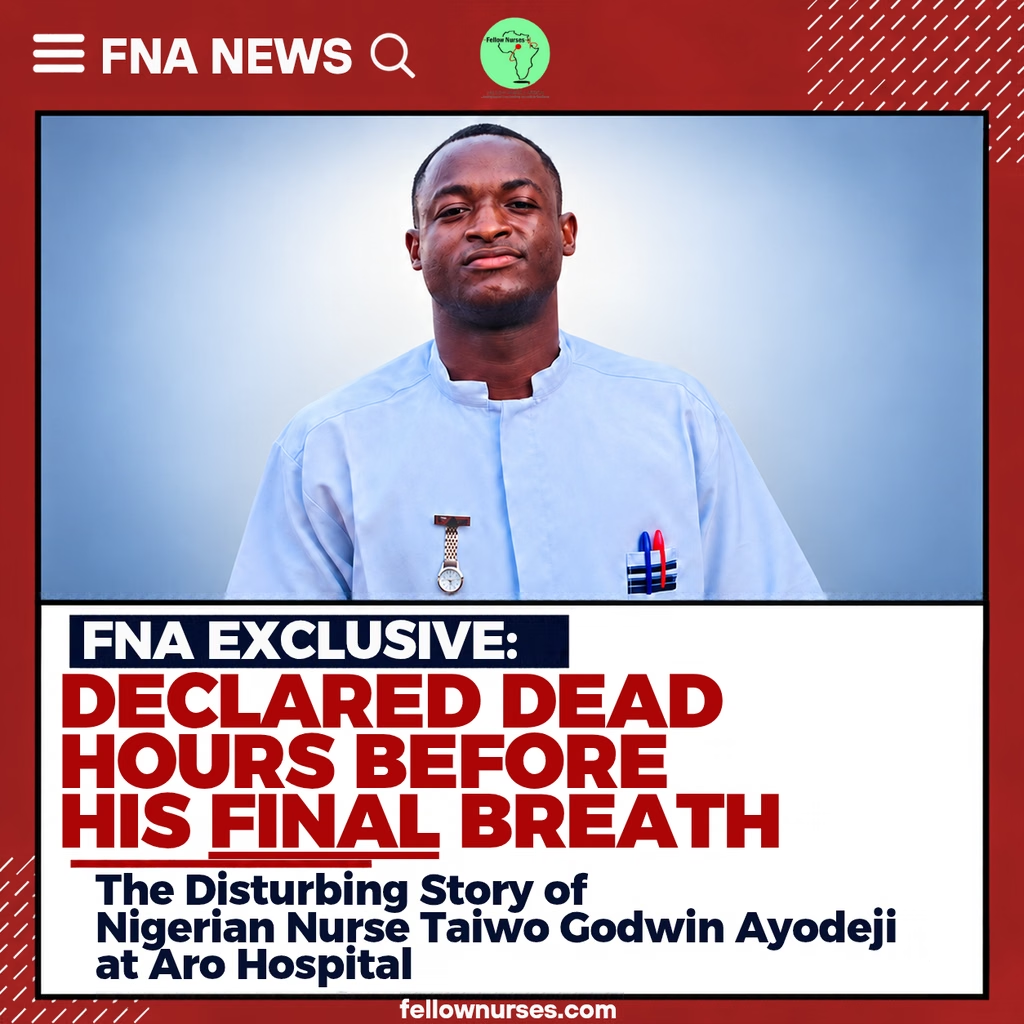
FNA EXCLUSIVE: Declared Dead Hours Before His Final Breath — The Disturbing Story of Nigerian Nurse Taiwo Godwin Ayodeji at Aro Hospital
He walked into the hospital alive, desperately struggling to breathe. Hours later, he was dead. But an eyewitness account obtained by Fellow Nurses Africa raises disturbing questions about what happened in between, including a reported declaration of death before colleagues discovered signs they believed indicated he was still alive. His death has since triggered student protests, police inquiries and an unprecedented disruption of academic activities at the institution.
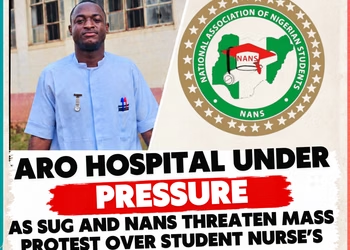
What began as an ordinary football match on Friday, 16 October 2026, ended in tragedy for Taiwo Godwin Ayodeji, a Nigerian nurse and post-basic psychiatric nursing student at the School of Psychiatric Nursing, Neuropsychiatric Hospital Aro, Abeokuta, Ogun State.
Godwin developed a severe asthma attack during the match and was rushed to the hospital’s General Medical and Psychiatric Unit (GMPU), where he later died.
But the circumstances surrounding his death have raised serious questions about emergency medical care, patient safety and institutional accountability.
In an exclusive three-page eyewitness statement obtained by Fellow Nurses Africa (FNA), Nurse Uthman Abdulmugni, Godwin’s friend and colleague, described a disturbing sequence of events involving alleged delays in emergency treatment, difficulties accessing essential medication, problems administering oxygen and a controversial declaration of death.
Most troubling was his account that Godwin had been pronounced dead, only for another colleague to discover what appeared to be signs of life approximately one hour later.
Further attempts were subsequently made to resuscitate him, but he could not be revived.
Godwin was buried the following day, Saturday, 17 October 2026.
His death has since sparked student protests, calls for accountability, reported police investigations and the indefinite suspension of academic activities at the institution, a decision later revised by hospital management.
Although these developments have intensified scrutiny of the hospital, the precise medical cause of death, the accuracy of the initial death declaration and whether any shortcomings in treatment contributed to the outcome remain subjects requiring independent investigation.
The football match that ended in tragedy
According to Uthman’s eyewitness statement, Godwin had been participating in a football league match on 16 October when he began experiencing breathing difficulties.
He left the field at the end of the first half.
A few minutes later, another colleague, identified as Nurse Ogunsola, informed Uthman that Godwin was looking for him.
Initially, Uthman assumed Godwin wanted to collect his mobile phone, which he had been keeping for him.
However, when he approached his friend, he realised that Godwin was experiencing an asthma attack.
Godwin reportedly explained that his inhaler, which he had purchased earlier that week, appeared to have run out.
He needed another inhaler.
At approximately 5:45 p.m., Uthman contacted a motorcycle rider to arrange transportation.
The rider initially indicated that he would arrive within 15 minutes, but Godwin’s condition was deteriorating.
Recognising the urgency, Uthman and other colleagues, including Nurse Akinde, stopped an approaching vehicle.
The driver agreed to transport Godwin immediately to the hospital’s General Medical and Psychiatric Unit, approximately one minute away.
According to the witness, Godwin was still conscious and able to walk into the hospital independently.
He had reached a healthcare facility while still breathing, but his respiratory distress was becoming increasingly severe.
What followed would become the focus of serious allegations about the hospital’s emergency response.
Desperate calls for help: Allegations of delayed emergency treatment
Immediately upon arrival, Uthman said he began shouting for emergency assistance.
He informed medical personnel that Godwin was experiencing a severe asthma attack and urgently needed oxygen and a nebuliser.
However, according to his statement, the nurses who responded did not immediately approach Godwin to assess him or initiate the interventions he was requesting.
Instead, he alleged, they continued calling for a doctor.
Uthman said the apparent delay was particularly distressing because he had accompanied Godwin to the same hospital unit on at least four previous occasions for nebulisation.
He was familiar with his friend’s history of asthma attacks and understood how quickly his breathing difficulties could become serious.
As Godwin struggled for air, Uthman said he repeatedly urged the medical personnel to intervene.
The testimony raises important questions about what emergency treatment was provided immediately upon Godwin’s arrival and whether the response was consistent with appropriate clinical standards.
Doctor’s arrival: Concerns over assessment and medication
According to the eyewitness account, the attending doctor, identified as Dr Ofor, subsequently arrived at the unit.
Uthman alleged that rather than immediately examining Godwin, the doctor initially sat at a table while he explained the situation.
The doctor reportedly questioned whether Godwin was genuinely experiencing an asthma attack.
Uthman said the doctor later approached the patient after observing him gasping for air and attempted to establish intravenous access.
The doctor was reportedly preparing to administer aminophylline.
However, Uthman claimed that the medication was unavailable at the nursing station.
He said he had to leave the treatment area and visit the pharmacy to obtain it, accompanied by another nurse.
By the time he returned, Godwin had been placed on a bed.
According to the witness, attempts to establish intravenous access remained unsuccessful.
Uthman also expressed concern about how Godwin had been positioned during the emergency, stating that he believed his friend should have been assisted into a more suitable position to ease his breathing.
He said he repeatedly offered suggestions and assistance as the situation deteriorated.
The account raises questions about the availability of emergency medication, the timeliness of clinical assessment and the interventions administered.
However, an independent review of the treatment records would be required to determine whether the care provided met accepted medical standards.
The oxygen controversy: Was Godwin receiving oxygen?
Perhaps one of the most disturbing allegations concerns the equipment intended to support Godwin’s breathing.
According to Uthman, a nasal prong was placed in Godwin’s nose and connected to an oxygen concentrator.
However, another colleague reportedly noticed that the concentrator was not switched on.
Uthman said they immediately alerted the healthcare personnel.
Rather than addressing their concern promptly, he alleged that staff questioned the students about their knowledge of the situation and told them to stop disturbing the treatment team.
Concerned that Godwin was not receiving oxygen, the students sought assistance from Nurse Abdulsalam of the Assessment Unit.
According to the statement, Nurse Abdulsalam subsequently confirmed that the oxygen concentrator was not switched on and had not been properly plugged in.
Uthman also alleged that a pulse oximeter was not readily available in the unit to assess Godwin’s oxygen saturation.
As Godwin’s condition deteriorated, additional oxygen equipment was reportedly brought into the treatment area.
But further difficulties arose.
The witness claimed that personnel appeared to struggle with assembling and connecting a portable oxygen concentrator.
Nurse Haruna and another nurse were reportedly called upon to assist.
During the process, Uthman recalled the doctor making a remark to the effect that oxygen should not be wasted.
For a patient experiencing severe respiratory distress, the availability and timely administration of appropriate respiratory treatment are critical components of emergency care.
The allegations therefore raise serious concerns that require clinical investigation.
It remains unclear how long the oxygen equipment was inactive, what respiratory support Godwin ultimately received and whether any equipment-related problem contributed to his death.
Declared dead — but what happened approximately one hour later?
The most controversial aspect of the testimony concerns what happened after Godwin was reportedly declared dead.
As efforts to manage the emergency continued, Uthman said some personnel advised him to step outside and arrange transportation in case Godwin needed to be transferred.
He complied, leaving briefly to check whether his motorcycle rider had arrived.
However, when he returned, Nurse Agunna reportedly informed him that the doctor had pronounced Godwin dead.
The news devastated his colleagues.
Believing their friend had died, they began mourning.
But approximately one hour later, according to Uthman, another colleague who had arrived from Abeokuta approached Godwin and noticed something unusual.
His body was reportedly still warm.
The colleague also observed slight movement around his face.
Concerned by these observations, the colleague checked for a pulse and believed one was present.
The students subsequently obtained a pulse oximeter from the female ward.
According to Uthman’s statement, the device produced a reading that they interpreted as confirmation of a pulse.
The discovery prompted renewed attempts to resuscitate Godwin.
The account raises a critical question: Was Godwin correctly assessed and pronounced dead during the initial examination?
However, the presence of warmth, apparent movement or a pulse oximeter reading does not independently prove that a patient had effective circulation. Such findings require interpretation alongside a proper clinical examination.
The original death declaration and the subsequent observations therefore require examination against the hospital’s medical records and accounts from the personnel involved.
The precise timing of Godwin’s death has not been medically established by the evidence currently available to FNA.
Final resuscitation efforts and the ICU controversy
Following the reported discovery, Uthman said the students began cardiopulmonary resuscitation (CPR), administered oxygen and attempted to transfer Godwin to the Intensive Care Unit.
However, the situation reportedly became even more difficult.
According to the eyewitness, no nurse was immediately available to attend to them upon arrival at the ICU.
He further alleged that the unit initially had no power supply and that the lights were switched off.
The students reportedly had to wait for lighting and equipment arrangements before continuing their efforts.
Eventually, the equipment was connected, and resuscitation continued.
Despite their efforts, Godwin could not be revived.
Uthman described the final moments as deeply distressing.
For him and the colleagues who had accompanied Godwin throughout the emergency, the experience left painful questions about whether their friend had received the care he urgently needed.
Buried the following day as questions mounted
Fellow Nurses Africa has confirmed that Taiwo Godwin Ayodeji was buried on Saturday, 17 October 2026, one day after his death.
His burial came as questions were emerging about the medical emergency and the circumstances surrounding the reported initial declaration of death.
It remains unclear from the documents reviewed whether a post-mortem examination was conducted before his burial.
The timing of the burial does not, by itself, establish wrongdoing.
Nevertheless, confirmation of the precise cause of death and examination of the care Godwin received are important to resolving the questions raised by the eyewitness account.
For his fellow nursing students, his burial did not mark the end of the controversy.
Instead, grief increasingly gave way to demands for answers.
Student protests erupt as colleagues demand justice
Following Godwin’s death, students of the School of Post-Basic Psychiatric Nursing began demanding accountability over the circumstances surrounding his death.
The Students’ Union Government, under the leadership of President Osukoya Timothy Olanrewaju and General Secretary Olufemi Oluwabukunmi Agnes, documented the developments in a situation report dated 20 October 2026.
The report confirmed that students had participated in protests and expressed solidarity in their collective pursuit of justice.
Their demands centred on accountability, improved emergency preparedness, functional medical equipment and a safer environment for all students.
The death also attracted attention from student organisations beyond the institution, including representatives of the National Association of Nigerian Students.
Although disagreements emerged between student leaders over proposed demonstrations and the appropriate response, the calls for an investigation and improved patient safety remained central to the controversy.
The Students’ Union Government said it would continue monitoring developments until meaningful action was taken.
Doctor and nurses reportedly detained for police questioning
In a significant development, the Students’ Union Government reported that Dr Ofor and other nurses involved in the incident had been detained for questioning by the police.
According to its situation report dated 20 October, those questioned were subsequently released on bail.
The union said they could be invited for further questioning as investigations progressed.
The report also described engagements with senior police authorities, including the Officer-in-Charge and Deputy Commissioner of Police.
Students’ demands were reportedly formally presented to the Deputy Commissioner of Police, who assured representatives that the matter would receive attention.
The union further reported that an investigative committee had been constituted by the Independent Corrupt Practices and Other Related Offences Commission (ICPC).
It also stated that relevant professional bodies had established an independent investigative team to examine the incident and determine whether disciplinary measures were necessary.
These developments were reported by the student union and have not been independently confirmed through official announcements from all the authorities identified.
Being questioned or released on bail does not establish criminal responsibility, and no finding of wrongdoing against the named healthcare personnel has been established in the material reviewed.
Hospital management indefinitely suspends academic activities
As tensions continued, the management of Neuropsychiatric Hospital Aro announced the indefinite suspension of academic activities at the School of Post-Basic Psychiatric Nursing.
In an official notice dated 20 October 2026, hospital management stated that the decision followed Godwin’s death and the student unrest within the hospital community.
The suspension affected both the 2025/2026 and 2026/2027 academic sets.
All students residing in the hostel were instructed to vacate immediately.
The notice, signed by Dr Taiwo C. Omirin, Coordinator of Programme and Head of School, on behalf of the Acting Provost and Medical Director, explained that the directive was intended to create a peaceful environment for a thorough investigation into the circumstances surrounding Godwin’s death.
However, the decision generated further concerns.
In its situation report, the Students’ Union Government said an earlier management letter had been perceived by students as intimidating.
The union requested clarification about its status and maintained its position that the students’ concerns should be properly addressed.
Management reverses indefinite suspension within 24 hours
In another development, the hospital management revised its decision on Wednesday, 21 October 2026.
A new official notice announced that the blanket indefinite suspension had been reconsidered.
Under the revised directive, students in the 2025/2026 academic set were allowed to remain in school.
However, they were required to write, sign and submit individual letters of undertaking promising good conduct, discipline and peaceful coexistence throughout the remainder of their programme.
Students in the 2026/2027 set were directed to proceed on a one-week break with immediate effect.
They were also required to submit similar letters of undertaking upon their return.
The notice instructed students to submit the signed undertakings through their class chief coordinators to the Head of School.
The decision marked a significant change from the previous day’s order requiring students to vacate the institution.
It also demonstrated the evolving institutional response to the controversy surrounding Godwin’s death.
Hospital facilities reopened as investigations continue
According to the Students’ Union Government, hospital facilities that had previously been shut down were subsequently reopened following engagements with the relevant authorities.
However, the union maintained that the pursuit of justice and accountability was far from over.
It pledged to continue monitoring the implementation of its demands and pushing for improved emergency response systems within the hospital.
The union also disclosed plans to honour Godwin’s memory through a proposed sickbay bearing his name.
Students were encouraged to remain calm, united and peaceful while continuing to support Godwin’s family.
What really killed Taiwo Godwin Ayodeji?
The circumstances surrounding Godwin’s death raise questions that extend beyond one hospital and one tragic medical emergency.
The eyewitness account describes a patient who arrived at a healthcare facility alive and in severe respiratory distress.
It alleges delays in assessment, difficulties obtaining medication, problems with oxygen delivery, shortages of readily available equipment and a disputed declaration of death.
The subsequent student protests, police inquiries and institutional suspension have only intensified scrutiny of the incident.
But the central question remains unanswered.
Did Godwin die solely from the severity of his asthma attack, or did failures in emergency medical care contribute to his death?
Severe asthma attacks can be fatal even when appropriate treatment is delivered promptly.
For that reason, determining whether medical negligence occurred requires a careful review of the clinical evidence rather than relying exclusively on eyewitness observations.
An independent investigation should establish:
- The exact sequence of treatment provided from Godwin’s arrival until his death.
- Whether appropriate emergency respiratory care was initiated promptly.
- The availability and functionality of oxygen equipment, nebulisers and other essential devices.
- The clinical findings supporting the original declaration of death.
- The explanation for the reported signs of circulation approximately one hour later.
- Whether the ICU was adequately staffed, powered and equipped during the emergency.
- Whether any act or omission contributed to the outcome.
- What preventive measures are required to improve patient safety.
These questions deserve clear answers supported by medical records, witness testimony and independent clinical assessment.
A nursing profession demanding accountability
The death of Taiwo Godwin Ayodeji is a painful loss to his family, friends, fellow nursing students and the wider nursing community.
He was pursuing further education in psychiatric nursing at a healthcare institution where he reportedly had received treatment for previous asthma episodes.
When another severe attack occurred, he was taken to the same institution for medical assistance.
He did not survive.
What remains is a deeply troubling account of his final hours and a series of questions that cannot be resolved through statements of condolence alone.
The subsequent protests and management decisions demonstrate how profoundly his death has affected the institution.
But grief, public anger and disciplinary speculation must ultimately give way to evidence, accountability and meaningful improvements in patient care.
Godwin has been laid to rest.
His colleagues have demanded justice.
Investigations have been announced and further inquiries reported.
The responsibility now is to establish what happened, whether his death could have been prevented and what must change to protect the next patient facing a similar emergency.
For his family, the truth matters.
For the nursing profession, patient safety matters.
And for the Nigerian healthcare system, accountability must matter.
FNA News will continue to monitor developments and provide updates as they emerge.
This exclusive report is based on an eyewitness incident statement signed by Nurse Uthman Abdulmugni, a two-page situation report issued by the Students’ Union Government on 20 October 2026, official hospital management notices dated 20 and 21 October 2026, and burial information confirmed to FNA. The allegations concerning individual healthcare personnel and the precise medical circumstances of death remain subject to investigation.
Fellow Nurses Africa is the independent voice of African nursing, we educate, inform and support nurses across Africa.

Kehinde Oluwatosin is one of the many editors here at Fellow Nurses Africa and fellownurses.com.
He is a registered nurse with a Master of Science degree in healthcare leadership from the University of Hull, United Kingdom. Kehinde is passionate about advancing the nursing profession across Africa. As Co-Founder of Fellow Nurses Africa, he plays a key role in shaping editorial direction, ensuring our content educates, informs, and empowers nurses continent-wide.
With expertise in leadership, patient flow, and healthcare operations, Kehinde brings valuable insights to nursing news, career development, and policy discussions. He is committed to amplifying the voice of African nurses and driving positive change in the profession.