
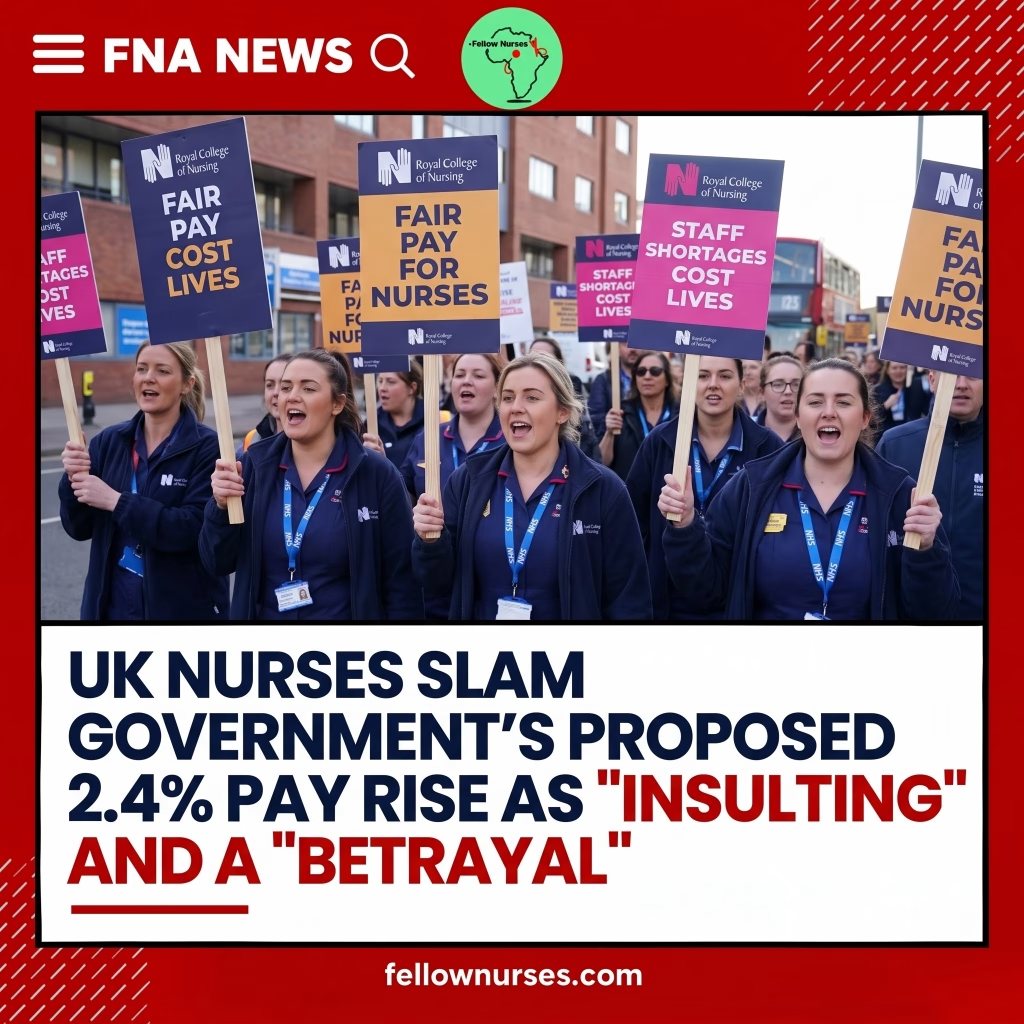
UK Nurses Slam Government’s Proposed 2.4% Pay Rise as “Insulting” and a “Betrayal”
FNA NEWS, 21st OF OCTOBER, 2026
By Health & Healthcare Policy Team Published 20 October 2026 | Updated 15:44 BST.
Healthcare unions in England have strongly condemned the government’s proposal for a 2.4% pay rise for NHS nurses,
labeling the figure a “betrayal” that fails to address years of real-terms pay erosion and an escalating workforce retention crisis.
👉 Join Fellow Nurses Africa on WhatsApp
In formal evidence submitted to the independent NHS Pay Review Body (NHSPRB), the Department of Health and Social Care (DHSC) stated that 2.4% represents the upper limit of what is affordable within existing health budgets.
Ministers warned that any higher award recommended by the independent panel would force difficult financial trade-offs, potentially risking patient care delivery targets and frontline service stability.
However, clinical leaders and union representatives argue that presenting an award below current inflation levels directly undermines ongoing efforts to recruit and retain frontline staff across hospital wards and community care.
Government Defends 2.4% Cap Citing Fiscal Pressures In its official submission,
the DHSC emphasized that maintaining public sector pay discipline is necessary to ensure long-term stability across NHS services amid ongoing backlog clearance efforts.
“Should the independent pay review bodies recommend an award above this level, we would need to consider whether and how this could be made affordable from within existing DHSC budgets,”
the department stated in its submission. “Accepting such an award would inevitably have an impact on healthcare delivery.”
Health officials argue that the 2.4% proposal strikes a balance between supporting staff and protecting direct operational funding for diagnostic centers, emergency care, and surgical recovery pathways.
Expert Analysis: The Real-Terms Impact on NHS Staffing The proposal comes at a critical juncture for the National Health Service, where workforce vacancies and staff burnout remain primary operational bottlenecks.
Key Economic & Workforce Dynamics
- Real-Terms Pay Deprivation: With broader living costs continuing to stretch household budgets,
an award below inflation effectively acts as a pay reduction in real terms for nursing personnel.
-
Retention Risk: Internal healthcare analytics indicate that uncompetitive compensation packages directly correlate with trained clinical staff leaving the NHS for private agencies, overseas providers, or non-clinical professions.
-
Cost of Temporary Staffing: Systemic retention failures force NHS trusts to rely heavily on agency cover,
which frequently costs significantly more per shift than retaining permanent salaried nursing staff.
Union Reaction: “We Cannot Accept Continued Pay Erosion”
The response from major healthcare unions was immediate, with leadership demanding direct negotiations with ministers rather than relying solely on the review body framework.
Professor Nicola Ranger, General Secretary of the Royal College of Nursing (RCN), expressed sharp disapproval of the submission:
"We will not entertain this sham PRB process, nor allow ministers to hide behind it.
NHS pay is their responsibility, and they will have to do much, much better than this.
Ministers should negotiate directly and reach a fair agreement."
Leaders from UNISON and Unite the Union echoed these concerns, characterizing the proposal as “derisory” and warning that hundreds of thousands of low-and-mid-grade healthcare support staff continue to earn rates close to statutory minimums.
Next Steps in the NHS Pay Process
-
Evidence Review: The NHS Pay Review Body will analyze formal submissions from government officials, NHS Employers, trade unions, and health economists.
-
Formal Report: The panel will formulate a non-binding recommendation on pay awards and submit its final report to health ministers.
-
Ministerial Decision: Health secretaries in England will decide whether to accept, modify, or reject the review body’s recommended percentage.
-
Union Response: Healthcare unions will review the final ministerial determination before deciding whether to ballot members on industrial action.
👉 Join Fellow Nurses Africa on WhatsApp
Fellow Nurses Africa is the independent voice of African nursing, we educate, inform and support nurses across Africa.

Durowoju Abisola is a registered nurse, nurse writer and On-Air Correspondent at Fellow Nurses Africa (FNA), passionate about nursing leadership, health education and advocacy.
Through journalism, storytelling and content creation, she amplifies important conversations around nursing, healthcare and the experiences of nurses in Nigeria. She is committed to using her voice and professional knowledge to educate the public, challenge misconceptions and inspire the next generation of nurses.