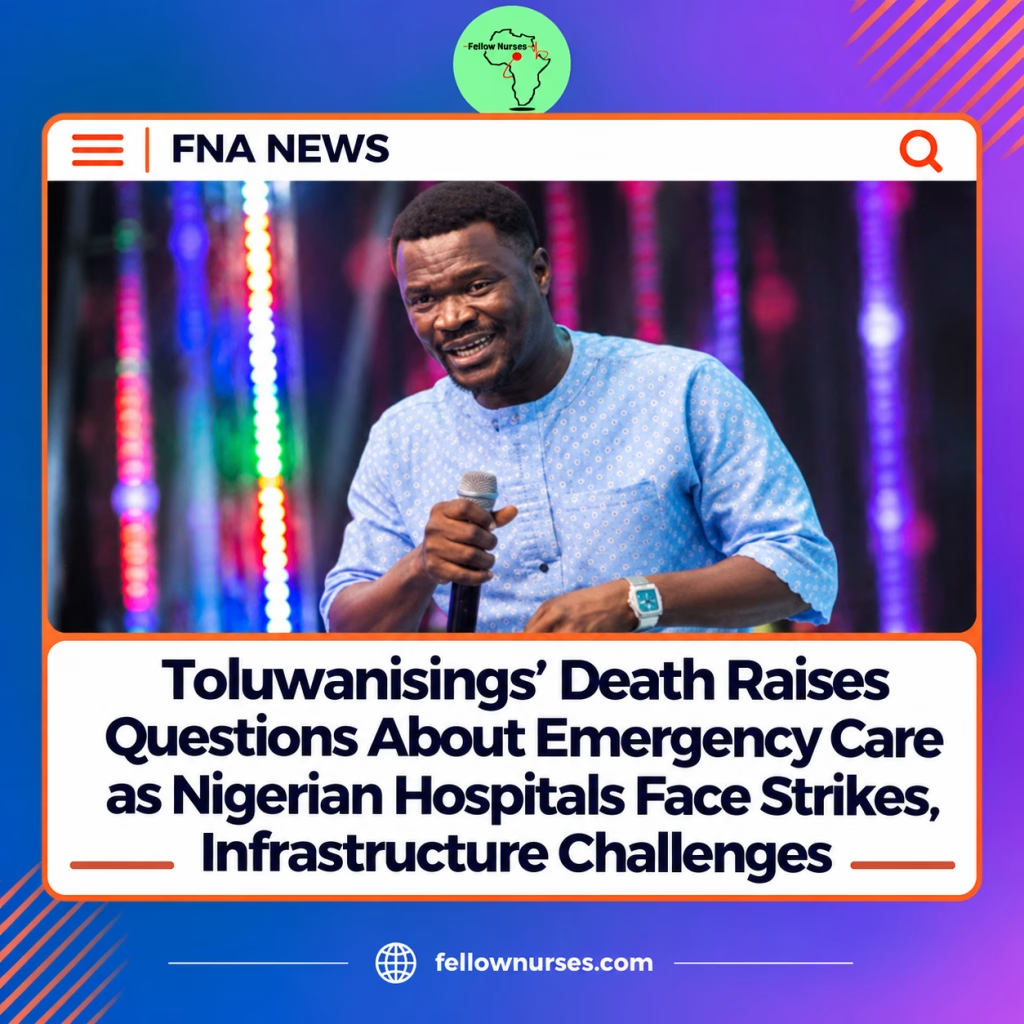
Toluwanisings’ Death Raises Questions About Emergency Care as Nigerian Hospitals Face Strikes, Infrastructure Challenges
FNA NEWS | October 16, 2026
The death of Nigerian gospel singer Olayemi Bayonile Bolaji, popularly known as Toluwanisings, has renewed concerns about emergency medical care in Nigeria after his personal assistant reported that efforts to obtain treatment took him to seven or eight hospitals in Ibadan, Oyo State, before he was pronounced dead.
👉 Join Fellow Nurses Africa on WhatsApp
Toluwanisings, aged 41, reportedly slumped in the early hours of Wednesday, October 14, 2026. According to his personal assistant, Babadunni Gbolabo, those who attempted to secure medical attention for the singer encountered different challenges, including facilities where doctors were reportedly unavailable because of industrial action and others that allegedly declined to admit him.
Gbolabo said those around the singer made frantic efforts to save him but were unable to secure the necessary medical attention before his death.
The exact cause of death has not been publicly established in the reports reviewed. It also remains unclear whether delays in obtaining treatment contributed to the outcome. The accounts, however, have prompted renewed questions about the availability and coordination of emergency medical services.
UCH strike highlights infrastructure concerns
The reports surrounding Toluwanisings’ final hours emerged as the University College Hospital (UCH), Ibadan, faced a dispute over electricity and water supply.
The Association of Resident Doctors at UCH embarked on a three-day warning strike on October 12 over persistent electricity problems and chronic water shortages affecting the College of Medicine area. The association subsequently announced that the warning strike had been completed and members were to resume work on October 15. It also issued a seven-day ultimatum over its demands, warning that further industrial action could follow if the issues remained unresolved.
The doctors’ demands included the restoration of reliable electricity, repairs to faulty circuit breakers and uninterrupted power supply across the affected areas.
The dispute has highlighted the difficulties healthcare professionals may face when essential infrastructure is unreliable. Electricity supports the operation of critical equipment, laboratory services, lighting, water systems and other functions required for safe hospital care.
However, available reports do not establish which hospitals Toluwanisings was taken to, or whether UCH was among the facilities his entourage visited. The electricity dispute should therefore be understood as a related concern about hospital readiness, rather than evidence of a direct connection to his death.
Workplace safety concerns trigger action in Ogun hospitals
The challenges facing Nigeria’s healthcare system extend beyond infrastructure to the safety and welfare of the professionals responsible for providing care.
At the Federal Medical Centre (FMC), Idi-Aba, Abeokuta, healthcare workers commenced a 72-hour warning strike on October 12 following the reported stabbing of medical laboratory scientist Lawal Toheeb Olasunkanmi by a patient’s relative within the hospital premises.
The Joint Action Committee of health-sector unions condemned the alleged attack and demanded accountability, medical and institutional support for the injured worker, and stronger security arrangements. The hospital management told reporters that the incident had been reported to the police and that measures to strengthen security were discussed with the unions.
Separately, nurses at Olabisi Onabanjo University Teaching Hospital (OOUTH), Sagamu, reportedly staged a protest after a colleague was allegedly assaulted by a deceased patient’s relative during a night shift. Reports published on October 15 also raised concerns about staffing shortages and unsafe working conditions at the facility.
Although these incidents are distinct from the circumstances surrounding Toluwanisings’ death, they illustrate the different pressures affecting healthcare delivery, from the availability of essential infrastructure to the protection of staff at work.
For healthcare workers, unsafe environments can undermine their ability to deliver care. For patients and their families, staffing shortages, industrial disputes and disruptions to hospital services can create uncertainty when medical attention is urgently required.
Healthcare workers also bear the consequences of system failures
👉 Join Fellow Nurses Africa on WhatsApp
The recurring challenges raise an important question about how responsibility for healthcare failures is understood.
Healthcare workers are often the first people patients and their families encounter in a hospital. When treatment is delayed, equipment is unavailable or a facility cannot provide a service, the frustration may be directed at the professionals at the point of care.
Yet healthcare delivery depends on more than the presence of doctors and nurses. It requires reliable infrastructure, functioning equipment, adequate staffing, sustainable funding, effective management and safe working conditions.
A clinician cannot safely operate equipment that is not functioning. Nurses cannot deliver the required level of care without adequate supplies and staffing. Emergency teams cannot guarantee effective treatment if essential services are unavailable or the facility cannot receive a patient.
These limitations do not remove the professional responsibility of healthcare workers to assess patients appropriately, communicate clearly and act within their competence. Nor do they establish that every reported refusal of admission or delay is justified. Rather, they highlight the need to investigate individual incidents fairly while examining the institutional conditions in which care is delivered.
The circumstances surrounding Toluwanisings’ reported hospital visits therefore warrant careful examination, including the reasons given for non-admission, the availability of emergency services and whether appropriate referrals were offered.
Calls for accountability and stronger emergency systems
The reports have renewed attention on the need for a healthcare system capable of responding promptly when patients experience life-threatening emergencies.
A functional emergency-care system requires trained personnel, reliable equipment, clear triage procedures, effective communication and referral arrangements, and facilities prepared to receive patients. Where a hospital cannot provide the necessary treatment, prompt assessment and a safe, coordinated referral can be critical.
The responsibility for improving these systems rests with multiple stakeholders, including federal and state governments, hospital management, regulators and healthcare institutions. Government authorities must address persistent infrastructure and workforce challenges, while hospital managers must maintain service readiness and establish procedures for managing emergencies during disruptions.
At the same time, protecting healthcare workers must remain part of the response. The recent incidents in Ogun State reinforce the need for effective security arrangements, prompt investigation of reported assaults and institutional support for affected staff.
Public accountability should also include transparent explanations when essential services are disrupted, clear communication with patients and families, and evidence that identified gaps are being addressed.
The death of Toluwanisings should not be used to assign blame without adequate evidence. Nevertheless, the reported difficulty in securing medical attention raises legitimate questions that deserve answers from the relevant authorities and institutions.
For Nigeria, the broader challenge is to ensure that access to emergency treatment does not become a prolonged search across multiple facilities, while also ensuring that healthcare professionals have the resources and protection required to provide safe care.
A healthcare system must be equipped to protect patients and support the professionals who care for them. When either responsibility is neglected, the consequences can extend far beyond the hospital walls.
👉 Join Fellow Nurses Africa on WhatsApp
Fellow Nurses Africa is the independent voice of African nursing, we educate, inform and support nurses across Africa.

Durowoju Abisola is a registered nurse, nurse writer and On-Air Correspondent at Fellow Nurses Africa (FNA), passionate about nursing leadership, health education and advocacy.
Through journalism, storytelling and content creation, she amplifies important conversations around nursing, healthcare and the experiences of nurses in Nigeria. She is committed to using her voice and professional knowledge to educate the public, challenge misconceptions and inspire the next generation of nurses.