
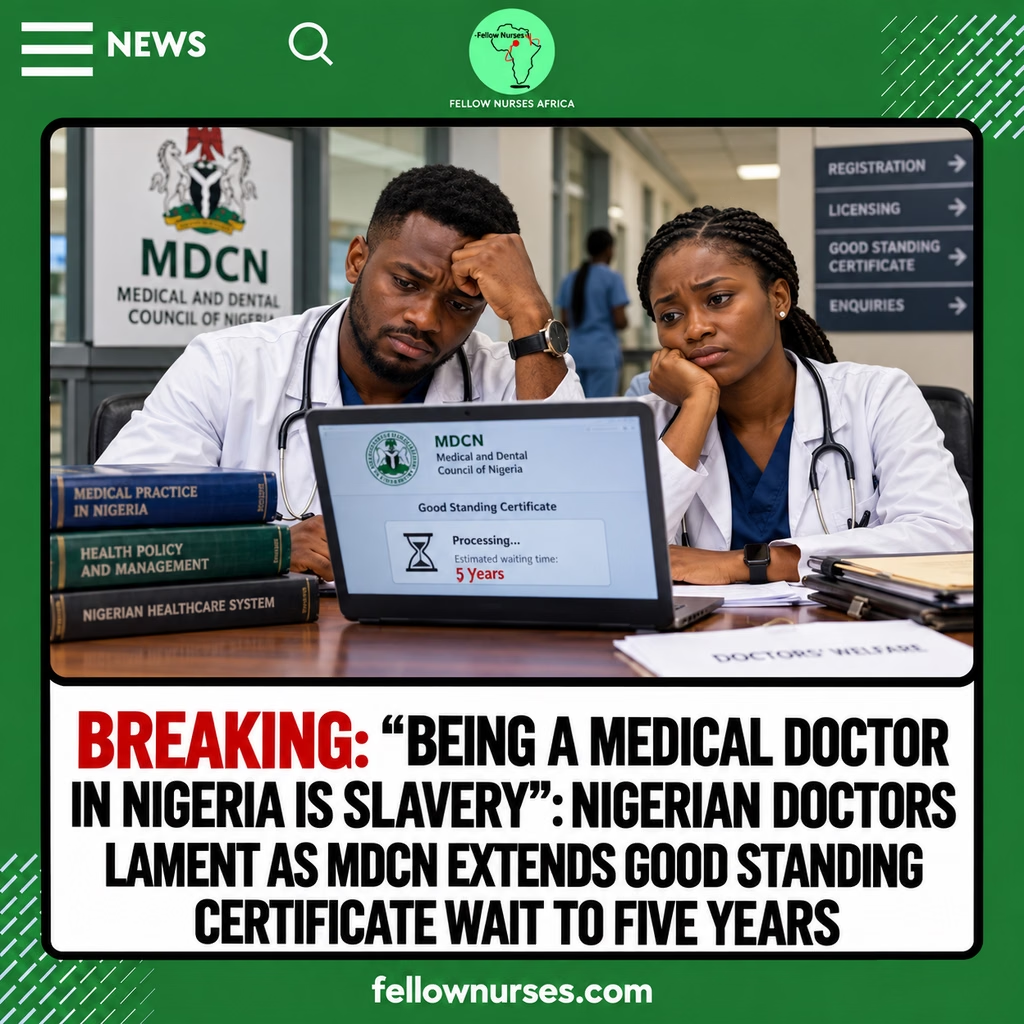
“Being a Medical Doctor in Nigeria Is Slavery”: Nigerian Doctors Lament as MDCN Extends Good Standing Certificate Wait to Five Years
Nigerian medical doctors have expressed growing outrage over the Medical and Dental Council of Nigeria’s reported five-year restriction on Certificates of Good Standing, with one practitioner describing the experience of practising medicine in the country as deeply painful and emotionally exhausting.
By Fellow Nurses Africa News Desk
22 October 2026 | Nigeria
Nigerian medical doctors have expressed frustration over reports that the Medical and Dental Council of Nigeria (MDCN) has quietly extended the eligibility period for obtaining a Certificate of Good Standing from two years after full registration to five years after graduation from medical school.
The development has sparked widespread criticism among practitioners, many of whom believe the restrictions could further limit professional mobility while doing little to address the difficult conditions confronting healthcare workers in the country.
The controversy intensified on Thursday, 22 October, after doctors shared screenshots purportedly obtained from the MDCN’s official registration portal, indicating that some applicants were no longer eligible to request the document until several years into the future.
The portal message reportedly reads:
“YOU ARE NOT YET ELIGIBLE TO APPLY FOR A CERTIFICATE OF GOOD STANDING.”
Some affected practitioners reported eligibility dates extending into 2028.
The restrictions have generated particular concern because doctors say the earlier two-year requirement was introduced without a formal public announcement, while the latest reported five-year threshold has similarly emerged without clear regulatory communication.
👉 Join Fellow Nurses Africa on WhatsApp
For many practitioners, the issue has become more than an administrative dispute. It has reopened painful conversations about the personal sacrifices involved in becoming a medical doctor in Nigeria and the limited professional opportunities available after years of training.
“I’ve invested my youth, my strength, my time, my life”
Amid the growing controversy, one Nigerian medical doctor expressed deep frustration over the realities of practising medicine in the country, describing the profession as emotionally draining and increasingly difficult to sustain.
In an emotional account reflecting the anger surrounding the development, the doctor wrote:
“Being a Medical Doctor in Nigeria is Slavery, it’s bondage, it’s something that’ll make you regret your life choices.
Nigeria will not make me use my mouth and say I regret studying medicine, I’ve held myself for too long not to say this.
I’ve invested my youth, my strength, my time. my life, my friends, my family, my desires, my passion, my countless of sleepless nights, my health, my everything, MILLIONS OF NAIRA into this profession and becoming a medical doctor.
I speak from a point of deep pain and speak on behalf of many medical doctors in Nigeria, I’m beginning to sincerely resent practicing medicine in Nigeria, deeply that it hurts.”
The doctor’s words offer a personal perspective on the frustration expressed by some practitioners who believe their years of sacrifice are being met with increasing professional restrictions rather than improved opportunities.
For many Nigerian doctors, the journey into medical practice involves several years of demanding academic training, financial commitments and significant personal sacrifices.
Medical education typically takes six years, followed by compulsory housemanship and, for many graduates, the National Youth Service Corps programme.
Those pursuing specialist careers may spend several additional years in residency training.
Despite these investments, many practitioners continue to face concerns about remuneration, inadequate staffing, limited medical resources, demanding schedules and occupational risks.
Against this background, restrictions affecting access to professional documentation have become particularly contentious.
The doctor’s description of medical practice as “slavery” represents an expression of personal frustration rather than a literal characterisation of the profession.
Nevertheless, the statement illustrates the depth of dissatisfaction among practitioners who feel increasingly constrained by conditions within the Nigerian healthcare system.
From two years to five: How the restrictions emerged
According to accounts from affected doctors, the MDCN previously began enforcing a two-year waiting period after full professional registration before practitioners could request Certificates of Good Standing.
The change reportedly appeared through the council’s online portal without a widely publicised announcement.
Doctors now report that the eligibility requirements have been extended, with some practitioners facing a five-year waiting period calculated from graduation.
The different starting points have generated confusion over the precise duration of the restrictions.
While the earlier requirement was reportedly calculated from full registration, the latest eligibility threshold has been described as five years after completion of medical school.
Practitioners have questioned why a document intended to confirm an individual’s professional standing should be withheld solely because a specified period has not elapsed.
They have also raised concerns about whether the changes were preceded by consultation with professional associations or supported by publicly available regulatory guidelines.
What the MDCN’s official guidance says
The MDCN’s published guidance outlines the process for obtaining a Certificate of Good Standing through its online portal.
According to the council, practitioners requesting the document must have maintained good professional standing from their year of graduation to the date of application.
Applicants are required to update their registration records, submit the relevant documents and complete the prescribed payment process.
The council also indicates that completed applications are normally processed within 10 to 14 working days.
However, the publicly available guidance reviewed by Fellow Nurses Africa does not clearly explain the reported five-year eligibility restriction.
This has raised questions about transparency and the regulatory basis for withholding certificates from otherwise registered practitioners.
The distinction between maintaining good professional standing and completing a specified number of years before becoming eligible for certification is particularly important.
Without a formal explanation, doctors remain uncertain about how the restrictions are applied and whether exemptions or review mechanisms are available.
Why the Certificate of Good Standing matters
A Certificate of Good Standing is an official document used by professional regulators to confirm a medical practitioner’s registration status and standing.
It is frequently required when doctors seek registration or employment opportunities in other countries.
For Nigerian doctors pursuing international careers, the certificate can form an essential part of the documentation required by overseas medical regulatory authorities.
In the United Kingdom, for example, the General Medical Council requires relevant Certificates of Good Standing from regulators with which an applicant has held registration during the preceding five years.
The document helps establish whether the practitioner has disciplinary restrictions or other concerns affecting their fitness to practise.
Although a Certificate of Good Standing is not a standard prerequisite for booking the PLAB 1 examination, it is relevant when applying for GMC registration.
Requirements vary for other international medical licensing pathways.
Consequently, an inability to obtain the certificate can delay overseas professional registration, employment and career development, even where an applicant has completed other stages of the licensing process.
Echoes of the Nigerian nurses’ verification controversy
The latest development has drawn comparisons with restrictions introduced by the Nursing and Midwifery Council of Nigeria (NMCN) in February 2024.
At the time, the council announced revised verification guidelines requiring nurses seeking verification for foreign nursing boards to possess at least two years of post-qualification experience from the issuance of their permanent practising licences.
The decision attracted widespread criticism and triggered protests by nurses in Lagos and Abuja.
Affected practitioners argued that the requirements created unnecessary obstacles to professional mobility and career advancement.
The controversy also resulted in legal challenges and renewed debate about the powers of healthcare regulatory authorities.
The reported MDCN restrictions have revived similar concerns, particularly regarding whether professional documentation should be used as an instrument of healthcare workforce retention.
Unlike the NMCN’s 2024 verification policy, which was communicated through a formal circular, the latest MDCN restrictions have not been accompanied by a publicly identified announcement explaining the reported change.
Nigeria’s previous attempt to impose a five-year service requirement
The controversy has also brought renewed attention to a legislative proposal introduced in Nigeria’s House of Representatives in April 2023.
The proposed legislation sought to require Nigerian-trained doctors and dentists to practise in the country for at least five years before obtaining full professional licences.
Supporters presented the bill as a measure to address the increasing migration of medical professionals.
However, the proposal encountered opposition from professional organisations, which questioned its fairness and effectiveness.
👉 Join Fellow Nurses Africa on WhatsApp
Critics argued that compelling medical practitioners to remain in Nigeria would not resolve the structural problems encouraging healthcare workers to seek opportunities abroad.
Although the current controversy concerns access to Certificates of Good Standing rather than the proposed legislation, it has revived similar concerns about the use of restrictive measures to address workforce shortages.
Can restrictions solve Nigeria’s healthcare workforce crisis?
Nigeria continues to face significant difficulties retaining trained medical professionals.
Across several healthcare institutions, staffing shortages, inadequate equipment and limited resources have increased pressure on available personnel.
Doctors and other healthcare workers have repeatedly identified poor remuneration, excessive workloads, limited specialist training opportunities and workplace safety concerns as important factors influencing migration decisions.
Restricting access to professional verification documents may delay some doctors’ international registration plans, but it does not necessarily address the circumstances motivating their decisions to leave.
Critics believe such measures could instead deepen frustration and undermine confidence in professional regulatory institutions.
Meaningful workforce retention requires sustained investment in healthcare infrastructure, competitive employment conditions, professional development and improved working environments.
These measures would make remaining in Nigeria a more attractive professional choice rather than an obligation reinforced through administrative restrictions.
Growing calls for professional associations to intervene
As criticism continues, practitioners are calling for greater engagement from the Nigerian Medical Association and the Nigerian Association of Resident Doctors.
Doctors want clarification on the legal basis for the reported waiting period, the date of implementation and the categories of practitioners affected.
They are also questioning whether doctors who maintain valid practising licences and have no disciplinary restrictions should face additional barriers to obtaining confirmation of their professional standing.
The controversy has further highlighted the need for transparent communication between regulators and the professionals they oversee.
Clear, consistent and publicly accessible guidance is particularly important when regulatory decisions have significant implications for employment, career progression and international registration.
FNA News analysis: Healthcare professionals need reasons to stay
The ongoing controversy surrounding the MDCN’s Certificate of Good Standing raises wider questions about Nigeria’s approach to healthcare workforce retention.
The country has a legitimate interest in retaining skilled medical professionals, especially as hospitals continue to face staffing shortages.
However, professional regulation and workforce retention are not necessarily the same responsibility.
Regulatory authorities are expected to protect patients, uphold professional standards and ensure accountability.
Workforce retention, meanwhile, requires effective government policies addressing pay, infrastructure, workplace safety and professional opportunities.
Where restrictions affect doctors’ access to official documentation, they should have a clear legal basis, transparent procedures and appropriate mechanisms for review.
The emotional reaction of the doctor who described medical practice in Nigeria as “slavery” illustrates the potential human consequences of a system in which some professionals feel that years of personal sacrifice have not translated into satisfactory working conditions or career opportunities.
The central question is whether Nigeria can build a healthcare system that doctors genuinely want to remain part of, rather than one in which they feel increasingly restricted from pursuing opportunities elsewhere.
As the debate continues, the MDCN faces growing calls to explain the rationale behind the reported five-year eligibility requirement and its implications for Nigerian medical practitioners.
For many doctors, the issue extends beyond obtaining a certificate. It concerns professional dignity, career autonomy and the future of medical practice in Nigeria.
Fellow Nurses Africa will continue to follow the controversy and its implications for healthcare professionals across the country.
👉 Join Fellow Nurses Africa on WhatsApp
Fellow Nurses Africa is the independent voice of African nursing, we educate,inform and support nurses across Africa.

Kehinde Oluwatosin is one of the many editors here at Fellow Nurses Africa and fellownurses.com.
He is a registered nurse with a Master of Science degree in healthcare leadership from the University of Hull, United Kingdom. Kehinde is passionate about advancing the nursing profession across Africa. As Co-Founder of Fellow Nurses Africa, he plays a key role in shaping editorial direction, ensuring our content educates, informs, and empowers nurses continent-wide.
With expertise in leadership, patient flow, and healthcare operations, Kehinde brings valuable insights to nursing news, career development, and policy discussions. He is committed to amplifying the voice of African nurses and driving positive change in the profession.