Nigeria’s Senate Proposes Six-Month Jail Term for Healthcare Workers and Hospitals That Delay Emergency Treatment
FNA NEWS, 5th Of November, 2026
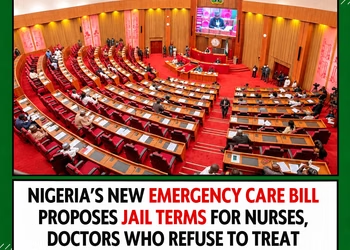
Nigeria’s Senate has advanced a proposed amendment to the National Health Act, 2014, seeking to introduce stricter penalties for healthcare facilities and professionals who deny or delay emergency medical treatment.
👉 Join Fellow Nurses Africa on WhatsApp
The bill, sponsored by Senator Abdulaziz Musa Yar’Adua, representing Katsina Central, proposes a maximum prison term of six months, a fine of up to ₦300,000, or both for individuals and healthcare facilities found guilty of violating its emergency treatment provisions.
The proposed amendment also seeks to establish clear timelines for emergency assessment, stabilisation and patient referral across public and private healthcare facilities.
The Senate passed the bill for second reading during plenary on Wednesday, 4 November 2026. It was subsequently referred to the Senate Committee on Health (Secondary and Tertiary) for further consideration, with a directive to report back within four weeks.
Proposed 15-minute emergency assessment requirement
Under the proposed legislation, healthcare facilities licensed to provide emergency medical services would be required to commence triage and initial patient assessment within 15 minutes of arrival.
Where a licensed medical doctor is unavailable, a trained and certified nurse may conduct the initial assessment and triage.
The bill also requires healthcare professionals to commence life-saving interventions immediately once they identify a life-threatening condition. These interventions include cardiopulmonary resuscitation, airway management and bleeding control.
In addition, hospitals would be required to begin basic stabilisation measures within 30 minutes of a patient’s arrival. Such measures include oxygen administration, intravenous fluid therapy, pain management and preliminary diagnostic procedures.
For patients requiring admission, the proposed amendment provides for the assignment of an available hospital bed within two hours.
However, where a facility lacks available bed space, it must commence stabilisation and initiate arrangements for referral to another healthcare institution.
The proposed referral framework also requires hospitals to arrange an ambulance or alternative transportation within 30 minutes of communicating a referral decision. The transfer process should be completed within three hours, except where circumstances beyond the facility’s control prevent compliance.
Mandatory emergency care training for healthcare workers
👉 Join Fellow Nurses Africa on WhatsApp
Beyond treatment timelines, the proposed amendment seeks to strengthen the emergency care competencies of healthcare professionals.
It proposes mandatory training and certification for healthcare workers involved in emergency medical services, with recertification intervals not exceeding 18 months.
The Medical and Dental Council of Nigeria and the Nursing and Midwifery Council of Nigeria would jointly develop and maintain a standardised national emergency care curriculum.
Leading the debate, Senator Yar’Adua argued that Nigeria’s healthcare system needs enforceable emergency response standards to address preventable deaths associated with delays in accessing medical attention.
He maintained that patients should receive timely emergency care regardless of their financial circumstances, social status, influence or location.
He also highlighted the need to strengthen coordination between primary, secondary and tertiary healthcare facilities to improve emergency referrals and patient outcomes.
Proposed protections for healthcare professionals
Although the bill introduces criminal liability for violations, it also recognises that healthcare professionals may encounter circumstances beyond their control.
The proposed provisions provide safeguards where resource limitations prevent compliance with prescribed emergency care standards, provided the circumstances are properly documented and the required referral procedures are followed.
This distinction is particularly important in a healthcare system where some facilities struggle with inadequate staffing, limited emergency equipment, insufficient bed capacity and other operational challenges.
Supporting the bill, Senate Whip Mohammed Monguno expressed concern about avoidable deaths resulting from the neglect of emergency patients. He argued that stronger legal provisions could improve accountability among healthcare providers.
Other lawmakers also supported the need for clearer emergency admission and referral procedures.
Why the proposed legislation matters to Nigeria’s healthcare system
👉 Join Fellow Nurses Africa on WhatsApp
Nigeria already has legal provisions protecting patients who require emergency medical attention.
Section 20 of the National Health Act, 2014, prohibits healthcare providers, health workers and healthcare establishments from refusing emergency medical treatment to anyone.
However, the continued reports of patients encountering delays, financial barriers and difficulties accessing emergency services have raised questions about the implementation and enforcement of these provisions.
The proposed amendment seeks to address some of these gaps by introducing more specific response timelines, standardised procedures and stronger penalties for violations.
Importantly, the development also comes amid growing concerns about emergency care delivery, hospital capacity and the working conditions of healthcare professionals in Nigeria.
While accountability for negligence and deliberate refusal of treatment remains essential, effective emergency care legislation must also consider the realities within healthcare facilities.
A hospital cannot consistently deliver timely emergency services without adequate personnel, functional equipment, essential medicines, sufficient bed capacity and an effective referral system.
Similarly, healthcare professionals should not be held criminally responsible for circumstances beyond their professional control when they have acted appropriately, documented the limitations and followed established protocols.
The effectiveness of the proposed legislation will therefore depend not only on its penalties but also on the government’s commitment to improving healthcare infrastructure, staffing and emergency response systems.
What happens next?
The Senate’s passage of the bill for second reading does not mean that the proposed penalties have become law.
The legislation must undergo further legislative scrutiny and complete the remaining constitutional processes before it can take effect.
The Senate Committee on Health (Secondary and Tertiary) is expected to examine the proposed provisions and report back within four weeks.
Meanwhile, a separate bill seeking to strengthen sanctions against hospitals that deny or delay emergency treatment has also passed second reading in the House of Representatives.
Sponsored by House spokesperson Akin Rotimi, the House proposal includes possible suspension or withdrawal of hospital operating licences, closure of facilities for subsequent violations and compensation for patients or families affected by breaches of emergency treatment obligations.
Together, the two legislative initiatives signal renewed attention to emergency healthcare delivery and accountability in Nigeria.
For patients and their families, the central expectation is straightforward: a medical emergency should not become a negotiation for survival.
For healthcare professionals, however, the legislation must establish a fair balance between individual accountability and the institutional responsibilities required to deliver safe and timely emergency care.
👉 Join Fellow Nurses Africa on WhatsApp
Fellow Nurses Africa is the independent voice of African nursing, we educate, inform and support nurses across Africa.

Durowoju Abisola is a registered nurse, nurse writer and On-Air Correspondent at Fellow Nurses Africa (FNA), passionate about nursing leadership, health education and advocacy.
Through journalism, storytelling and content creation, she amplifies important conversations around nursing, healthcare and the experiences of nurses in Nigeria. She is committed to using her voice and professional knowledge to educate the public, challenge misconceptions and inspire the next generation of nurses.