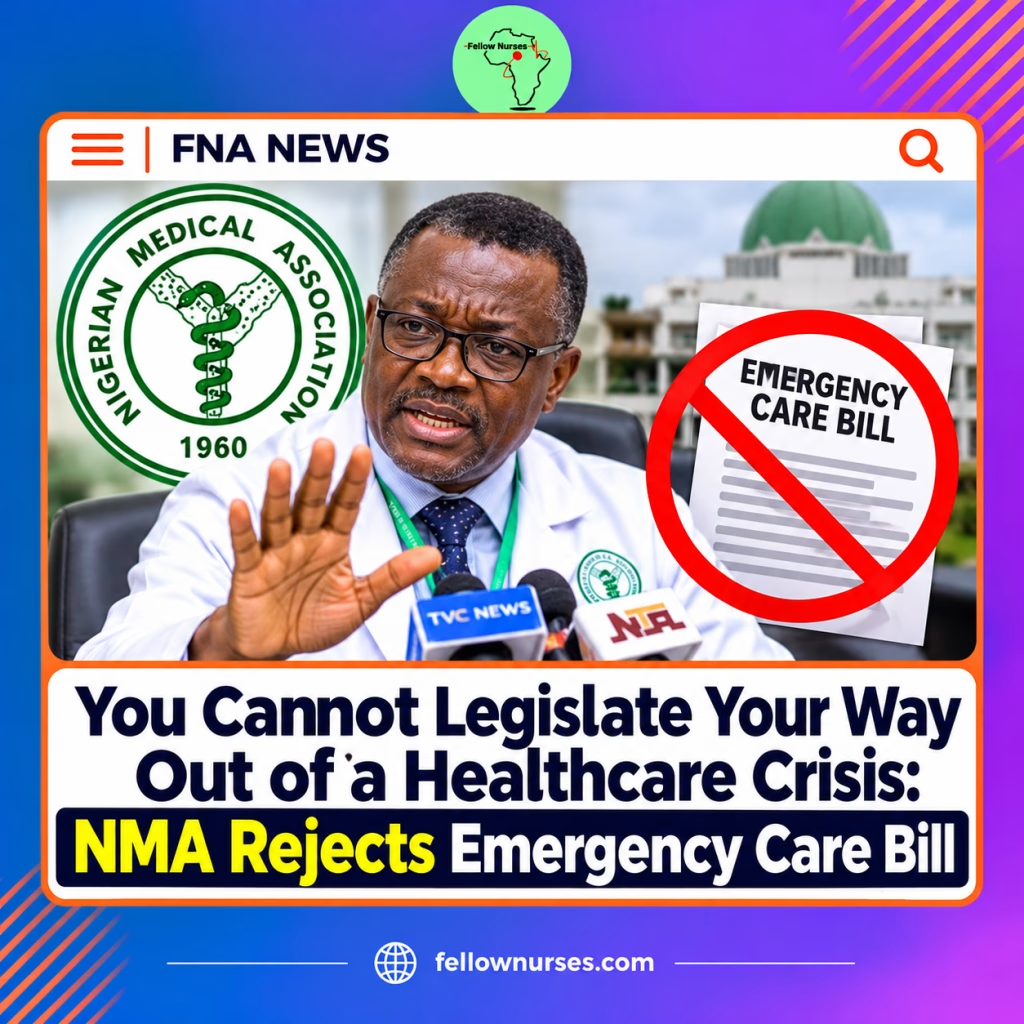
You Cannot Legislate Your Way Out of a Healthcare Crisis: NMA Rejects Emergency Care Bill
FNA NEWS, 5th Of NOVEMBER, 2026
The Nigerian Medical Association (NMA) has criticised the proposed amendment to the National Health Act seeking stricter penalties for healthcare workers and hospitals that refuse or delay emergency medical treatment, describing the move as “putting the cart before the horse”.
👉 Join Fellow Nurses Africa on WhatsApp
The association argued that introducing tougher criminal sanctions without first addressing the systemic challenges affecting healthcare delivery could further weaken Nigeria’s already strained health system.
In a statement signed by its President, Dr. (Prof.) Afekhide Ernest Omoti, the NMA said it supports the principle that every patient deserves access to emergency medical care, regardless of their financial circumstances. However, it maintained that the government must first create the conditions necessary for healthcare facilities and professionals to meet their obligations.
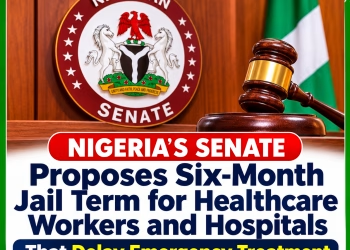
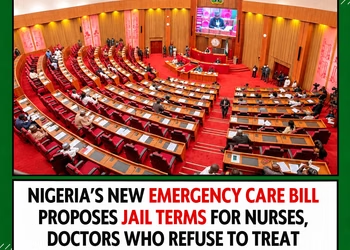
The association’s reaction follows the Senate’s passage for second reading of a bill seeking to amend the National Health Act, 2014, to establish mandatory emergency treatment standards and referral protocols across public and private healthcare facilities.
Sponsored by Senator Abdulaziz Yar’Adua, who represents Katsina Central, the proposed amendment seeks to prescribe a fine of up to ₦300,000, imprisonment for up to six months, or both, for healthcare providers and facilities found guilty of violating its provisions.
NMA Questions Implementation of Existing Emergency Care Laws
The NMA argued that Nigeria does not necessarily lack legislation prohibiting the refusal of emergency medical treatment. Instead, it identified poor implementation of existing provisions and inadequate government support as major obstacles to effective emergency care.
The association specifically highlighted the Basic Health Care Provision Fund (BHCPF), which provides a framework for funding essential healthcare services, including emergency medical treatment.
According to the NMA, hospitals that provide emergency treatment often bear substantial financial costs without receiving the expected reimbursements. It described the situation as unsustainable, particularly for facilities already struggling with limited resources.
The association questioned the fairness of imposing criminal liability on healthcare professionals and hospitals when the government has not fulfilled its responsibility to provide adequate funding and the necessary infrastructure.
It maintained that emergency care obligations must be matched with functional funding and reimbursement mechanisms.
Staff Shortages and Poor Infrastructure Raise Concerns
👉 Join Fellow Nurses Africa on WhatsApp
Beyond funding, the NMA identified Nigeria’s shortage of doctors and other healthcare professionals as another major concern.
It attributed the workforce shortage to poor remuneration, unfavourable working conditions, excessive workloads, insecurity, inadequate infrastructure and limited professional support.
The association also linked these challenges to the continued migration of Nigerian healthcare professionals to other countries in search of better working conditions.
According to the NMA, many hospitals now operate with dangerously inadequate manpower, leaving available healthcare workers to manage overwhelming patient loads under difficult circumstances.
It further highlighted shortages of essential emergency-care resources, including oxygen, essential medicines, blood and blood products, resuscitation equipment, consumables and functional ambulances.
The association questioned how healthcare professionals could reasonably be expected to meet strict emergency treatment requirements when hospitals lack the basic resources needed to provide life-saving interventions.
It warned that threatening professionals with imprisonment for circumstances beyond their control could further demoralise an already distressed workforce.
What the Proposed Amendment Seeks to Introduce
The proposed amendment seeks to establish enforceable timelines for emergency assessment, treatment, stabilisation and referral.
Among its key provisions, hospitals would be required to commence triage and initial assessment within 15 minutes of a patient’s arrival at the emergency department.
Where a licensed medical doctor is unavailable, a trained and certified nurse may conduct the initial assessment.
The bill also proposes that basic stabilisation measures, including oxygen therapy, intravenous fluids, pain relief and preliminary diagnostic procedures, should begin within 30 minutes.
Life-saving interventions such as cardiopulmonary resuscitation (CPR), airway management and bleeding control would be required immediately once a life-threatening condition is identified.
For patients requiring admission, hospitals would be expected to assign a bed within two hours, subject to availability. Where no bed is available, facilities would be required to stabilise the patient and initiate referral arrangements.
The proposed legislation also introduces mandatory emergency-care training and certification for healthcare workers involved in emergency services, with periodic renewal at intervals not exceeding 18 months.
Importantly, the proposal provides safeguards for healthcare practitioners who cannot meet the prescribed timelines because of resource limitations, provided they document the circumstances, follow referral procedures and report the incident to the appropriate authorities.
The bill has passed second reading and has been referred to the relevant Senate committee for further legislative consideration.
NMA Calls for Government Investment Before Punitive Measures
👉 Join Fellow Nurses Africa on WhatsApp
While maintaining that healthcare professionals must be held accountable for deliberate and unjustifiable refusal to provide emergency care, the NMA argued that criminal liability should not be imposed indiscriminately on workers affected by systemic failures.
The association called on the National Assembly to prioritise the effective implementation of the National Health Act and improve access to emergency-care funding and reimbursement.
It also urged federal and state governments to invest in functional emergency units, essential medicines, oxygen supply systems, diagnostic equipment, blood banks and other life-saving resources.
Other demands include sustained recruitment and retention of healthcare professionals, improved remuneration, better working conditions, adequate staffing and safer working environments.
The NMA further called for broader stakeholder engagement, urging lawmakers to consult medical and other healthcare professional associations, hospital managers and relevant stakeholders before introducing additional criminal liabilities.
It stressed that professional misconduct and systemic failures must be treated differently, particularly where healthcare workers lack the resources or institutional support required to deliver appropriate care.
The Bigger Question: Can Punishment Fix a Dysfunctional Emergency Care System?
The NMA’s position raises an important question about the balance between patient protection and healthcare workforce accountability.
There is no question that denying emergency treatment because a patient cannot make an immediate payment is unacceptable. Equally, preventable deaths resulting from avoidable delays, negligence or deliberate refusal of care demand accountability.
However, accountability must extend beyond the individual healthcare professional at the point of care.
A nurse cannot independently provide oxygen when a facility has no functional oxygen supply. A doctor cannot administer unavailable medicines or create hospital beds where none exist. Similarly, a healthcare team cannot guarantee timely referral when ambulances, transportation or receiving facilities are unavailable.
These realities do not excuse professional negligence or deliberate refusal to provide care. Rather, they demonstrate why effective emergency healthcare legislation must address both individual responsibility and institutional obligations.
For Nigeria, strengthening emergency care requires more than prescribing timelines and penalties. It demands functional hospitals, adequate staffing, reliable funding, essential equipment and clear referral systems.
The NMA maintained that it supports legislation that protects patients and guarantees access to quality emergency medical care. However, it urged the Senate to reconsider the proposed amendment in its present form and focus on correcting the structural deficiencies undermining healthcare delivery.
The association concluded that healthcare professionals must be adequately equipped, supported and protected before the government demands greater accountability.
For a healthcare system already struggling with workforce shortages and inadequate infrastructure, the challenge is not simply to punish failures but to build the capacity to prevent them.
👉 Join Fellow Nurses Africa on WhatsApp
Fellow Nurses Africa is the independent voice of African nursing, we educate, inform and support nurses across Africa.

Durowoju Abisola is a registered nurse, nurse writer and On-Air Correspondent at Fellow Nurses Africa (FNA), passionate about nursing leadership, health education and advocacy.
Through journalism, storytelling and content creation, she amplifies important conversations around nursing, healthcare and the experiences of nurses in Nigeria. She is committed to using her voice and professional knowledge to educate the public, challenge misconceptions and inspire the next generation of nurses.
 ✓
Did you know that we're the accredited ReMar NCLEX Training Centre in Nigeria with Prof. Regina Callion?
Prepare and pass your NCLEX-RN / NCLEX-PN with official ReMar Review curriculum, Regina Callion video lectures, Quick Facts, and dedicated clinical mentorship right here in Nigeria.