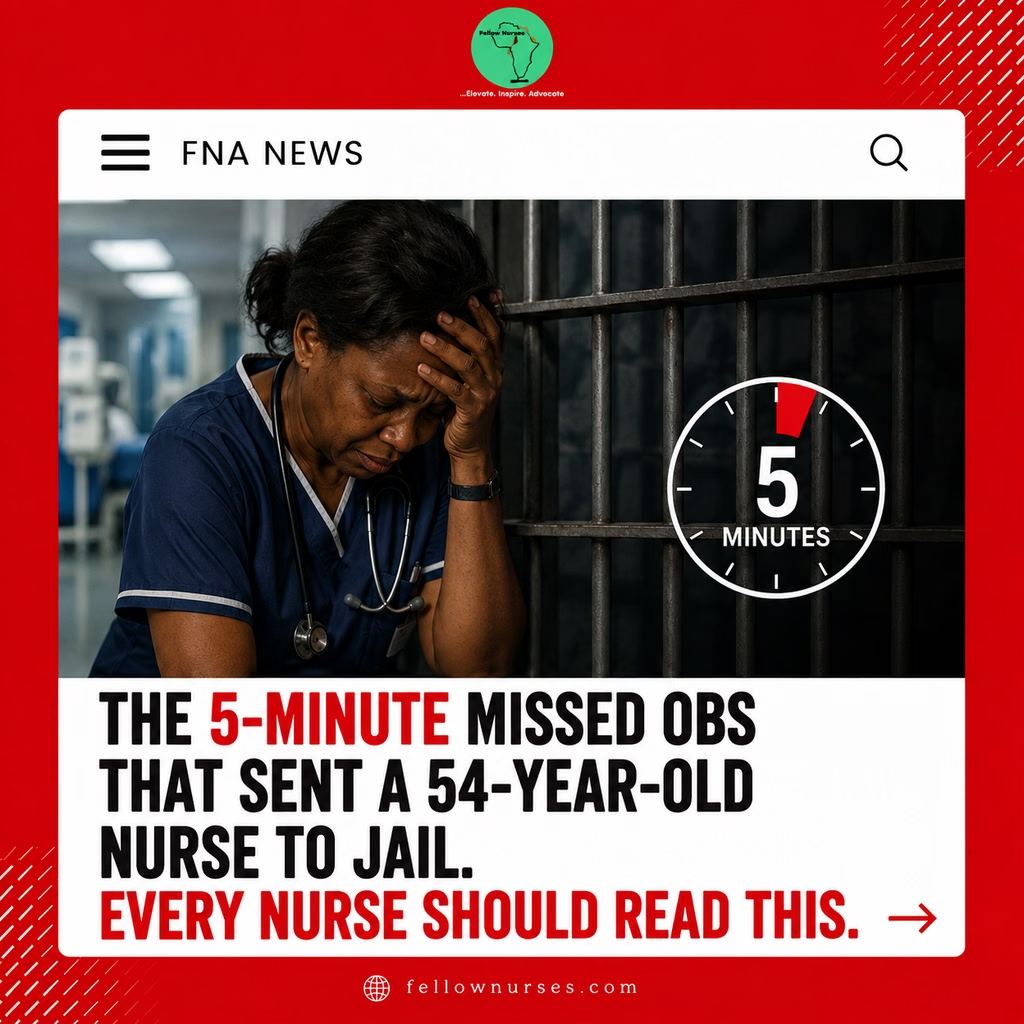
The 5-Minute Missed Obs That Sent a 54-Year-Old Nurse to Jail. Every Nurse Should Read This.
FNA News, 4th September, 2026. Lagos, Nigeria.
A registered nurse has been sent to prison after she failed to carry out required observations on a patient who later died. The case began on a psychiatric intensive care unit. The lesson belongs to every ward.
On 1 September 2026, Laurence Tchapong, 54, of Manchester, was sentenced to four years’ imprisonment at Liverpool Crown Court. A jury had already found her guilty of wilful neglect. She had been responsible for five-minute observations on Amy Barber, 22. The records said those checks were done. CCTV showed they were not. Barber was later found unresponsive and died.
👉 Join Fellow Nurses Africa on WhatsApp
This is not only a mental health story. It is a story about what happens when a nurse is told to watch a patient — and does not.
That duty exists in theatre recovery, on surgical wards, beside a poorly medical patient, during 1:1 supervision, and in hospitals across the UK and Africa. The setting changes. The professional standard does not.
What the court found
Barber was an inpatient at Brooklands Psychiatric Intensive Care Unit at Clatterbridge Hospital in Bebington, Wirral, a service run by Cheshire and Wirral Partnership NHS Foundation Trust. She had a complex mental health history, had been detained under the Mental Health Act, and had a significant history of self-harm. By late June 2022 she was on level 2 observations: checks every five minutes.
Tchapong, a band 5 registered mental health nurse working through an agency, was allocated those observations on the evening of 30 June 2022. CCTV showed her handing Barber a towel at about 8.15pm and closing the door. She did not check again. At 8.40pm another nurse found Barber unresponsive. She was taken to Arrowe Park Hospital and died on 4 July 2022. The gap was about 24 to 25 minutes.
Tchapong then completed observation records as if the checks had taken place. The court heard that multiple signed entries were false. Judge Anil Murray said she had “deliberately lied” in the records in an attempt to evade justice.
She denied wilful neglect. She said the ward was short-staffed and that she had competing demands. The judge said the jury rejected those claims. The court also heard she was working agency shifts at Clatterbridge while holding another full-time role near Manchester.
👉 Join Fellow Nurses Africa on WhatsApp
The judge found there had been discord between nurse and patient. Barber had previously photographed Tchapong sleeping on duty and reported her, leading to a verbal warning. The judge said he was sure Tchapong held a grudge “for a perceived lack of warmth” and because Barber had complained about her.
Tchapong was not charged with causing the death. The judge still said the evidence showed the death was preventable if the observations had been carried out.
Senior Crown Prosecutor Maqsood Khan said she held a position of significant trust, failed to carry out the checks she was responsible for, and then tried to conceal that failure by falsifying records. Barber’s mother, Susan, described her daughter as “the most caring, bright, funny and intelligent girl I’ve ever met.” She said Amy’s drive “was taken away by a system that let her down,” and asked those responsible for care to learn from it.
The law nurses need to understand
The offence was not “a patient died on my shift.” It was wilful neglect by a care worker.
Under section 20 of the Criminal Justice and Courts Act 2015, it is an offence for a paid care worker to ill-treat or wilfully neglect a person in their care. On conviction on indictment, the maximum sentence is five years’ imprisonment, a fine, or both. Tchapong received four years.
“Wilful” is the word that should stop every nurse. The law is aimed at deliberate or reckless failure, not an honest mistake made while trying to do the job. Missing a check and then writing that it happened is what turns poor practice into a criminal case.
The same principle exists wherever nurses are registered. The NMC Code requires nurses to prioritise people, preserve safety and act with honesty. Nursing councils across Africa require the same core duties: protect the patient, tell the truth in the record, and do the task you accepted. A conviction, or even a proven false chart, can end a career in the country where it happened and block registration somewhere else.
Why this case reaches beyond mental health
Observations are not a psychiatric ritual. They are how nursing manages time-critical risk.
A surgical patient can bleed into a drain, drop their blood pressure, or become confused after anaesthesia. A poorly medical patient can move from “stable” to septic, hypoxic or unconscious between one set of observations and the next. A patient in recovery can lose an airway in minutes. After a fall, neuro observations exist because the first missed check may be the last useful one. A woman in maternity can seize or bleed while staff assume she is resting. An older patient on 1:1 because they pull at lines or try to climb out of bed is being supervised for a reason.
In each of those situations, someone has already decided the patient cannot be left to ordinary ward rhythm. The plan may say:
- 1:1 supervision
- 5-minute or 15-minute observations
- hourly NEWS2 or local early-warning scores
- post-operative vital signs
- close observation after a rapid-response call
Once that plan is set, and a nurse accepts the allocation, the duty follows the nurse. It does not follow the specialty.
What 1:1 supervision and close obs actually require
1:1 supervision means one trained staff member stays with one patient. It is not “be on the same ward.” It is not “look in when you can.” It is continuous attention, unless the instruction says otherwise.
Intermittent observations are timed safety checks. If the plan says five minutes, a 25-minute gap is not lateness. It is several missed checks in a row.
Close observation of a poorly or post-operative patient means looking at the things that can kill or harm that person in the next few minutes: airway, breathing, circulation, bleeding, consciousness, pain, urine output, drains, blood sugar, and behaviour.
A 1:1 who sits in the corridor is not a 1:1. A five-minute observation done from the nurses’ station is not an observation. A NEWS score copied from the last set of figures is not an assessment. See the patient. Then write what you saw.
If you cannot give that attention because you have been given other patients, a drug round, or a phone, say so immediately. Do not keep the allocation and hope.
What nurses should learn and know
1. The duty follows the allocation, not the ward name.
Mental health, surgery, medicine, theatre recovery, A&E, maternity, paediatrics and community care all use watching plans. If you are named to observe a patient, that is your primary job for that period. “I was busy with someone else” is the most common explanation after harm. It is also the explanation a court or regulator may reject if you never escalated.
2. Do the check you were asked to do, in the way it was meant.
Look at the wound, the drain, the colour, the breathing, the urine bag, the behaviour. Speak to the patient if they can respond. For a 1:1, stay with them. For timed observations, be there on time. The plan is useless if the nurse performs a different, easier version of it.
3. Never write what you did not see.
This is the point that moved the Tchapong case from missed care to a prison sentence. False records turn a gap into concealment. If you missed a check, write that you missed it and why. If an emergency started, write the emergency. Do not tidy the chart afterwards. In any hospital, your signature is evidence.
4. A deteriorating patient can change in the gap you skip.
Post-operative bleeding, airway obstruction, pulmonary embolism, sepsis, stroke, hypoglycaemia and opioid toxicity do not wait for a convenient round. That is why close observations exist after theatre, after a fall, after a rapid-response call, and for any patient described as poorly. The chart is there because someone already judged the risk to be high.
5. 1:1 is not a chance to sit down and use your phone.
Families, managers, coroners and courts later ask what the supervising nurse was doing. If you are allocated 1:1, you are the safety plan. Eating, chatting, scrolling or leaving “for a minute” is how these cases are described in evidence. If you need relief, ask for a break and a handover. Do not disappear.
6. Personal feelings cannot change the observation.
The court found Tchapong held a grudge after the patient complained about her. The professional rule is the same on every ward, in every country. A difficult patient, a rude relative, a complaint, or friction between nurse and patient does not reduce the observation level. If the relationship is strained, ask to be moved. Do not withdraw care.
7. Agency work, extra shifts and two jobs do not lower the standard.
Many African and internationally educated nurses work agency or bank shifts in the UK, or extra duties at home because staffing is short. Extra work does not create a different professional code. If you are too tired to watch a patient safely, do not take the shift. If the ward gives you a 1:1 plus other patients, say the assignment is unsafe before harm happens.
8. Staffing pressure is real. It does not authorise fake compliance.
Nurses in the NHS and across Africa know this picture: too many patients, no relief for the special, a manager who says “just do your best.” Do your best out loud. Escalate. Record the escalation. Ask for the observation level to be reviewed. What you must not do is sign a chart that creates the appearance of safety that did not exist.
9. Your registration travels with your signature.
For nurses on the NMC register, a conviction for wilful neglect will almost always trigger fitness-to-practise action. For nurses planning to work in the UK, Ireland, the Gulf or elsewhere, a finding of dishonest records can block future registration. Your name on an observation sheet is not a local formality. It is a statement of professional character.
10. The family will judge the gap, not your intention.
A mother asked the profession to learn from her daughter’s death. A surgical family will ask the same question after a missed bleed. A medical family will ask it after a missed deterioration. Intention is not what the record shows. Presence is.
Individual failure and system pressure can both be true
It would be a mistake to read this case as only one nurse’s collapse in standards. It would also be a mistake to dissolve her responsibility into “the system.”
Mental health wards, surgical units and general hospitals are under strain in the UK and in many African health systems. Observation culture can become box-ticking. Agency work can weaken continuity. One nurse can be left with more than any safe plan can carry.
None of that permits a nurse to skip required checks on a patient known to be at risk and then falsify the record.
👉 Join Fellow Nurses Africa on WhatsApp
The professional response is therefore twofold. The nurse on the shift must protect the integrity of the observation. Leaders must staff and design wards so that 1:1s and timed checks are actually possible. Nurses should say when they cannot do both. Managers should hear that before a court does.
The standard this case sets
The facts are simple enough to teach on any ward.
A patient was placed on timed observations because she was at risk. The nurse allocated to those observations did not do them. The paperwork said she had. The patient was later found unresponsive and died. A court called that wilful neglect and imposed a four-year sentence.
Translate that into ordinary nursing:
- the post-operative patient on 15-minute obs
- the septic patient on hourly NEWS
- the confused patient on 1:1
- the bleeding patient you were told not to leave
- the poorly patient in the side room who has gone quiet
If you are the nurse who is supposed to be there, be there. If you cannot be there, say so. If you were not there, do not write that you were.
That is the lesson for mental health nurses. It is also the lesson for surgical nurses, medical nurses, recovery staff, and any nurse entrusted with 1:1 supervision. The specialty is different. The duty is the same.
👉 Join Fellow Nurses Africa on WhatsApp
Fellow Nurses Africa is the independent voice of African nursing, we educate,inform and support nurses across Africa.

Charles Wealth is an accomplished healthcare administrator with decades of hands-on experience across various healthcare organizations in Nigeria and beyond. Known for his strategic leadership, operational excellence, and deep commitment to advancing the nursing profession, Charles brings a wealth of expertise to healthcare management, policy, and professional development.
As a co-founder and Editor at Fellow Nurses Africa, he plays a pivotal role in shaping content that educates, inspires, and unites nurses across the continent. His editorial vision focuses on amplifying the voices of nurses, highlighting best practices, addressing contemporary challenges in healthcare, and promoting professional growth within the nursing community.
With a strong background in healthcare administration, Charles is passionate about bridging the gap between clinical practice and effective leadership. He continues to contribute significantly to the development of robust healthcare systems and the empowerment of nurses through knowledge sharing and advocacy.