67th National Council on Health Approves 22 Memos, 17 National Strategies to Drive Healthcare Reforms
FNA NEWS, 26th Of NOVEMBER,2026
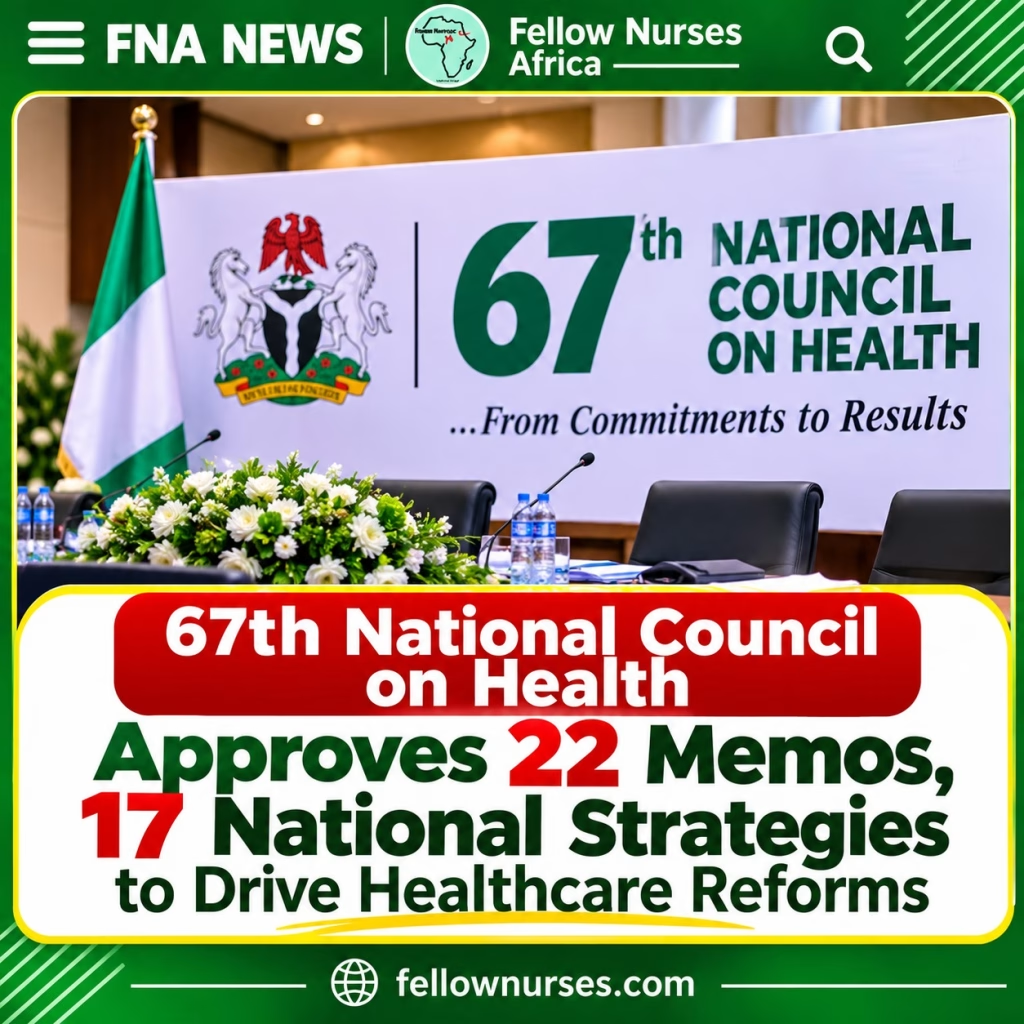
Nigeria’s 67th National Council on Health has approved 22 memoranda and launched 17 national strategies, guidelines and frameworks aimed at strengthening healthcare delivery, improving health worker welfare and expanding access to essential health services.
👉 Join Fellow Nurses Africa on WhatsApp
The decisions, which cover mental healthcare, maternal health, health financing, digital health and healthcare quality, were reached during the Council’s meeting in Lafia, Nasarawa State, held from November 16 to 20, 2026.
The meeting, themed “From Commitments to Results: Delivering Quality and Equitable Healthcare for All Nigerians,” brought together health sector stakeholders to review national health policies, assess previous commitments and agree on measures to improve healthcare delivery across the country.
The National Council on Health (NCH) is Nigeria’s highest health policy-making body, providing a platform for federal and state health authorities to deliberate on policies and coordinate priorities for the health sector.
Mental Health Services to Be Integrated into Primary Healthcare
One of the significant resolutions concerns the integration of essential mental health services into primary healthcare facilities and the Basic Minimum Package of Health Services.
The decision comes amid renewed national attention on mental healthcare, following President Bola Tinubu’s transmission of the National Mental Health Amendment Bill 2026 to the Senate.
The proposed amendment seeks to decriminalise attempted suicide and provide appropriate care and support for survivors rather than subjecting them to criminal punishment.
Integrating mental health services into primary healthcare could improve access to early identification, assessment and treatment, particularly for people in underserved communities.
However, the success of this policy will depend on the availability of trained health workers, essential medicines, referral systems and adequate funding at the primary healthcare level.
New Measures to Strengthen Health Worker Protection and Welfare
👉 Join Fellow Nurses Africa on WhatsApp
The Council also approved recommendations aimed at addressing harassment and improving the working conditions of healthcare professionals.
The recommendations include strengthening legal measures against the harassment of health workers and adopting national policies on working hours and locum engagement.
These decisions address longstanding concerns about workplace safety, excessive working hours and employment arrangements within Nigeria’s healthcare system.
For nurses, doctors and other healthcare professionals, effective implementation could contribute to safer working environments and more structured employment practices.
However, the impact will depend on how the policies are translated into enforceable workplace standards across federal, state and private healthcare institutions.
National Minimum Standards Approved for Secondary Healthcare Facilities
In a move aimed at improving healthcare quality, the Council approved national minimum standards for secondary healthcare facilities.
The standards represent an important step towards establishing a common benchmark for service delivery at this level of care.
The Council also emphasised the need for a functional two-way referral system between primary and secondary healthcare facilities.
This means that patients should not only be referred from primary healthcare centres to secondary facilities when they require more advanced care. They should also be appropriately referred back to primary facilities for continued management and follow-up.
A functional referral system is essential for continuity of care, better coordination between healthcare providers and more efficient use of available resources.
NHIA to Define Requirements for Emergency Maternal Care Coverage
The Council also addressed access to emergency obstetric and newborn care through health insurance.
Under the resolution, the National Health Insurance Authority (NHIA) will define the requirements states must meet before secondary healthcare facilities with medical officers skilled in Comprehensive Emergency Obstetric and Newborn Care (CEmONC) can be empanelled.
The decision is expected to support access to emergency maternal and newborn services through health insurance arrangements.
For pregnant women experiencing complications, timely access to facilities capable of providing comprehensive emergency obstetric care can be critical to preventing avoidable maternal and newborn deaths.
The effectiveness of this resolution will depend on the standards established by NHIA, the readiness of participating facilities and the ability of states to meet the requirements.
National Health Accounts Adopted to Improve Health Financing
👉 Join Fellow Nurses Africa on WhatsApp
On health financing, the Council adopted the 2023 and 2024 National Health Accounts.
The accounts provide information on how resources are raised, allocated and spent within the health sector.
Their adoption is expected to support evidence-based planning, improve resource allocation and help policymakers identify gaps in healthcare financing.
At a time when access to affordable healthcare remains a major concern for many Nigerians, reliable health expenditure data is important for determining where resources are most urgently needed.
Other Resolutions Cover Cancer, Nutrition and Digital Health
Beyond the major decisions, the Council’s resolutions also addressed other areas of national health policy, including nutrition, cancer control and digital health.
The broader package of decisions reflects efforts to strengthen health system coordination, improve service delivery and advance the country’s health sector reform agenda.
The Council also approved a comprehensive review of the National Health Act 2014, which provides the legal foundation for Nigeria’s healthcare system.
A review of the Act could create an opportunity to address existing gaps and align the country’s health legislation with current healthcare priorities and emerging challenges.
Implementation Remains the Biggest Test
👉 Join Fellow Nurses Africa on WhatsApp
Despite the range of resolutions adopted, their impact will ultimately depend on implementation.
The original report highlighted that the previous year’s average implementation score stood at 55 per cent. However, this assessment was based on reports received from only about half of the states expected to submit updates.
This raises concerns about the consistency of state-level reporting and the extent to which national health commitments translate into measurable improvements in healthcare delivery.
To strengthen accountability, the Council agreed on measures that include designated lead institutions, implementation timelines, measurable indicators, quarterly reporting through the MSDAT NCH Resolutions Dashboard and independent verification.
Every state is also expected to appoint a National Council on Health Resolutions Desk Officer by the end of the first quarter of 2027.
These measures could improve transparency and make it easier to track the progress of resolutions across the federation.
However, monitoring frameworks alone will not guarantee results. Sustained political commitment, adequate financing, institutional coordination and active participation by relevant stakeholders will be necessary to ensure that the decisions produce meaningful improvements.
Stakeholders Await Final Council Communiqué
The Federal Ministry of Health and Social Welfare is expected to publish the final Council communiqué, which will provide stakeholders and the public with an official record of the resolutions adopted and the commitments made.
The countdown to the 68th National Council on Health, scheduled to hold in Enugu State, will provide another opportunity to assess progress on the decisions reached at the 67th meeting.
For Nigerians, the real measure of success will not be the number of policies approved or strategies launched, but whether these commitments translate into accessible mental healthcare, safer working conditions for health professionals, improved maternal health outcomes and better-quality healthcare services.
The challenge now is to move from policy commitments to measurable results.
👉 Join Fellow Nurses Africa on WhatsApp
Fellow Nurses Africa is the independent voice of African nursing, we educate, inform and support nurses across Africa.

Durowoju Abisola is a registered nurse, nurse writer and On-Air Correspondent at Fellow Nurses Africa (FNA), passionate about nursing leadership, health education and advocacy.
Through journalism, storytelling and content creation, she amplifies important conversations around nursing, healthcare and the experiences of nurses in Nigeria. She is committed to using her voice and professional knowledge to educate the public, challenge misconceptions and inspire the next generation of nurses.
 ✓
Did you know that we're the accredited ReMar NCLEX Training Centre in Nigeria with Prof. Regina Callion?
Prepare and pass your NCLEX-RN / NCLEX-PN with official ReMar Review curriculum, Regina Callion video lectures, Quick Facts, and dedicated clinical mentorship right here in Nigeria.