
FNA News, Lagos Nigeria. 3rd November, 2026.
From Auxiliary Nurses to Certified Caregivers: Nurses Take the Back Seat as Nigeria Approves National Care Policy
As Nigeria moves to professionalise caregiving under its newly approved National Care Policy, critical questions are emerging over the place of registered nurses in a sector built around the very principle that defines their profession: care.
For decades, Nigeria’s nursing profession has grappled with the activities of unregulated auxiliary nursing practitioners, some of whom perform clinical responsibilities without recognised professional nursing qualifications.
Now, with the Federal Government introducing a national framework for caregiver training, certification and regulation, another question demands urgent attention: is Nigeria building a stronger care system with nurses at its centre, or creating another professional structure in which nursing expertise risks being pushed to the sidelines?
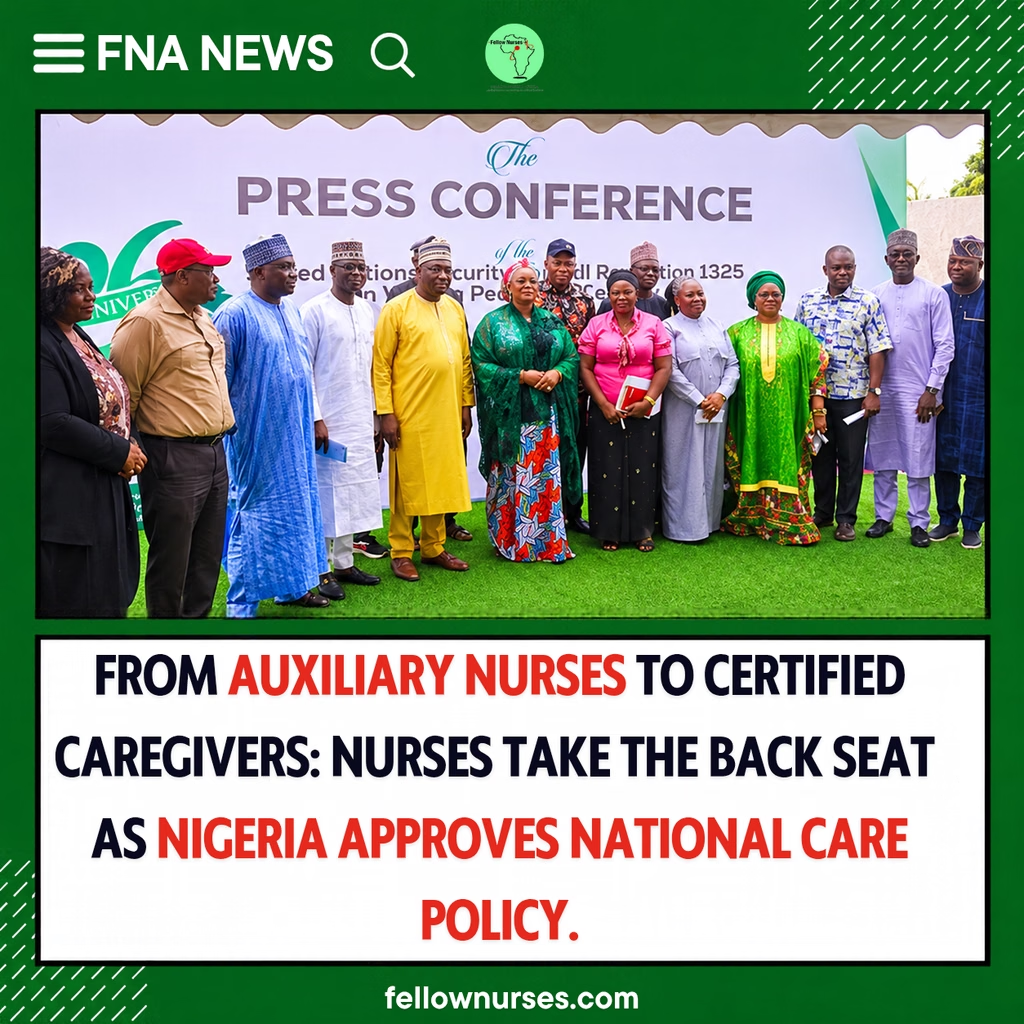
The Federal Executive Council (FEC), chaired by President Bola Ahmed Tinubu, approved the National Care Policy and Implementation Plan 2026–2030 on Wednesday, 28 October 2026.
👉 Join Fellow Nurses Africa on WhatsApp
The Minister of Women Affairs and Social Development, Imaan Sulaiman-Ibrahim, announced the approval the following day in Abuja.
The policy seeks to formalise caregiving, establish professional training and certification pathways, improve elderly and disability care, recognise unpaid care work and create employment opportunities.
It also proposes minimum standards for care services, social protection for care workers and a National Care Fund.
While these objectives represent a welcome step towards strengthening Nigeria’s care economy, the policy raises an equally important issue for healthcare professionals: what role will registered nurses play in shaping, leading and regulating the clinical aspects of this emerging sector?
Care is at the heart of nursing. Why should nurses take the back seat?
Care is not merely an activity associated with nursing. It is central to the profession’s identity, education and practice.
From maternity wards and intensive care units to community clinics, rehabilitation centres and patients’ homes, nurses have long been responsible for assessing care needs, coordinating interventions, protecting vulnerable patients and supporting recovery.
Professional nursing combines compassionate care with scientific knowledge, clinical judgement, accountability and evidence-based practice.
It is therefore difficult to discuss the future of organised healthcare-related caregiving in Nigeria without recognising the nursing profession as a central stakeholder.
A national care system that fails to place registered nurses at the forefront of clinical care planning, professional standards and patient safety risks overlooking one of the country’s most important sources of care expertise.
This does not suggest that every form of care belongs exclusively to nursing.
Social workers, physiotherapists, occupational therapists, trained caregivers and family members all make valuable contributions to supporting individuals with different needs.
However, where caregiving crosses into clinical assessment, nursing interventions, monitoring of complex health conditions and management of healthcare risks, registered nurses should have clearly recognised leadership and professional responsibilities.
The concern is not the emergence of certified caregivers. It is the possibility of establishing a care system in which nursing responsibilities become blurred, nursing expertise is undervalued and clinical accountability becomes difficult to enforce.
Nigeria should not develop its care economy while leaving professional nursing leadership as an afterthought.
From auxiliary nurses to certified caregivers: Is history about to repeat itself?
The controversy surrounding auxiliary nursing practice offers an important lesson.
Across Nigeria, the term auxiliary nurse has frequently been used to describe individuals trained outside recognised professional nursing education and registration pathways.
Although some provide valuable assistance in healthcare settings, concerns arise when individuals without professional nursing registration are employed to undertake clinical responsibilities or presented to patients as qualified nurses.
This has contributed to longstanding debates around nursing quackery, unsafe practices, professional identity and the enforcement of nursing regulations.
The Nursing and Midwifery Council of Nigeria (NMCN) remains the statutory authority responsible for nursing and midwifery professional regulation.
With the proposed introduction of formal caregiver certification, Nigeria now faces another important regulatory test.
Will the certification framework clearly distinguish caregiving from professional nursing, or could it become a new route through which inadequately qualified individuals are deployed to perform nursing duties?
Nigeria cannot afford to confront the problem of unregulated auxiliary nursing on one hand while inadvertently creating another pathway for similar practices under the label of certified caregiving.
The distinction is crucial.
A caregiver trained to assist with feeding, bathing, dressing or mobility is providing an essential service.
But assisting someone with daily living activities is not equivalent to possessing the education and professional competence required to assess complex clinical conditions, manage nursing interventions or exercise independent nursing judgement.
A certificate in caregiving must never become a substitute for registration as a nurse.
Without those safeguards, the country risks repeating regulatory problems that the nursing profession has spent years trying to address.
Nurses should be leading, not merely participating
One of the most important questions arising from the policy concerns professional representation and leadership.
The government has outlined plans to formalise care work, develop training pathways and establish standards across the sector.
But who will define the clinical competencies required in facilities caring for medically dependent patients? Who will determine when a service user requires a registered nurse rather than a general caregiver? And who will take responsibility when unsafe clinical practices occur?
These questions cannot be adequately addressed without nursing expertise.
Registered nurses should not simply be invited to participate after care-sector decisions have been made. They should be at the forefront of developing the clinical standards, workforce frameworks and patient-safety systems that will shape the sector.
The development of caregiver education should involve nurses with relevant specialist expertise, alongside other qualified professionals.
Clinical care standards should be established in consultation with the NMCN, nursing leaders and appropriate healthcare authorities.
Facilities providing professional nursing services should be subject to the relevant nursing regulatory requirements.
And the responsibilities of caregivers must be clearly defined to prevent role confusion, misrepresentation and unsafe delegation.
For a policy with such significant implications for healthcare delivery, nursing representation should be a central part of its governance arrangements rather than a peripheral consideration.
You cannot build safe home healthcare without nursing expertise
The policy places considerable emphasis on elderly care, disability support and home-based care.
These are areas in which professional nursing expertise is especially important.
An older adult recovering from a stroke may require assistance with bathing and mobility, but may also be at risk of aspiration, pressure injuries, infections and other complications.
A person living with diabetes may need routine assistance at home while also requiring clinical monitoring and appropriate nursing interventions.
Someone receiving palliative care may need symptom assessment, medication-related support and coordinated end-of-life care.
These responsibilities demand more than goodwill or basic caregiving skills.
They require appropriate education, professional accountability and clinical judgement.
The expansion of home-based care must not become an excuse to replace registered nurses with cheaper, less-qualified workers where professional nursing care is required.
It would be equally inappropriate to suggest that every person receiving social care requires a nurse.
The correct approach is to match each individual’s needs with appropriately qualified personnel, supported by clear referral arrangements and risk-based clinical supervision.
Within that framework, nurses should play a leading role in assessing complex nursing needs, planning clinical care, supervising appropriately delegated tasks and evaluating patient outcomes.
Caregivers, meanwhile, should be recognised and supported to deliver the essential non-clinical services for which they are trained.
This is how a functional care system should operate: through collaboration, not professional substitution.
A new care economy must not weaken nursing regulation
Nigeria’s new policy could create jobs, expand care services and encourage investment in home healthcare.
For registered nurses, it could also provide opportunities to establish nurse-led home healthcare agencies, geriatric services, palliative care programmes and professional education initiatives.
But economic growth should not be pursued at the expense of professional standards.
As private care agencies and residential facilities expand, regulators must ensure that workers are not employed beyond their competence or misrepresented to patients.
A family engaging a registered nurse should receive the services of an appropriately qualified and registered professional.
A family engaging a trained caregiver should understand the nature and limitations of that worker’s responsibilities.
Employers must not blur these distinctions simply to reduce staffing costs.
The government should therefore establish clear rules on professional titles, qualifications, clinical staffing, referral pathways and the delegation of tasks.
The NMCN and other relevant authorities must have defined responsibilities for regulating professional nursing activities within the care sector.
Without effective oversight, the expansion of caregiving could expose vulnerable Nigerians to the same problems associated with unregulated clinical practice.
Where does Nigeria’s nursing strategy fit in?
The approval of the National Care Policy comes approximately one year after Nigeria unveiled its Strategic Directions for Nursing and Midwifery 2025–2030.
That framework seeks to strengthen nursing education, professional regulation, workforce development and leadership.
The two policies have significant areas of intersection.
Both concern workforce competence, service quality, healthcare delivery and the protection of patients.
Yet their implementation must be deliberately coordinated.
Nigeria cannot afford to develop a new national care workforce without integrating existing professional nursing structures where clinical nursing services are concerned.
Such coordination should involve the Federal Ministry of Health and Social Welfare, the Ministry of Women Affairs and Social Development, the NMCN, relevant nursing associations and other professional bodies.
👉 Join Fellow Nurses Africa on WhatsApp
The aim should be to prevent conflicting standards and establish a care system in which each profession understands its responsibilities.
Importantly, nurses must also be supported with adequate staffing, remuneration, training and professional protections if they are expected to take on additional clinical leadership and supervisory roles.
Nursing leadership cannot be achieved by assigning more responsibilities without providing the resources required to deliver them safely.
The government must answer the nursing question
Caring Africa, a technical partner involved in developing the policy, has welcomed the Federal Government’s decision.
Its founder and Chief Care Officer, Blessing Adesiyan, described the framework as an opportunity to address the country’s fragmented caregiving arrangements.
“Nigeria has never lacked caregivers. What we have lacked is a system,” she said.
That observation reflects an important challenge.
Nigeria needs an organised system that supports families, recognises care workers, establishes standards and protects vulnerable people.
But an organised care system must also recognise the distinct responsibilities of professional healthcare workers.
For the nursing profession, several questions now require clear answers.
What role did nursing leaders and the NMCN play in developing the policy?
How will registered nurses be represented in its implementation?
Who will regulate clinical activities undertaken within care agencies?
Will home-care facilities providing complex nursing services be required to engage appropriately qualified nurses?
And what measures will prevent certified caregivers from being deployed as substitutes for registered nurses?
These are not questions intended to undermine caregivers or their contribution.
They are questions about clinical standards, public protection and accountability.
Caregiving must complement nursing, not replace it
Nigeria’s National Care Policy has the potential to improve the lives of millions of people who provide or depend on care.
Its emphasis on professional recognition, training, social protection and quality standards deserves serious attention.
However, the success of the policy will depend not only on the number of caregivers trained or certified, but also on the safety and quality of services delivered.
Care is at the heart of nursing, and any major reform of healthcare-related care services must recognise registered nurses as essential professional leaders, not optional participants.
The nursing profession should not have to compete for recognition in areas where its education, clinical expertise and professional accountability are fundamental to patient safety.
At the same time, the development of a competent and respected caregiving workforce should be encouraged.
Nigeria needs both nurses and caregivers, working within clearly defined responsibilities and supported by effective regulation.
The danger is not in recognising caregivers. The danger lies in failing to distinguish their responsibilities from those of registered nurses.
After years of concerns surrounding unregulated auxiliary nursing practice, Nigeria has an opportunity to learn from the past rather than repeat it under a different professional title.
Professionalising caregiving must not become a back door to professional nursing practice.
As implementation begins, the government must ensure that nursing leaders have a meaningful place at the decision-making table, that the NMCN’s statutory responsibilities are respected and that patient safety remains non-negotiable.
The central message is clear: nurses must be at the forefront of the clinical care sector, while caregivers are empowered to work within their own recognised competencies.
Anything less risks creating confusion where Nigeria urgently needs clarity.
👉 Join Fellow Nurses Africa on WhatsApp
Fellow Nurses Africa is the independent voice of African nursing, we educate, inform and support nurses across Africa.

Kehinde Oluwatosin is one of the many editors here at Fellow Nurses Africa and fellownurses.com.
He is a registered nurse with a Master of Science degree in healthcare leadership from the University of Hull, United Kingdom. Kehinde is passionate about advancing the nursing profession across Africa. As Co-Founder of Fellow Nurses Africa, he plays a key role in shaping editorial direction, ensuring our content educates, informs, and empowers nurses continent-wide.
With expertise in leadership, patient flow, and healthcare operations, Kehinde brings valuable insights to nursing news, career development, and policy discussions. He is committed to amplifying the voice of African nurses and driving positive change in the profession.