


End of Retrogression? US Congress Proposes NURSE Visa Act – 20,000 New Nonimmigrant Visas for Foreign Nurses
Washington DC, 6 February 2026 – US Congressman Don Beyer (Democrat-Virginia) has introduced legislation that could offer a significant new pathway for internationally trained nurses to work in the United States, potentially easing long-standing delays in permanent residency for many skilled professionals.
The National Urgent Recruitment for Skilled Employees (NURSE) Visa Act, introduced on 4 February 2026, would create 20,000 new nonimmigrant visas each fiscal year exclusively for qualified registered nurses. These temporary work visas would be available only for employment in healthcare facilities located in areas officially designated by the Health Resources and Services Administration (HRSA) as experiencing a nursing workforce shortage.
👉 Join our Whatsapp channel Here
Facilities hiring under the programme would be required to maintain established provider to patient staffing ratios, a measure intended to safeguard care quality and working conditions.
Addressing a deepening workforce crisis
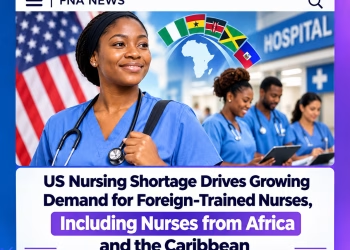
The proposal comes amid persistent warnings from federal agencies about the scale of the US nursing shortage. A Health Workforce Analysis published by HRSA in December 2025 projected a shortfall of 267,330 full-time registered nurses by 2028, falling to 204,690 by 2033 even after accounting for expected growth in domestic training capacity.
The shortages, which worsened during and after the COVID-19 pandemic, have led to increased pressure on existing staff, longer patient wait times in some regions, and concerns about the sustainability of healthcare delivery in underserved communities.
What the bill does and does not change for visa backlogs
The NURSE Visa Act focuses on nonimmigrant (temporary) work authorisation rather than immigrant visas that lead to permanent residency (green cards).
It would not directly alter the existing employment-based third preference (EB-3) category backlog that affects many foreign nurses, particularly those from high-demand countries where priority dates have remained static for years.
However, experts note that the creation of a dedicated, capped nonimmigrant pathway could provide a faster route for qualified nurses to enter the US workforce while they pursue longer-term permanent residency sponsorship if desired. Unlike the current EB-3 process, the proposed visas would not be subject to the same per-country numerical limits or multi-year retrogression delays.
The bill is at a very early stage. It has been introduced in the House of Representatives but has not yet been assigned a bill number in the current Congress, nor has a companion measure been introduced in the Senate. Passage would require committee review, debate and votes in both chambers.
Implications for internationally trained nurses
For nurses trained outside the United States including many from Africa, Asia, the Caribbean and other regions the legislation represents a potential bridge between current lengthy green-card waits and immediate workforce participation.
If enacted, the measure could allow eligible nurses to begin working in shortage areas relatively quickly, subject to meeting US licensing requirements (including passing the NCLEX-RN examination and obtaining appropriate credential evaluations).
👉 Join our Whatsapp channel Here
Congressman Beyer described the proposal as a pragmatic response to a crisis that domestic training programmes alone cannot resolve in the short to medium term.
The full text of the bill is available on the official congressional website.
This development will be closely watched by healthcare employers, nursing organisations and immigration practitioners as the United States continues to grapple with one of the most severe skilled-labour shortages in its recent history.
👉 Join our Whatsapp channel Here
Fellow Nurses Africa is the independent voice of African nursing, we educate, inform and support nurses across Africa

Kehinde Oluwatosin is one of the many editors here at Fellow Nurses Africa and fellownurses.com.
He is a registered nurse with a Master of Science degree in healthcare leadership from the University of Hull, United Kingdom. Kehinde is passionate about advancing the nursing profession across Africa. As Co-Founder of Fellow Nurses Africa, he plays a key role in shaping editorial direction, ensuring our content educates, informs, and empowers nurses continent-wide.
With expertise in leadership, patient flow, and healthcare operations, Kehinde brings valuable insights to nursing news, career development, and policy discussions. He is committed to amplifying the voice of African nurses and driving positive change in the profession.





I am interested to work in US and i will obey to the terms and conditions
Am interested candidate a professional nurse with more working experience
Am in need of a job
Am interested am a professional midwife nurse with more working experience