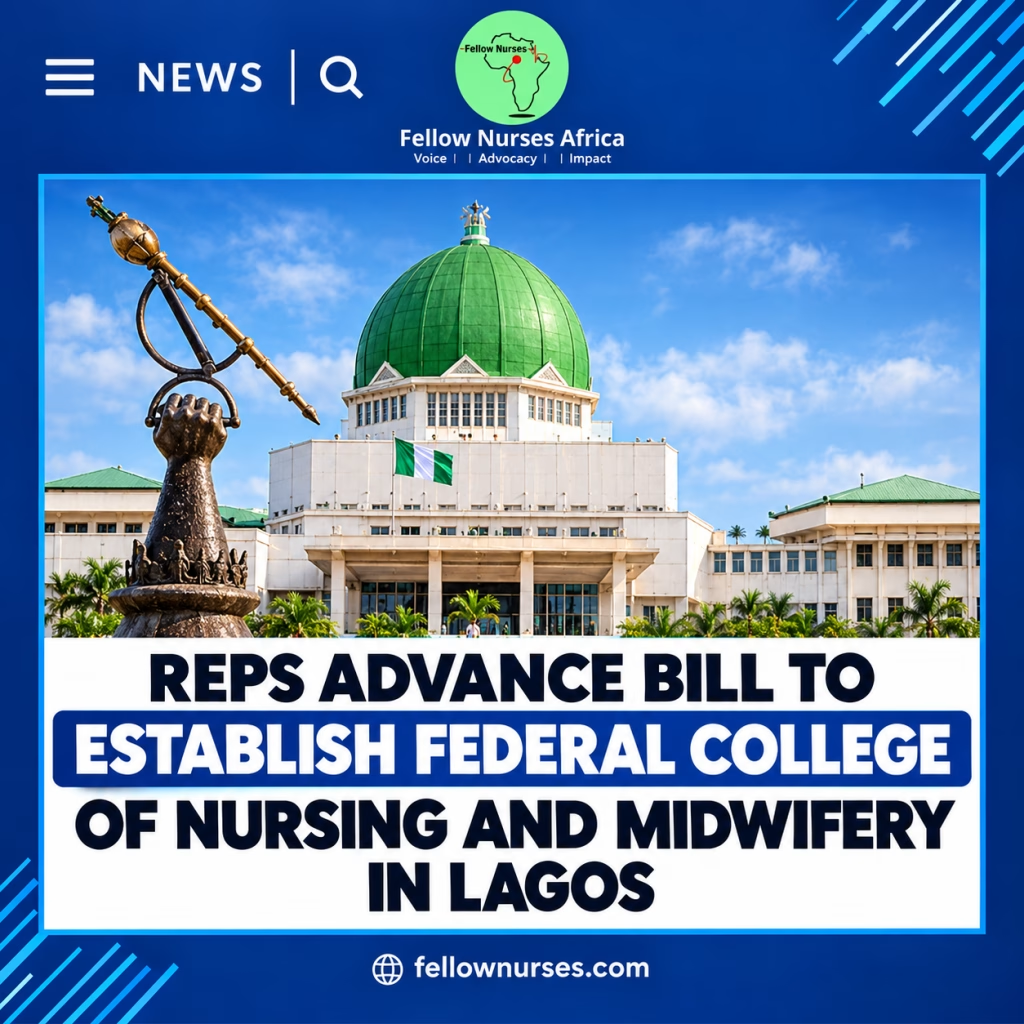
Reps Advance Bill to Establish Federal College of Nursing and Midwifery in Lagos
FNA NEWS, 29th OF OCTOBER, 2026
The proposed institution in Ifako/Ijaiye aims to expand nursing and midwifery training, create educational opportunities and help address Nigeria’s healthcare workforce shortage.
👉 Join Fellow Nurses Africa on WhatsApp
The House of Representatives has advanced a bill seeking to establish a Federal College of Nursing and Midwifery in Ifako/Ijaiye Local Government Area of Lagos State, in a move aimed at expanding access to professional healthcare education and addressing Nigeria’s shortage of skilled health workers.
The bill, sponsored by Benjamin Olabinjo, who represents Ifako/Ijaiye Federal Constituency, passed its second reading during plenary on Wednesday, October 28, 2026.
The proposed institution would serve as a centre for training, research and continuing education in nursing, midwifery and related disciplines.
Bill Seeks to Expand Nursing and Midwifery Training
Presenting the bill to lawmakers, Olabinjo said Nigeria needed to increase the number of qualified nurses and midwives available to hospitals and other healthcare facilities.
He expressed concern that the migration of trained health professionals to countries such as the United Kingdom, Canada and the United States had placed additional pressure on Nigeria’s healthcare system.
“Ask any hospital in Nigeria what it needs most, and the answer is almost always the same: more nurses and midwives,” Olabinjo said.
He argued that the country was losing trained professionals faster than it could replace them, making investment in professional education increasingly important.
According to the lawmaker, Lagos State’s large population and growing demand for healthcare services make additional training opportunities necessary.
He also noted that limited access to federally accredited training places had made admission difficult for many aspiring nurses and midwives, despite the continuing need for skilled personnel across healthcare facilities.
Proposed College to Offer Multiple Qualifications
👉 Join Fellow Nurses Africa on WhatsApp
Under the proposed legislation, the Federal College of Nursing and Midwifery would offer professional certificates, diplomas, degrees and post-basic qualifications in nursing, midwifery and related specialities.
The institution would also be empowered to admit students, conduct examinations and research, organise academic programmes and provide continuing education for practising professionals.
The proposed administrative structure includes a governing council, a School of Nursing and a School of Midwifery, alongside principal officers responsible for the institution’s academic and administrative operations.
If established, the college could widen access to professional training for young people in Lagos State and neighbouring communities. It could also create employment opportunities for lecturers, administrators and other workers.
Olabinjo said locating the institution in Ifako/Ijaiye would allow more young people to pursue healthcare careers without bearing the additional cost of relocating to distant parts of the country.
“Training close to home means a real career for young people in this constituency and Lagos, without the cost of moving far away to study,” he said.
What the Proposed College Could Mean for Nigeria’s Healthcare System
The proposed college comes amid concerns about the availability of nurses and midwives in Nigeria’s healthcare system.
These professionals play essential roles in patient monitoring, disease prevention, maternal healthcare, childbirth, newborn care and health education. Their availability is particularly important in primary healthcare facilities, where nurses and midwives often provide frontline services.
Expanding the number of training institutions could increase opportunities for prospective students and strengthen the country’s capacity to produce qualified healthcare professionals.
However, increasing training capacity alone may not resolve Nigeria’s nursing workforce challenges.
The country must also consider the factors that influence health workers’ decisions to remain in or leave the healthcare system, including remuneration, working conditions, staffing levels, career progression and access to professional development.
Without sustained investment in these areas, an increase in the number of graduates may not translate into a corresponding improvement in the availability of experienced nurses and midwives across the country.
👉 Join Fellow Nurses Africa on WhatsApp
Fellow Nurses Africa is the independent voice of African nursing, we educate, inform and support nurses across Africa.

Durowoju Abisola is a registered nurse, nurse writer and On-Air Correspondent at Fellow Nurses Africa (FNA), passionate about nursing leadership, health education and advocacy.
Through journalism, storytelling and content creation, she amplifies important conversations around nursing, healthcare and the experiences of nurses in Nigeria. She is committed to using her voice and professional knowledge to educate the public, challenge misconceptions and inspire the next generation of nurses.