
Fellow Nurses Africa | Lagos, Nigeria | 17 January, 2026
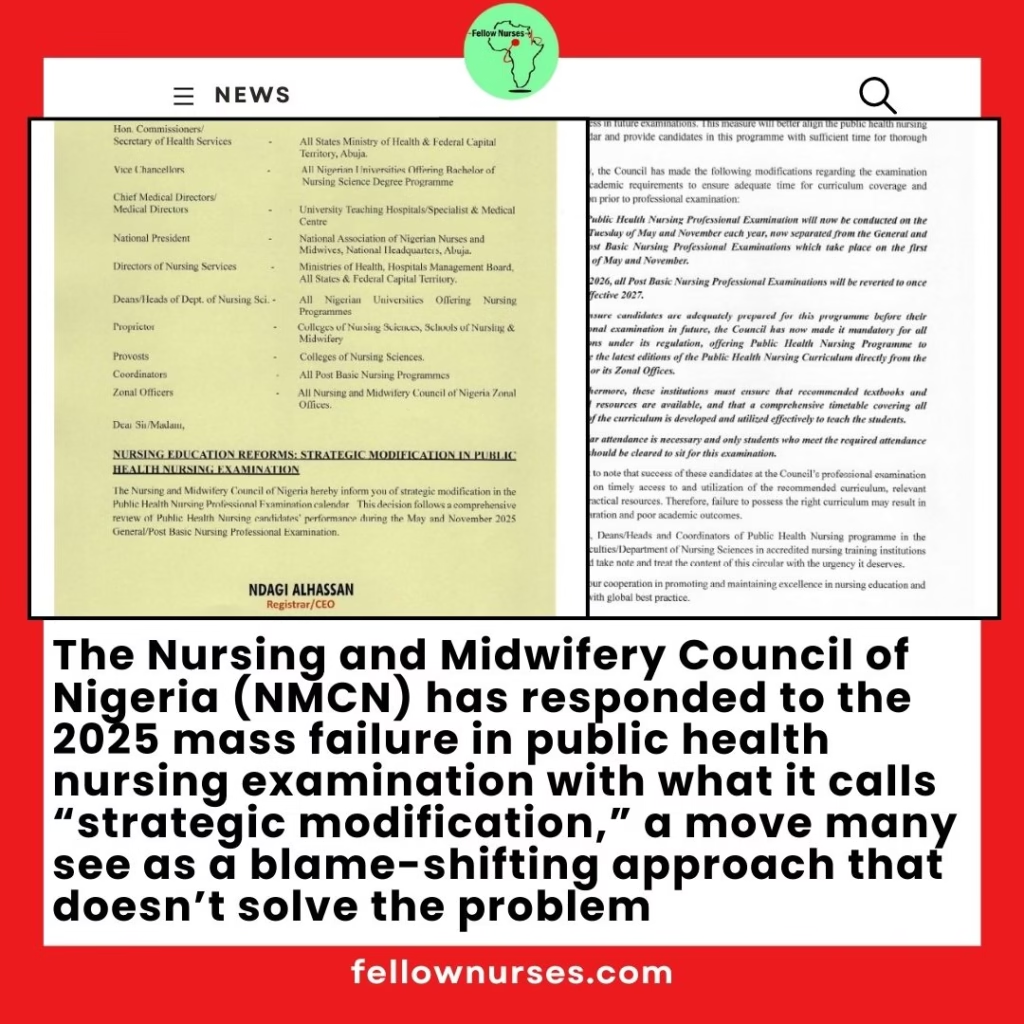
The Nursing and Midwifery Council of Nigeria (NMCN) has announced what it describes as “strategic modification” to the Public Health Nursing (PHN) professional examination following an unprecedented mass failure recorded in 2025.
While the Council says the changes are aimed at improving outcomes, many students, educators, and nursing advocates argue that the reforms fail to address the root causes of the crisis and instead shift responsibility almost entirely onto students and training institutions.
The Numbers That Triggered the Reform
The scale of the failure was difficult to ignore.
In the November 2025 Public Health Nursing professional examination, only 179 candidates passed out of approximately 1,890, representing a pass rate of about 9%. This means roughly 90% of candidates failed.
By contrast:
- General Nursing recorded an estimated 83% pass rate during the same examination cycle.
- Other post-basic programmes, including Midwifery, recorded pass rates ranging between 74% and 85% in earlier 2025 sittings.
The sharp disparity immediately raised questions within Nigeria’s nursing community, with many describing the Public Health Nursing result as a statistical outlier rather than a routine academic outcome.
NMCN’s “Strategic Modification” Explained
In a circular dated 16 January 2026, NMCN outlined a series of reforms under the heading “Nursing Education Reforms: Strategic Modification in Public Health Nursing Examination.”
Key changes include:
- Public Health Nursing examinations will now be conducted separately from other post-basic nursing examinations
- PHN exams will hold on the second Tuesday of May and November, while other post-basic exams remain on the first Tuesday
- Institutions offering Public Health Nursing are required to purchase the latest PHN curriculum directly from NMCN
- Schools must ensure recommended textbooks, practical resources, and comprehensive timetables are in place
- Only students who meet strict attendance requirements will be cleared to sit for the examination
According to NMCN, the decision followed a review of candidate performance in May and November 2025 and is intended to allow better curriculum coverage and thorough preparation.
The Policy Gap Fueling the Backlash
Despite the structural changes, one major policy remains unchanged, and it is the centre of the controversy.
Under current rules, a referral in Public Health Nursing automatically prevents a candidate from sitting for any other post-basic nursing examination, including Midwifery.
This means:
- A nurse academically cleared for Midwifery can still be barred from writing the exam because of a PHN referral
- Candidates may miss time-bound professional exams
- Students are forced into repeated PHN re-sits, often at significant financial cost
- Career progression is delayed indefinitely
While Public Health Nursing has been separated on the calendar, its consequences remain tied to all other post-basic programmes.
Why Critics Say the Reform Shifts Blame
Critics argue that the circular repeatedly points to:
- Curriculum gaps
- Institutional preparedness
- Student readiness
But it does not publicly address:
- Examination validity reviews
- Marking transparency
- Examiner consistency
- Allegations of technical or administrative issues during the 2025 exams
Reports from nursing advocacy platforms also highlighted claims of candidates being marked failed in subjects they did not register for, as well as concerns about system glitches during computer-based testing.
To many, the absence of a publicly released audit suggests the reforms focus more on controlling outcomes than confronting systemic weaknesses.
“Standards” Versus Fairness
NMCN has consistently emphasised maintaining professional standards, a position widely supported within the profession.
However, students and educators are asking a more uncomfortable question:
If a nurse is already a Registered Nurse, academically cleared for another specialty, and competent in that area, should a single post-basic referral invalidate all other professional progress?
Globally, many professional systems allow parallel remediation, where candidates correct deficiencies without being locked out of unrelated qualifications.
A Reform That May Improve the Future, But Punishes the Present
There is little disagreement that Public Health Nursing outcomes needed attention.
What remains contested is whether the response adequately protects candidates already caught in the fallout of the 2025 mass failure.
For many affected nurses, the reforms feel less like support and more like retroactive punishment for a system-wide breakdown they did not create.
The Bigger Question Facing Nigeria’s Nursing System
A 9% pass rate in a national professional examination is not merely a student performance issue, it is a systemic alarm.
As Nigeria pushes to strengthen its healthcare workforce, the question remains:
When a system fails nearly nine out of ten candidates at once, should the cost of that failure rest solely on the students or should the system itself be examined just as rigorously?
Fellow Nurses Africa is the independent voice of African Nursing. We educate, inform and support the Nursing profession.

Kehinde Oluwatosin is one of the many editors here at Fellow Nurses Africa and fellownurses.com.
He is a registered nurse with a Master of Science degree in healthcare leadership from the University of Hull, United Kingdom. Kehinde is passionate about advancing the nursing profession across Africa. As Co-Founder of Fellow Nurses Africa, he plays a key role in shaping editorial direction, ensuring our content educates, informs, and empowers nurses continent-wide.
With expertise in leadership, patient flow, and healthcare operations, Kehinde brings valuable insights to nursing news, career development, and policy discussions. He is committed to amplifying the voice of African nurses and driving positive change in the profession.