
Inside Nigeria’s 2026 Nursing Council Examinations as Thousands of Students Take Professional Qualifying Tests
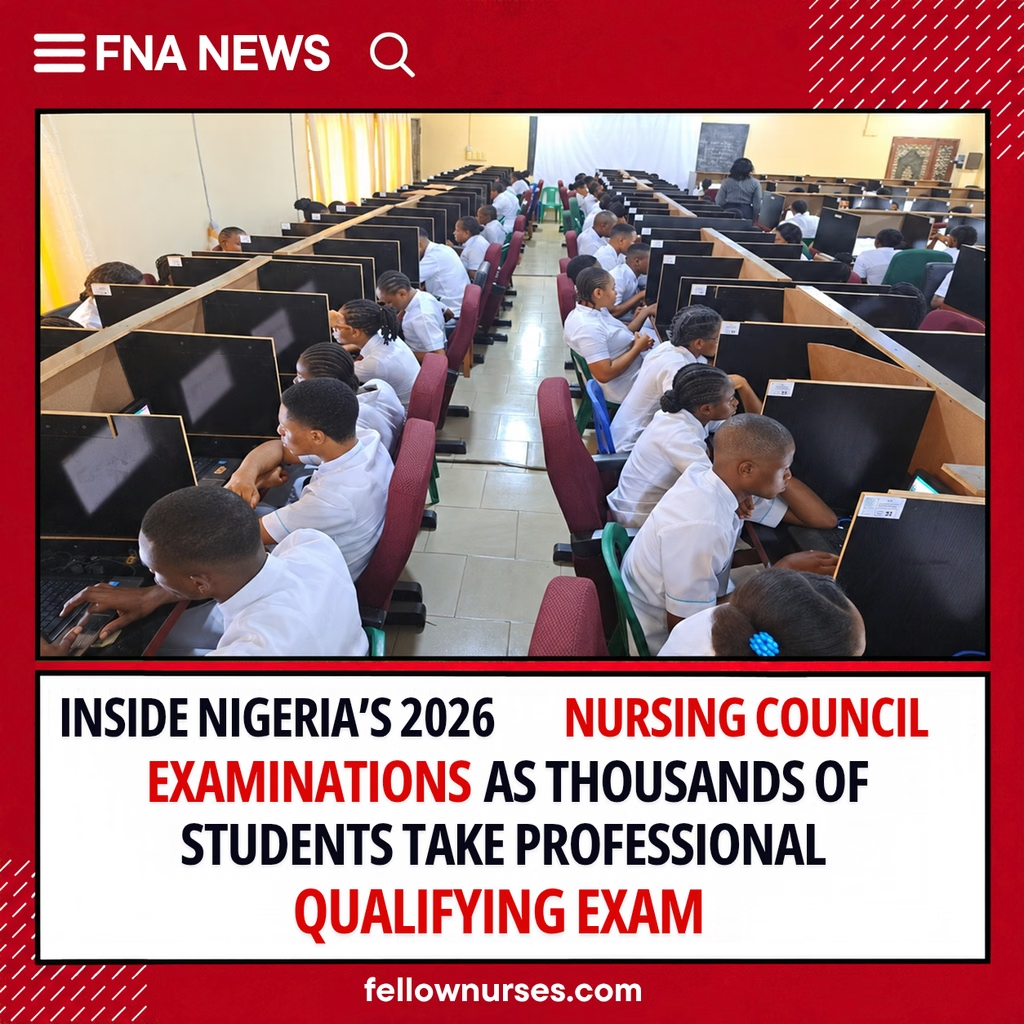
Thousands of nursing students across Nigeria have commenced the November 2026 Professional Qualifying Examinations conducted by the Nursing and Midwifery Council of Nigeria (NMCN), marking a crucial stage in their journey towards becoming registered nurses.
FNA News | Lagos, Nigeria | 4 November 2026
The nationwide exercise began on Tuesday, 3 November, with candidates from nursing institutions across the country taking their first professional examination papers at designated centres.
The examinations, which assess candidates’ theoretical knowledge and clinical competence, are among the final major hurdles nursing students must overcome before qualifying for professional registration.
For many candidates, the exercise represents the culmination of years of lectures, hospital postings, clinical assessments and intensive academic preparation.
The November examinations are taking place under a revised timetable announced by the Nursing and Midwifery Council of Nigeria following what the regulatory body described as an exceptionally large number of candidates.
General Nursing candidates commenced their examinations on Tuesday, while their Post-Basic Nursing counterparts are scheduled to begin next week.
Thousands of prospective nurses are expected to undergo the professional assessments during the examination period.
👉 Join Fellow Nurses Africa on WhatsApp
Inside the Examination: Candidates Share Early Experiences
As the examinations enter their second day, attention has turned to the experiences of candidates taking one of the most significant assessments of their nursing education.
A firsthand account obtained by Fellow Nurses Africa following Tuesday’s examination offered an early insight into the nature of the questions and candidates’ expectations.
“Overall, the examination was manageable and went well,” one candidate told Fellow Nurses Africa in a written account.
“The questions were clear, properly structured and arranged, and they were not particularly difficult or outside the expected scope of the nursing curriculum.”
The candidate explained that the examination covered major general nursing subjects, testing knowledge acquired throughout years of classroom instruction and clinical training.
According to the account, the questions focused on fundamental nursing principles and assessed candidates’ understanding of different aspects of professional practice.
The experience also highlighted the importance of adequate preparation, with the candidate expressing optimism about a favourable outcome.
While the account provides an encouraging early perspective, the experiences of candidates may differ across examination centres, and a comprehensive nationwide assessment has yet to be released.
The examination process extends beyond written assessments.
Candidates are also required to demonstrate their clinical knowledge and practical competencies through the Computer-Assisted Objective Structured Clinical Examination (CAOSCE), an assessment designed to evaluate their readiness to apply nursing knowledge in clinical situations.
For students who have spent years combining theoretical education with hospital-based training, the clinical assessment represents another important measure of their preparedness for professional responsibilities.
NMCN Revises Examination Timetable Amid High Candidate Numbers
The commencement of the examinations comes days after the Council announced changes to its November examination timetable.
In a circular dated 27 October 2026, the NMCN said the decision followed concerns over an exceptionally large number of candidates expected to participate in the exercise.
The Council explained that separating General Nursing and Post-Basic Nursing examinations would help reduce congestion at examination centres, strengthen coordination and maintain examination standards.
Under the revised timetable, General Nursing candidates are scheduled to complete their assessments between 3 and 6 November 2026.
Paper I was conducted on Tuesday, 3 November, while Paper II is scheduled for Wednesday, 4 November. The clinical assessment is expected to take place on Friday, 6 November.
Post-Basic Nursing candidates, including those undertaking Public Health Nursing programmes, will sit their examinations between 10 and 13 November 2026.
The Council also instructed candidates to arrive at their designated examination centres at least one hour before the scheduled commencement of their papers.
It warned against lateness and examination malpractice, while directing heads of nursing institutions to ensure that all candidates comply with the examination guidelines.
The circular was signed by the Registrar and Chief Executive Officer of the NMCN, Ndagi Alhassan.
Over 27,000 Candidates Sat November 2025 Examinations
The November professional qualifying examinations remain one of the major annual assessments conducted by the Nursing and Midwifery Council of Nigeria.
👉 Join Fellow Nurses Africa on WhatsApp
Figures from the corresponding November 2025 examinations provide an indication of the scale of the exercise.
According to official results released by the Council, 27,694 candidates participated in the November 2025 General and Post-Basic Nursing professional examinations nationwide.
Of that number, 20,197 candidates passed, representing an overall success rate of approximately 73%.
General Nursing recorded an 83% pass rate, with 17,263 successful candidates.
Public Health Nursing, however, recorded a considerably lower pass rate of 9%, with only 179 candidates successful.
The differences in performance across nursing programmes raised important questions about academic preparation, institutional readiness and the need for consistent educational standards.
For the ongoing November 2026 examinations, the Council has yet to confirm the final number of registered candidates, participating institutions and examination centres.
Beyond the Examination Halls: A Defining Moment for Nigeria’s Future Nurses
Beyond the written papers and clinical assessments, the nationwide examinations represent an important transition in the professional development of Nigeria’s next generation of nurses.
The Nursing and Midwifery Council of Nigeria is responsible for regulating nursing education and professional practice, including assessing candidates seeking entry into the profession.
The qualifying examinations are intended to ensure that prospective nurses possess the knowledge and competencies required to deliver safe and effective patient care.
However, professional examinations also raise broader questions about the quality of nursing education, particularly as training institutions prepare increasing numbers of graduates for the healthcare workforce.
The ability of nursing institutions to provide adequate clinical exposure, modern learning facilities, qualified educators and effective examination preparation remains central to producing competent nurses.
For the Council, maintaining credible, transparent and well-coordinated professional examinations is essential to public confidence in nursing education and the standards expected of registered practitioners.
For candidates, the immediate priority remains completing the examinations successfully and progressing towards professional registration.
As General Nursing students continue their assessments this week and Post-Basic Nursing candidates prepare for theirs next week, attention will remain on the conduct of the exercise and the eventual release of results.
Fellow Nurses Africa congratulates all nursing students participating in the November 2026 professional qualifying examinations and wishes them success.
Fellow Nurses Africa will continue to monitor developments, gather verified examination experiences and report official updates from the Nursing and Midwifery Council of Nigeria as the exercise progresses.
👉 Join Fellow Nurses Africa on WhatsApp
Fellow Nurses Africa is the independent voice of African nursing, we educate, inform and support nurses across Africa.

Kehinde Oluwatosin is one of the many editors here at Fellow Nurses Africa and fellownurses.com.
He is a registered nurse with a Master of Science degree in healthcare leadership from the University of Hull, United Kingdom. Kehinde is passionate about advancing the nursing profession across Africa. As Co-Founder of Fellow Nurses Africa, he plays a key role in shaping editorial direction, ensuring our content educates, informs, and empowers nurses continent-wide.
With expertise in leadership, patient flow, and healthcare operations, Kehinde brings valuable insights to nursing news, career development, and policy discussions. He is committed to amplifying the voice of African nurses and driving positive change in the profession.