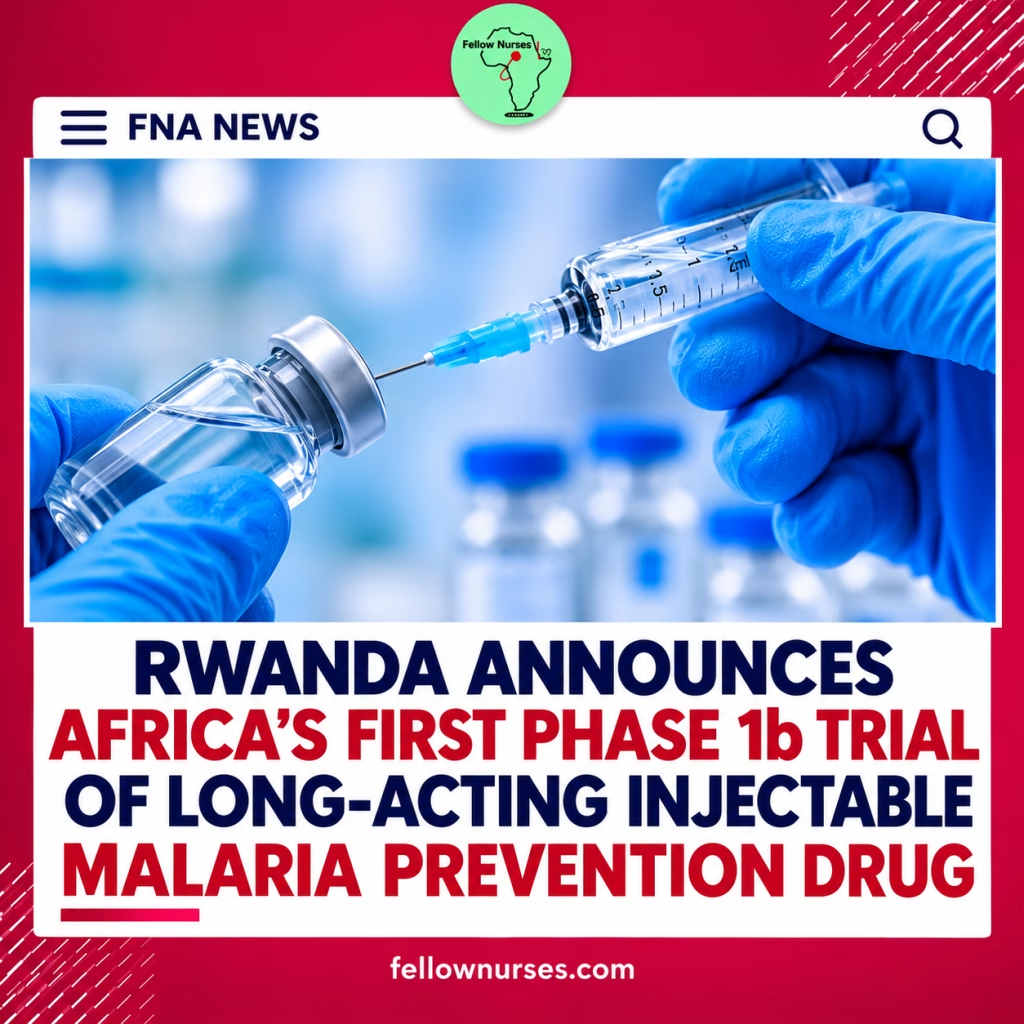
Rwanda Begins Africa’s First Trial of Long-Acting Injectable Malaria Prevention Drug
FNA NEWS, 3rd Of NOVEMBER, 2026
Rwanda has launched a Phase 1b clinical trial of an experimental long-acting injectable medicine designed to prevent malaria. The study will assess the safety and potential effectiveness of MMV371, a drug that researchers hope could provide protection for approximately three months following a single injection.
👉 Join Fellow Nurses Africa on WhatsApp
Rwanda has taken a significant step in malaria research with the launch of an early-stage clinical trial of a long-acting injectable medicine designed to prevent malaria.
The trial, being conducted through a partnership between Medicines for Malaria Venture (MMV) and Rinda Ubuzima, a Rwandan health research organisation, will evaluate an experimental compound known as MMV371.
The study is the first Phase 1 trial of a long-acting injectable malaria prevention candidate to be conducted in Africa.
If successful, the development could introduce another option for malaria prevention, particularly in regions where the disease remains a major public health challenge.
What is the MMV371 malaria injection?
👉 Join Fellow Nurses Africa on WhatsApp
MMV371 is an experimental long-acting injectable medicine being developed to provide extended protection against malaria.
Unlike conventional preventive medicines that may require regular oral doses, the injectable is designed to release its active medicine gradually after administration.
The compound is based on atovaquone, an established antimalarial medicine used in combination with proguanil for malaria prevention and treatment.
Researchers are developing the injectable formulation to maintain protective drug levels in the body for longer periods, potentially reducing the frequency of preventive medication.
Previous research involving healthy volunteers in the United Kingdom provided early safety and drug-exposure data. The development programme is targeting protection lasting at least three months from a single injection.
However, this remains a research objective. The drug has not yet been proven to provide three months of clinical protection in malaria-endemic populations.
What will the Rwanda clinical trial investigate?
The Phase 1b study will assess the safety, tolerability and pharmacokinetics of MMV371 in healthy adults and adolescents living in Rwanda.
According to the clinical trial registration, the study plans to recruit approximately 80 participants aged between 12 and 50 years.
Participants will receive either a single intramuscular injection of MMV371 or a placebo under a randomised, double-blind, placebo-controlled study design.
This means participants will be assigned to different study groups, and neither the participants nor the researchers directly assessing them will know who receives the experimental medicine or placebo during the blinded phase.
Researchers will monitor participants for possible side effects, injection-site reactions and changes in drug levels in the body.
The study will also explore whether the medicine provides protection against malaria while it remains in the bloodstream.
Pharmacokinetics will be particularly important in determining how the body absorbs, distributes and processes the medicine, as well as how long it remains at potentially protective levels.
The planned follow-up period extends to 24 weeks, allowing researchers to monitor participants over several months.
Importantly, the study is still an early stage of clinical development. Its findings will help determine whether the medicine can progress to larger studies.
Why a new malaria prevention option matters for Africa
👉 Join Fellow Nurses Africa on WhatsApp
Malaria continues to place a significant burden on healthcare systems across Africa.
The World Health Organization (WHO) estimates that 282 million malaria cases and 610,000 deaths occurred globally in 2024.
The WHO African Region accounted for approximately 95 per cent of global malaria cases and deaths.
Children under five remain particularly vulnerable, accounting for about 75 per cent of malaria deaths in the African Region.
Nigeria also carries a substantial share of the burden. WHO data indicate that the country accounted for 31.9 per cent of malaria deaths in the African Region in 2024.
Although existing interventions have helped reduce malaria-related illness and deaths, gaps in prevention, access to healthcare, drug resistance and other public health challenges continue to affect malaria control efforts.
The development of longer-acting preventive medicines could therefore provide another approach to protecting populations at risk.
Could the injection replace existing malaria vaccines?
Not necessarily.
The proposed injectable is being developed as an additional malaria prevention option, rather than a replacement for existing interventions.
Currently available malaria vaccines, including RTS,S and R21, are important tools in protecting young children in malaria-endemic countries.
Other prevention strategies include insecticide-treated mosquito nets, indoor residual spraying, seasonal malaria chemoprevention and appropriate preventive medicines for eligible populations.
A long-acting injectable could potentially complement these measures if further research establishes that it is safe, effective and affordable.
Its potential value would depend on how long protection lasts, which populations can safely receive it, how frequently it must be administered and whether health systems can deliver it at an affordable cost.
These questions will require further clinical research.
What the development means for African healthcare research
👉 Join Fellow Nurses Africa on WhatsApp
Beyond the potential medical benefits, the Rwanda trial highlights the importance of conducting clinical research within the communities that stand to benefit from new health technologies.
The partnership between MMV and Rinda Ubuzima also provides an opportunity to strengthen local research capacity and increase the participation of African researchers in the development of medicines targeting diseases that disproportionately affect the continent.
For African healthcare professionals, particularly nurses involved in public health, infectious disease prevention and community health education, developments in malaria research are important to follow.
Nurses play an essential role in malaria prevention, early recognition of symptoms, patient education, treatment support and community-based health interventions.
As new preventive technologies emerge, healthcare professionals will need reliable evidence to understand their safety, appropriate use and place within existing malaria control programmes.
The road ahead
Although the Rwanda trial represents an important milestone, MMV371 is not yet an approved malaria prevention medicine.
Its safety, effectiveness, duration of protection and affordability must be established through further clinical studies before it can be considered for wider use.
The results will help determine whether the experimental injection can advance to later-stage trials and potentially become part of Africa’s malaria prevention strategy.
For a continent that continues to account for the overwhelming majority of malaria cases and deaths, the search for more effective and accessible prevention tools remains critical.
The Rwanda study is therefore an important development to watch, but its ultimate impact will depend on the scientific evidence generated and whether the medicine can eventually reach the people who need it most.
👉 Join Fellow Nurses Africa on WhatsApp
Fellow Nurses Africa is the independent voice of African nursing, we educate, inform, and support nurses across Africa.

Durowoju Abisola is a registered nurse, nurse writer and On-Air Correspondent at Fellow Nurses Africa (FNA), passionate about nursing leadership, health education and advocacy.
Through journalism, storytelling and content creation, she amplifies important conversations around nursing, healthcare and the experiences of nurses in Nigeria. She is committed to using her voice and professional knowledge to educate the public, challenge misconceptions and inspire the next generation of nurses.