
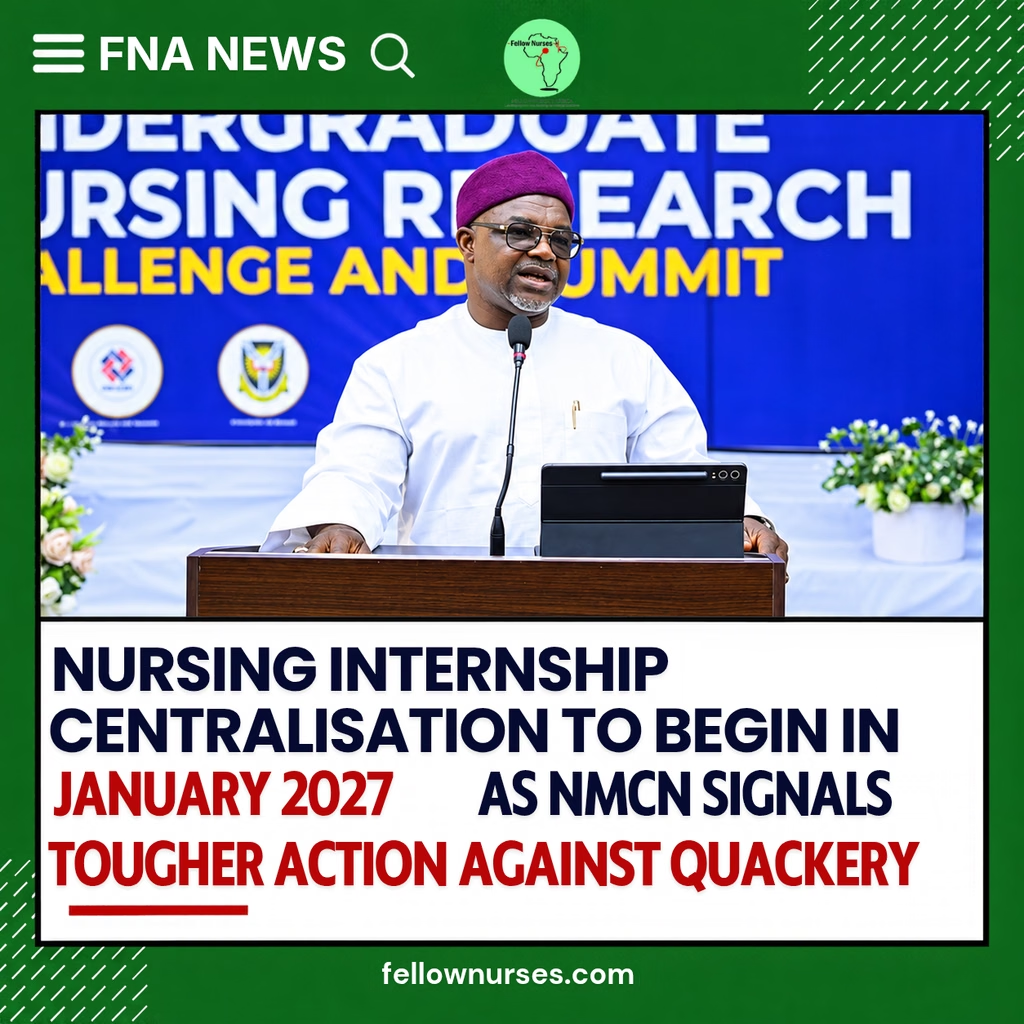
Nursing Internship Centralisation to Begin in January 2027 as NMCN Signals Tougher Action Against Quackery
NMCN Registrar Ndagi Alhassan says centralised nursing internship placements are expected to begin in January 2027, as the Council outlines plans to strengthen enforcement against quackery and addresses concerns over nurse recruitment in Nigeria.
By FNA News Desk | 2 November 2026
IBADAN, NIGERIA — The Nursing and Midwifery Council of Nigeria (NMCN) has indicated that the long-awaited centralisation of nursing internships is expected to commence in January 2027, marking a potentially significant change in how eligible nursing graduates secure clinical placements across the country.
The Registrar of the Council, Alhaji (Dr) Ndagi Alhassan, disclosed the expected commencement date during the 2026 Undergraduate Nursing Research Challenge and Summit, organised by the Golden Lamp Leadership Initiative Africa (GLLIA) at the University of Ibadan on Saturday, 31 October.
Speaking at the event, which was covered by FNA News, the Registrar said financial provisions for the new system had been incorporated into the Federal Government’s 2027 budget planning process.
He also addressed growing concerns about quackery in nursing, the role of professional associations in tackling illegal practice, and the need to recruit more nurses into healthcare institutions.
His remarks provided an update on issues affecting nursing graduates, practising nurses and healthcare delivery in Nigeria.
👉 Join Fellow Nurses Africa on WhatsApp
January 2027: A New Direction for Nursing Internships
For many Nigerian nursing graduates, securing an internship placement has become a major challenge after completing their university education.
Limited opportunities, competitive recruitment processes and delays in obtaining placements have contributed to concerns about access and fairness.
The centralised internship system is intended to address some of these difficulties by introducing a more coordinated approach to placement.
According to Dr Alhassan, the new arrangement is expected to take effect in January 2027, with federal health institutions across the country.
The development follows the Federal Government’s approval of centralised nurse internship placements in October 2025.
In a circular dated 27 October 2025, the NMCN announced that the Coordinating Minister of Health and Social Welfare, Professor Muhammad Ali Pate, had approved the implementation of centralised placements across accredited public health facilities.
The Council said the policy was designed to promote a standardised and transparent process for allocating internship positions to newly qualified nurses.
Under the proposed arrangement, the NMCN will coordinate the recruitment and deployment of nursing interns instead of leaving participating hospitals to operate separate placement processes independently.
The Federal Government’s 2027 Personnel Costs Budget Call Circular, issued in September 2026, also directs that recruitment, deployment, administration and budgetary provisions for nursing interns be handled centrally by the NMCN.
This provides an administrative foundation for the proposed reform.
What Will Change for Nursing Graduates?
If implemented as proposed, centralised placement could significantly alter how eligible nursing graduates apply for internships.
Rather than applying separately to numerous healthcare institutions, applicants could benefit from a coordinated allocation system overseen by the professional regulator.
The approach is intended to improve transparency, reduce inconsistencies and ensure better coordination between training institutions and healthcare facilities.
However, important questions remain.
These include the number of available internship positions, eligibility requirements, application procedures, selection criteria and how placements will be distributed among participating hospitals.
For the new system to succeed, nursing graduates will need clear and timely guidance before the proposed January 2027 commencement.
NMCN Signals Stronger Action Against Nursing Quackery
Beyond internships, Dr Alhassan also addressed the persistent problem of quackery in Nigeria’s nursing profession.
He stressed that the Council was working with relevant organisations and institutions to tackle illegal and unsafe nursing practice.
According to the Registrar, there is no place for quackery in a profession entrusted with protecting patients’ lives.
He explained that the fight against quackery requires coordinated action from regulatory authorities, professional associations, state governments and healthcare institutions.
The Registrar pointed to the existing Nursing and Midwifery Committees operating at state level, explaining that these structures have responsibilities relating to professional oversight and the enforcement of nursing standards.
He urged stakeholders to make better use of these institutions in identifying and reporting suspected violations.
The Council’s published inspectorate responsibilities already include investigating threats to professional standards, checking registration and licensing credentials, and collaborating with state health ministries and police authorities over suspected illegal practice.
Registered Nurses Practising Beyond Their Competence Also Under Scrutiny
In a notable part of his remarks, the Registrar expanded the discussion beyond individuals who falsely claim to be qualified nurses.
He raised concerns about what he described as professional quackery, referring to situations in which registered nurses undertake specialised clinical responsibilities without the necessary training or competence.
His comments highlighted a distinction between holding a professional nursing licence and being appropriately prepared to perform specialised clinical duties.
A nurse may be legally registered but still lack the specific knowledge, skills or supervised experience required to undertake certain procedures safely.
This is particularly important in complex clinical environments where inadequate preparation could expose patients to avoidable risks.
The Registrar’s remarks reinforced the importance of professional accountability and working within one’s recognised competencies.
They also raised wider questions about the responsibility of healthcare employers to provide appropriate training, supervision and staffing for specialist services.
Professional competence is not solely the responsibility of individual nurses. Healthcare institutions must also ensure that staff are prepared for the responsibilities assigned to them.
👉 Join Fellow Nurses Africa on WhatsApp
NANNM Urged to Take a Leading Role in Reporting Quackery
The Registrar also called on the National Association of Nigerian Nurses and Midwives (NANNM) to strengthen its role in addressing suspected illegal nursing practice.
He explained that the association should serve as an initial point of contact for complaints and concerns relating to quackery.
Cases requiring further regulatory action should then be referred to the NMCN.
According to Dr Alhassan, the Council has law enforcement representation within its governing structure and is prepared to work with relevant authorities to enforce professional regulations.
However, he emphasised that effective intervention depends on receiving credible reports and referrals.
His comments drew attention to the need for stronger collaboration between NANNM, state nursing authorities, healthcare institutions and the national regulatory body.
They also underscored the importance of establishing effective reporting channels through which nurses and members of the public can raise concerns about suspected unsafe practice.
For patients, the ultimate objective is to ensure that individuals providing nursing services possess the qualifications, registration and competence appropriate to their responsibilities.
Federal Government Has Directed Recruitment of More Nurses, Registrar Says
Dr Alhassan also addressed concerns about staffing shortages and the limited recruitment of nurses into government healthcare institutions.
Speaking on nursing staffing ratios and employment opportunities, he said the Federal Government had issued directives aimed at increasing the recruitment of nurses.
The remarks come amid continuing concerns about heavy workloads, workforce shortages and the availability of nursing employment opportunities in Nigeria.
The Federal Ministry of Health and Social Welfare previously announced recruitment waivers for 20,000 additional healthcare workers, with 60% of the proposed positions designated for nurses and midwives.
For nurses working in understaffed facilities, meaningful progress will depend on funded vacancies being filled and additional personnel being deployed where they are most needed.
Staffing Ratios Remain a Patient Safety Concern
The discussion about nurse recruitment also raises concerns about safe staffing levels across Nigeria’s healthcare system.
Insufficient nursing personnel can increase workloads, contribute to fatigue and reduce the time available for individual patient care.
However, addressing workforce shortages requires more than simply increasing the number of nurses employed.
Effective staffing also depends on patient acuity, clinical workload, specialist competencies, available resources and the distribution of personnel across healthcare facilities.
The Registrar’s comments have renewed attention on the need for government recruitment policies to translate into measurable improvements in clinical staffing.
For nursing professionals, the key question is whether recruitment directives will lead to better working conditions, safer staffing and improved patient outcomes.
FNA News Analysis: Promising Reforms, but Implementation Will Be the Real Test
The expected commencement of centralised nursing internships in January 2027 represents an important development for nursing graduates who have struggled to secure placements.
A well-designed national system could improve transparency, limit opportunities for exploitation and create a more consistent approach to allocating internship positions.
However, centralisation alone will not solve the problem if the number of available placements remains significantly below demand.
Adequate funding, expanded clinical training capacity and transparent allocation procedures will be essential.
Similarly, the Council’s position on quackery highlights the need for stronger professional oversight and enforcement.
While reporting suspected violations is necessary, regulatory bodies must also maintain effective inspection systems and respond promptly to credible concerns.
The discussion about professional quackery is particularly important because it shifts attention towards competence, patient safety and accountability within the profession itself.
It must also be accompanied by greater investment in specialist education, continuing professional development and workplace supervision.
On nurse recruitment, government commitments must produce visible results.
For Fellow Nurses Africa, these developments underline a wider advocacy concern: meaningful nursing reforms require transparent implementation, adequate resources and accountability from the institutions responsible for delivering them.
What Happens Next?
As January 2027 approaches, attention will turn to the NMCN for further information on the planned internship system.
Nursing graduates will be looking for official details on application procedures, placement capacity, eligibility requirements and the institutions expected to participate.
The profession will also be watching for progress in the Council’s efforts to combat quackery and the Federal Government’s commitments to increased nursing employment.
The latest announcements offer grounds for cautious optimism.
But for thousands of nursing graduates awaiting internship placements and practising nurses concerned about staffing and professional standards, the real measure of success will be whether these commitments deliver meaningful changes.
The challenge for Nigeria’s nursing regulators and policymakers is now to turn policy commitments into practical results.
👉 Join Fellow Nurses Africa on WhatsApp
Fellow Nurses Africa is the independent voice of African nursing, we educate, inform and support nurses across Africa.

Kehinde Oluwatosin is one of the many editors here at Fellow Nurses Africa and fellownurses.com.
He is a registered nurse with a Master of Science degree in healthcare leadership from the University of Hull, United Kingdom. Kehinde is passionate about advancing the nursing profession across Africa. As Co-Founder of Fellow Nurses Africa, he plays a key role in shaping editorial direction, ensuring our content educates, informs, and empowers nurses continent-wide.
With expertise in leadership, patient flow, and healthcare operations, Kehinde brings valuable insights to nursing news, career development, and policy discussions. He is committed to amplifying the voice of African nurses and driving positive change in the profession.