
FNA NEWS | Lagos Nigeria | 29th October, 2026.
ECOWAS Declares War on Substandard Nursing and Midwifery Schools, Moves to Crack Down Across West Africa
The Economic Community of West African States (ECOWAS) has moved to tackle substandard nursing and midwifery training institutions across West Africa, raising concerns over schools admitting students without qualified lecturers, adequate infrastructure or essential learning facilities.
The regional initiative seeks to strengthen accreditation requirements and ensure that institutions training future nurses and midwives meet recognised educational and professional standards.
The move comes amid growing concerns that poorly regulated training institutions could undermine healthcare quality, expose students and their families to financial exploitation, and place patients at risk.
Through the West African Health Organisation (WAHO), ECOWAS is working towards a harmonised accreditation framework designed to improve nursing and midwifery education across the region.
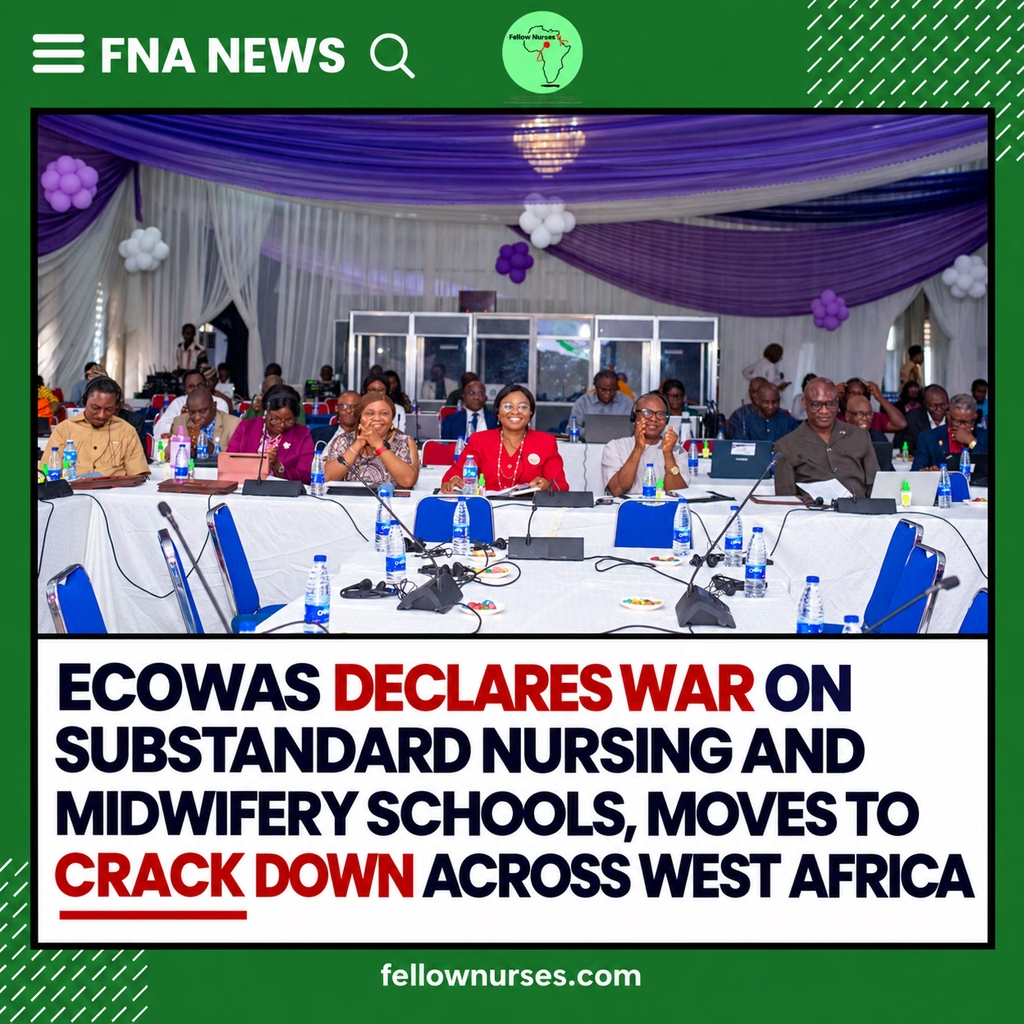
The development was highlighted at a three-day regional workshop which began in Abuja, Nigeria, on Thursday, 29 October 2026, bringing together education experts, regulatory authorities and healthcare leaders to finalise common accreditation criteria.
👉 Join Fellow Nurses Africa on WhatsApp
ECOWAS raises alarm over poorly equipped nursing schools
Speaking at the workshop, Professor Koffi Balogou, President of the Regional Council for Health Professionals Education, expressed concern over the operation of nursing and midwifery institutions that fail to meet essential academic and professional requirements.
According to him, some institutions admit students despite lacking qualified teaching staff, suitable infrastructure and essential educational resources.
He warned that such practices undermine the quality of healthcare education and could produce graduates who are inadequately prepared for professional practice.
Balogou also raised concerns about the financial burden placed on families who invest heavily in nursing education, only to discover that some institutions cannot provide adequate training or recognised qualifications.
He explained that the proposed framework would help ensure that only institutions meeting established educational requirements are authorised to provide recognised nursing and midwifery training.
The initiative is also expected to improve public confidence in healthcare professionals trained across West Africa.
Tougher accreditation standards for nursing and midwifery schools
Under the proposed framework, nursing and midwifery institutions would be assessed against common regional standards covering several critical aspects of education.
These include:
- Qualified teaching personnel: Schools must have appropriately trained educators capable of delivering professional nursing and midwifery education.
- Adequate infrastructure: Institutions must provide suitable classrooms, laboratories, equipment and learning resources.
- Quality clinical training: Students must have access to appropriate practical training and supervised clinical experience.
- Standardised curricula: Training programmes must meet agreed educational requirements and professional competencies.
- Regular monitoring: Accreditation would involve institutional assessments, compliance checks and periodic reviews.
According to WAHO Director-General Professor Palokinam Pitche, the proposed process would involve formal applications, verification of minimum requirements, advisory visits and comprehensive accreditation assessments.
Institutions could receive interim or final accreditation, with periodic reviews conducted every two or five years, depending on their status
These measures are intended to strengthen accountability and ensure that graduates possess the knowledge, clinical skills and professional competencies required to deliver safe healthcare.
Nursing education is a patient safety issue, ECOWAS warns
Beyond the quality of educational facilities, regional leaders emphasised the relationship between nursing education and patient safety.
Nurses and midwives are responsible for critical aspects of healthcare delivery, including medication administration, patient assessment, emergency care, maternal health and the monitoring of vulnerable patients.
Inadequate training in these areas can have serious implications for patients.
Professor Balogou warned that allowing institutions to operate without adequate resources and qualified instructors risks exposing communities to poorly prepared healthcare professionals.
The concern is particularly significant in West Africa, where nurses and midwives often serve as the first point of contact for patients seeking healthcare, particularly in rural and underserved communities.
Regional leaders stressed that improving the quality of nursing education should be considered an essential investment in stronger healthcare systems rather than simply an administrative requirement.
👉 Join Fellow Nurses Africa on WhatsApp
ECOWAS wants nurses and midwives to work more easily across West Africa
The proposed accreditation framework is also expected to support professional mobility among nurses and midwives.
Professor Pitche explained that harmonising educational standards across member states would improve confidence in professional qualifications and facilitate the movement of qualified healthcare workers between countries.
Currently, differences in training requirements, professional regulation and accreditation systems can complicate the recognition of qualifications across national borders.
A common framework could help reduce these barriers while maintaining consistent educational standards.
Senegalese President Bassirou Diomaye Faye, represented at the workshop by Professor Awa Coll-Seck, emphasised the importance of harmonised nursing and midwifery education in strengthening regional healthcare delivery.
He highlighted the need for cooperation among member states to address differences in healthcare workforce availability.
Some countries train more healthcare professionals than their domestic systems can absorb, while others continue to experience shortages.
Regional harmonisation could therefore support better workforce distribution, although professional registration and employment would remain subject to applicable national requirements.
What does this mean for nursing and midwifery schools in Nigeria?
For Nigeria, the development could introduce greater regional alignment in the assessment of nursing and midwifery training institutions.
The Nursing and Midwifery Council of Nigeria (NMCN) already regulates professional nursing education and maintains accreditation requirements for approved training institutions.
According to the Council’s published guidelines, institutions must satisfy minimum educational and infrastructural requirements before accreditation is granted.
Existing accreditation arrangements also provide for periodic assessments, with provisional accreditation generally reviewed after two years and full accreditation after five years.
The proposed ECOWAS framework is expected to complement national regulatory systems by establishing common regional benchmarks for quality assurance.
However, there has been no confirmed announcement that ECOWAS has ordered the immediate closure of nursing or midwifery schools in Nigeria or elsewhere in West Africa.
The current initiative focuses on finalising accreditation criteria and strengthening future implementation.
Any enforcement action against individual institutions would depend on the applicable regulatory framework and decisions by the relevant authorities.
FNA analysis: Expanding nursing education must not come at the expense of quality
The development raises an important question about the rapid expansion of nursing and midwifery education across Africa.
As demand for nursing education continues to grow, establishing additional training institutions can create opportunities for young people seeking careers in healthcare.
However, increasing the number of schools without corresponding investment in competent educators, clinical facilities and learning resources risks weakening the standards the profession is expected to uphold.
A nursing institution should not be judged solely by the number of students it admits or the certificates it awards.
The true measure of its quality lies in whether its graduates are adequately prepared to deliver safe, ethical and evidence-based patient care.
There is also a responsibility to protect students.
Young people and their families often make significant financial sacrifices to pursue nursing education. Where institutions fail to meet accreditation standards, students should not automatically bear the consequences of regulatory failures or institutional negligence.
Transparent accreditation systems, accessible lists of approved institutions and appropriate arrangements for affected students must therefore form part of any meaningful reform.
For Fellow Nurses Africa, improving nursing education is inseparable from strengthening the nursing profession.
Africa does not simply need more nursing schools. It needs nursing schools capable of producing competent, confident and professionally prepared nurses and midwives.
The proposed ECOWAS initiative offers an opportunity to strengthen that foundation.
Its long-term success, however, will depend on consistent enforcement, transparent assessment processes and cooperation between regional authorities, national regulators and educational institutions.
What happens next?
Following the workshop, further work will be required to align regional requirements with national regulatory arrangements and establish implementation procedures.
For students, parents and prospective applicants, the development reinforces the importance of verifying an institution’s accreditation status before enrolling.
The ultimate test will be whether the regional initiative delivers measurable improvements in nursing education, protects students from substandard training and strengthens patient safety across West Africa.
👉 Join Fellow Nurses Africa on WhatsApp
Fellow Nurses Africa is the independent voice of African nursing, we educate, inform and support nurses across Africa.

Kehinde Oluwatosin is one of the many editors here at Fellow Nurses Africa and fellownurses.com.
He is a registered nurse with a Master of Science degree in healthcare leadership from the University of Hull, United Kingdom. Kehinde is passionate about advancing the nursing profession across Africa. As Co-Founder of Fellow Nurses Africa, he plays a key role in shaping editorial direction, ensuring our content educates, informs, and empowers nurses continent-wide.
With expertise in leadership, patient flow, and healthcare operations, Kehinde brings valuable insights to nursing news, career development, and policy discussions. He is committed to amplifying the voice of African nurses and driving positive change in the profession.