

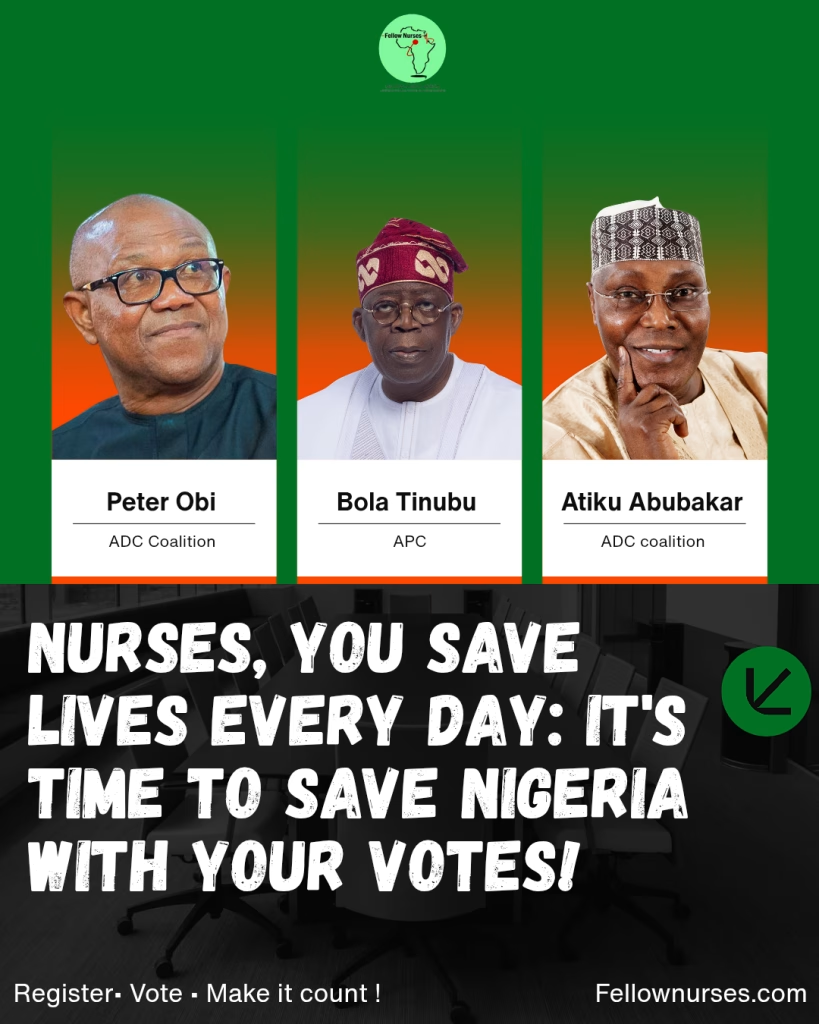
Nurses, You Save Lives Every Day: It’s Time to Save Nigeria with Your Votes!
By Fellow Nurses Africa
Lagos, Nigeria – 28 February 2026
A motivational message is gaining momentum among Nigerian nurses: “Nurses, you save lives every day: it’s time to save Nigeria with your votes!” Shared widely on social media, including X, it calls on healthcare workers to register for Permanent Voter’s Cards (PVCs) and participate actively in the 2027 general elections.
Nurses are the cornerstone of Nigeria’s healthcare system, yet they confront severe challenges that extend beyond clinical settings. Understaffing, low wages, burnout and the “japa” exodus where professionals migrate abroad continue to strain services. These issues are compounded by broader social determinants of health (SDOH), including economic instability, poor infrastructure, insecurity and banditry, which directly impact health outcomes and the safety of healthcare workers.
👉 Join our Whatsapp channel Here
Recent tragedies underscore these risks. Last week, six final-year nursing students from Ladoke Akintola University of Technology (LAUTECH) died in a road accident while travelling to Ogbomoso for their examinations. The crash, which occurred on 22 February on the Ilorin-Ogbomoso road, highlights the dangers of poor infrastructure and inadequate transportation systems—key SDOH that contribute to preventable deaths. In another incident, a nurse was killed in Abuja on New Year’s Eve, reportedly by “one chance” operators—criminal gangs posing as public transport drivers who rob and sometimes murder passengers. Banditry has also claimed lives, with reports of nurses and other healthcare workers among victims in attacks across northern states. These events reflect a pattern where insecurity disrupts access to healthcare, displaces communities and exposes frontline workers to violence.
Insecurity in northern Nigeria, including banditry and terrorism, has led to thousands of deaths in recent years, surpassing previous records in some periods. This violence affects maternal and child health by limiting access to services, exacerbating food insecurity and straining already fragile infrastructure. Falling standards of living, driven by unemployment, high inflation and rising poverty, further entrench health inequalities, with vulnerable populations facing barriers to education, sanitation and nutrition.
Fellow Nurses Africa, although non-partisan and has no ties to any political party, candidate or movement. We offer balanced insights to empower nurses in making informed choices. This analysis examines leading presidential contenders—Peter Obi, Atiku Abubakar and incumbent President Bola Tinubu—focusing on their positions on healthcare, insecurity, banditry, standards of living, infrastructure and related SDOH. Assessments are based on public statements, records and policy proposals.
Peter Obi: Emphasis on Human Capital, Anti-Corruption and Comprehensive Security Reforms
Peter Obi, former Anambra governor (2006-2014) and 2023 Labour Party candidate, has joined the African Democratic Congress (ADC) coalition. He garnered about 6.1 million votes in 2023, appealing to reform advocates.
Obi views healthcare as a neglected sector vital for progress, advocating investments to reduce poverty and boost the economy. His donations, including N15 million to St. Philomena College of Nursing in February 2026, support training and faith-based facilities. On insecurity, Obi criticises governance failures, describing Nigeria as a “crime scene” due to mismanagement, and links banditry to poor leadership. He calls for treating insecurity as a national priority and addresses SDOH through fiscal discipline to improve living standards, infrastructure and economic opportunities.
Nurses should weigh if his philanthropy and critiques translate to systemic reforms in nurse welfare and security.
Atiku Abubakar: Focus on Restructuring, Electoral Integrity and Rejecting Bandit Deals
Atiku Abubakar, vice president (1999-2007) and 2023 PDP candidate with 6.98 million votes, has aligned with the ADC coalition.
His 2023 manifesto promised restructuring for better resource allocation in health and other sectors. Atiku emphasises quality healthcare, education and poverty reduction. On insecurity, he condemns bandit attacks, cautions against peace deals that favour criminals and demands stronger action. He ties banditry to governance failures and calls for people-centred approaches. Atiku addresses SDOH through coalition-building for inclusive policies, warning that repression undermines elections and exacerbates inequalities in living standards and infrastructure.
Nurses should evaluate his experience against limited recent specifics on nurse issues amid coalition dynamics.
Bola Tinubu: Renewed Hope Agenda with Push for State Police and Infrastructure Investments
President Bola Tinubu, elected in 2023 with 8.7 million votes under the APC, is expected to seek re-election.
Healthcare is core to his Renewed Hope Agenda, aiming to expand primary centres to over 17,000 by 2027 and launch training programmes. Over N98 billion has been disbursed for upgrades. On insecurity, Tinubu appeals for constitutional amendments to establish state police, vowing to reclaim forests from bandits and enhance responses to terrorism. He has issued directives to intensify operations in affected areas. Tinubu links SDOH to security, promoting multisectoral actions for better living standards, infrastructure and economic reforms, though critics note slow implementation amid rising costs.
👉 Join our Whatsapp channel Here
Nurses should assess if these commitments yield improvements in safety and conditions.
Electoral Timeline Update
The Independent National Electoral Commission (INEC) recently released a revised timetable for the 2027 general elections following the repeal of the Electoral Act 2022 and the enactment of the Electoral Act 2026, which introduced new timelines for pre-election activities.
- Initial dates (announced earlier under the 2022 Act): Presidential and National Assembly elections were scheduled for Saturday, 20 February 2027; Governorship and State Houses of Assembly elections for Saturday, 6 March 2027.
- Revised dates (announced in late February 2026): Presidential and National Assembly elections will now hold on Saturday, 16 January 2027; Governorship and State Houses of Assembly elections on Saturday, 6 February 2027.
Preparatory activities, including party primaries and Continuous Voter Registration updates, have been realigned accordingly. Nurses are encouraged to monitor INEC’s official channels for exact deadlines.
Insights for Nurses: Addressing Social Determinants Intellectually
The ADC coalition could consolidate opposition votes, but rivalries persist. Intellectually, the SDOH framework reveals how insecurity disrupts health access, infrastructure failures cause accidents and economic pressures fuel migration. A whole-of-government approach is needed to integrate security, economy and health policies.
Nurses are urged to:
- Scrutinise manifestos on SDOH metrics.
- Prioritise pledges for security, wages and infrastructure.
- Register or update details via INEC’s portal (cvr.inecnigeria.org) without delay.
As frontline experts, nurses’ informed votes can foster accountability and resilient systems.
Fellow Nurses Africa champions non-partisan advocacy and professional unity. Visit fellownursesafrica.org for resources.
👉 Join our Whatsapp channel Here
Fellow Nurses Africa is the independent voice of African nursing, we educate, inform and support nurses across Africa

Kehinde Oluwatosin is one of the many editors here at Fellow Nurses Africa and fellownurses.com.
He is a registered nurse with a Master of Science degree in healthcare leadership from the University of Hull, United Kingdom. Kehinde is passionate about advancing the nursing profession across Africa. As Co-Founder of Fellow Nurses Africa, he plays a key role in shaping editorial direction, ensuring our content educates, informs, and empowers nurses continent-wide.
With expertise in leadership, patient flow, and healthcare operations, Kehinde brings valuable insights to nursing news, career development, and policy discussions. He is committed to amplifying the voice of African nurses and driving positive change in the profession.





Okay