When Hospitals Become Unsafe: What Must Nigeria Do to Stop Violence Against Nurses and Health Workers?
FNA NEWS, 29th Of September,2026
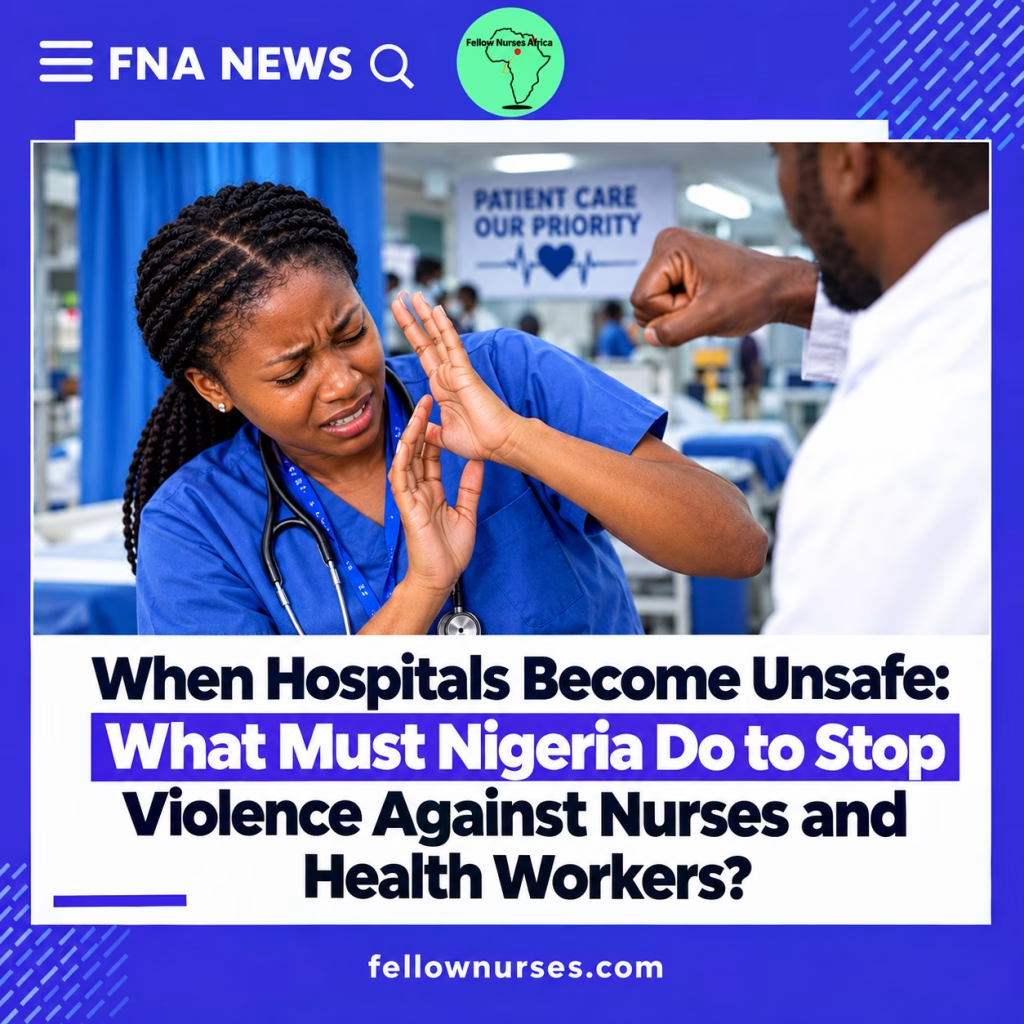
From nurses allegedly attacked by patients’ relatives to healthcare workers assaulted by colleagues and even security personnel, incidents across Nigerian hospitals are raising a difficult question: what will it take to make hospitals safe for the people who work in them?
👉 Join Fellow Nurses Africa on WhatsApp
A hospital should be one of the places where people feel safest.
Patients arrive seeking treatment. Families arrive hoping their loved ones will recover. Nurses, doctors and other healthcare workers arrive to provide care.
Yet across Nigeria, there have been repeated reports of healthcare workers being verbally abused, threatened, intimidated and physically assaulted while carrying out their duties.
The latest allegation at Lagos State University Teaching Hospital (LASUTH) has again brought the issue into public conversation.
According to the Elegant Nurses Forum, Nurse Kareem was allegedly assaulted by a doctor identified as Dr Salaudeen during a night shift at LASUTH on September 26, 2026. The organisation said the nurse sustained injuries and was admitted for treatment before being discharged on September 28. It has called for an impartial investigation and the preservation of CCTV footage and other evidence.
But the larger issue goes beyond LASUTH.
Violence in healthcare facilities is a documented problem.
The problem is bigger than one hospital
In August 2026, Nigeria’s Federal Ministry of Health and Social Welfare said a ministerial committee had identified 18 incidents of assault, intimidation or harassment across federal tertiary health institutions during the preceding 12 months.
The reported incidents involved patients, relatives, members of the public and security personnel.
According to the ministry, the incidents resulted in bodily injuries, psychological harm, damage to hospital property, disruption of healthcare services and industrial action.
The committee also identified several factors that can contribute to tension in healthcare facilities, including poor communication, prolonged waiting times, inadequate staffing, deficient infrastructure, emotional distress, abuse of authority and inadequate security protocols.
That finding is important.
👉 Join Fellow Nurses Africa on WhatsApp
It means the problem cannot be reduced simply to saying that Nigerians are becoming violent.
There are systemic pressures inside hospitals that can create conditions for conflict.
But those pressures do not justify assault.
Nurses are particularly exposed
Nurses occupy one of the most direct points of contact between hospitals and patients.
They are often the professionals who receive patients, monitor them, administer treatment, respond to complaints and communicate with relatives.
Research from a Nigerian accident and emergency department illustrates the exposure.
A study involving doctors and nurses found that 72.5% of respondents had experienced workplace violence, while 86.2% had experienced verbal abuse.
Patient relatives accounted for 83.8% of reported perpetrators in the study.
Perhaps more concerning, 86.5% of victims said they did not report the incidents. The researchers recommended stronger hospital policies, deterrents, communication training and improved reporting systems.
This means the number of incidents officially recorded may not represent the full scale of the problem.
And that creates another problem: what is not reported is difficult to measure and even harder to prevent.
The violence is not hypothetical
Recent Nigerian cases show how the problem can unfold in different forms.
At ATBUTH, a nurse was reportedly attacked by a patient’s relatives
In March 2026, Fellow Nurses Africa reported that a nurse working in the Emergency Medical Unit of Abubakar Tafawa Balewa University Teaching Hospital (ATBUTH), Bauchi, was physically attacked by relatives following the death of a patient during emergency care.
The report said the nurse sustained a ruptured tympanic membrane, or eardrum, following the attack.
The case illustrates one of the most difficult moments in emergency medicine: relatives dealing with the death of a loved one while healthcare workers are attempting to provide treatment.
Grief and anger may be understandable human emotions, violence is not.
At KWASUTH, both a doctor and nurse were reportedly attacked
In April 2026, the Nigerian Association of Resident Doctors demanded justice after a female doctor and a nurse were reportedly assaulted at Kwara State University Teaching Hospital (KWASUTH).
The doctor was explaining hospital charges for a medical procedure to a patient’s relative when she was allegedly physically assaulted. A nurse who was present was also attacked.
The alleged assailant was apprehended and placed in police custody, according to NARD’s account. The association called for due process, justice and compensation for the affected healthcare workers, as well as stronger security in sensitive areas of the hospital.
UCH doctors and nurses took industrial action
In May 2026, doctors and nurses at University College Hospital (UCH), Ibadan, commenced a warning strike following an incident at the Accident and Emergency Unit.
According to Tribune, two doctors and a nurse were physically assaulted after the death of a critically ill patient. Other hospital workers were also reportedly verbally abused.
The incident prompted healthcare workers to demand stronger protection.
👉 Join Fellow Nurses Africa on WhatsApp
A nurse was allegedly assaulted at University of Maiduguri Teaching Hospital
In February 2026, a nursing officer at University of Maiduguri Teaching Hospital (UMTH) was allegedly physically assaulted by a serving soldier while she was on duty in the Accident and Emergency Unit, according to a petition reported by Emirate Radio.
NANNM condemned the alleged incident and called for accountability.
This case is particularly significant because it demonstrates that workplace violence does not come only from patients or relatives.
Healthcare workers can also face threats from people exercising authority or operating within the hospital environment.
Violence can also occur between healthcare workers
The problem is not limited to patients and their relatives.
In January 2026, FMC Abeokuta confirmed that it was investigating an allegation involving a nurse who claimed she had been assaulted by her Head of Department.
The hospital said it had issued a query and established an investigative panel, while the Head of Nursing Service denied the allegation and gave a different account of the meeting. The case illustrates why workplace violence allegations require evidence, fair investigation and due process, regardless of the professional status of the people involved.
That distinction matters.
👉 Join Fellow Nurses Africa on WhatsApp
Protecting healthcare workers does not mean automatically believing every allegation.
It means ensuring that every credible complaint is properly documented, investigated and resolved through a fair process.
Why does violence happen in hospitals?
There is no single explanation.
But available Nigerian evidence points to several recurring pressure points.
- Poor communication
A Nigerian emergency-department study identified lack of communication as the most commonly perceived reason for assault, accounting for 41.2% of responses.
A relative who does not understand why treatment is delayed may assume that nothing is being done.
A family that does not understand the seriousness of a patient’s condition may interpret a poor outcome as neglect.
A patient waiting for hours without information may become increasingly frustrated.
This does not excuse violence, it does show why communication is part of violence prevention.
- Long waiting times
The Federal Ministry’s 2026 committee identified prolonged waiting times among the factors contributing to incidents across federal tertiary institutions.
Hospitals cannot always eliminate waiting.
Emergency departments, by definition, must prioritise patients according to clinical urgency.
But hospitals can do more to explain the process.
A patient who knows what is happening, why someone else is being attended to first and approximately how the process works is in a different position from someone who has been waiting without information.
- Inadequate staffing
The Federal Ministry also identified inadequate staffing as a contributing factor.
This matters because understaffing can increase waiting times, workload and pressure on frontline workers.
The nurse at the bedside may become the person receiving complaints about delays she cannot personally fix.
- Weak security arrangements
Emergency units can become particularly vulnerable when large numbers of distressed relatives have unrestricted access.
The Federal Government has now directed federal tertiary hospitals to strengthen access control, surveillance, visitor identification and security in emergency units and other sensitive areas.
That should not mean turning hospitals into hostile environments.
It means creating security systems that protect patients, relatives and workers while allowing legitimate access.
What Can Nigeria Do?
👉 Join Fellow Nurses Africa on WhatsApp
-
Strengthen accountability at every level Preventing violence requires accountability from both patients and healthcare workers. Allegations of assault, intimidation or harassment should be investigated promptly, fairly and independently, with appropriate action taken where evidence supports the allegation. process.
-
Improve hospital security Hospitals should strengthen security systems, including CCTV coverage, panic buttons, controlled access and rapid-response mechanisms, particularly in emergency departments and other high-risk areas.
-
Improve communication with patients and relatives Poor communication and long waiting times can increase tension. Patients and families should receive timely information about delays, treatment progress and changes in a patient’s condition.
-
Strengthen reporting and complaint systems Healthcare workers should have safe, accessible channels for reporting violence without fear of retaliation or victimisation. Patients and relatives should also have clear channels for raising legitimate complaints without resorting to abuse or violence.
-
Train healthcare workers in de-escalation and conflict management Hospitals should provide regular training on communication, de-escalation and managing difficult situations, particularly for staff working in emergency and high-pressure environments.
-
Address staffing and system pressures Inadequate staffing, overcrowding, poor infrastructure and prolonged waiting times can contribute to tension. Addressing these underlying problems is part of violence prevention.
-
Enforce consequences while protecting due process Where an assault is established, there should be appropriate consequences under applicable professional, administrative or criminal procedures. At the same time, allegations must be investigated fairly before conclusions are reached.
The Federal Government has already acknowledged the scale of the problem.
It has identified contributing factors.
It has issued measures.
The next question is implementation.
A safe hospital should protect everyone.
The nurse should be able to provide care without fear of being attacked.
The doctor should be able to make clinical decisions without intimidation.
The patient should be able to complain without being ignored.
The relative should be able to ask questions without being treated as a nuisance.
And when someone crosses the line into violence, there should be a system capable of responding quickly, fairly and lawfully.
Nigeria does not need hospitals where everyone is afraid of everyone else.
Nurses should not have to choose between caring for a patient and protecting themselves from the people around them.
👉 Join Fellow Nurses Africa on WhatsApp
Fellow Nurses Africa is the independent voice of African nursing, we educate, inform and support nurses across Africa.

Durowoju Abisola is a registered nurse, nurse writer and On-Air Correspondent at Fellow Nurses Africa (FNA), passionate about nursing leadership, health education and advocacy.
Through journalism, storytelling and content creation, she amplifies important conversations around nursing, healthcare and the experiences of nurses in Nigeria. She is committed to using her voice and professional knowledge to educate the public, challenge misconceptions and inspire the next generation of nurses.