
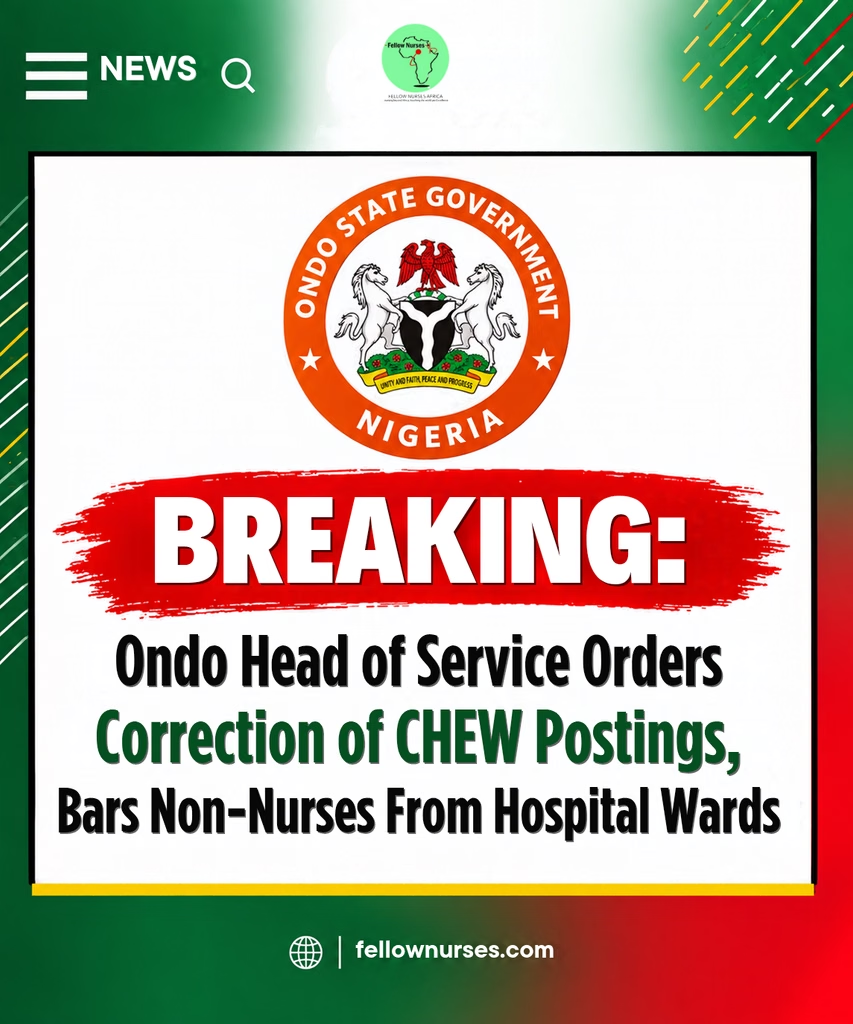
BREAKING: Ondo Head of Service Orders Correction of CHEW Postings, Bars Non-Nurses From Nursing Wards
FNA NEWS | 2 October 2026
The Ondo State Government has directed the correction of employment and posting arrangements considered inconsistent with the professional roles of nurses, midwives and Community Health Extension Workers (CHEWs) across health facilities under the State Hospitals Management Board (HMB).
The directive is contained in a circular dated 30 September 2026 and signed by the Ondo State Head of Service, Chief Segun Odusanya.
Titled “Correction of Lopsidedness in the Employment/Postings of Officers at Health Facilities in the State Hospitals Management Board (HMB),” the circular sets out a distinction between the qualifications, training and job responsibilities of nurses and midwives and those of CHEWs.
👉 Join Fellow Nurses Africa on WhatsApp
It also directs the relevant authorities to correct employment and posting arrangements that do not align with the provisions of the circular, which takes immediate effect.
The development is the latest turn in a dispute that has unfolded in Ondo State over the recruitment and deployment of CHEWs to secondary healthcare facilities.
Head of Service clarifies distinction between nurses and CHEWs
The circular states that nurses and midwives and Community Health Extension Workers have different qualifications, training and job specifications.
According to the document, nurses and midwives are appointed based on the requisite qualifications and registration with the Nursing and Midwifery Council of Nigeria (NMCN), while CHEWs are appointed based on recognised qualifications in Community Health.
The circular also distinguishes between the facilities where the two cadres are ordinarily posted.
It lists General Hospitals, Specialist Hospitals and Teaching Hospitals among facilities for nurses and midwives, while identifying health posts, Basic Primary Health Centres (PHCs) and Comprehensive Health Centres (CHCs) for CHEWs.
The document further states that nurses are trained to provide comprehensive nursing care and are legally authorised to take charge of wards and labour rooms, conduct deliveries and provide nursing care.
For CHEWs, the circular describes their role primarily in relation to preventive and community healthcare.
The distinction is significant because the controversy in Ondo has not simply been about whether CHEWs are qualified healthcare professionals. Community health advocates have maintained that CHEWs are recognised and regulated health professionals with a legitimate role in Nigeria’s health system, while nurses have raised concerns about their deployment to positions they consider nursing posts.
‘Non-Nurses should not be posted to Nursing duty post/ward’
The most significant provision in the new circular appears in paragraph four.
It states:
“By the provision of this Circular, Non-Nurses should not be posted to Nursing duty post/ward in Secondary facilities.”
The Head of Service subsequently directed the accounting officers of the relevant Ministries, Departments and Agencies to take note of the clarification and “effect necessary correction in the appointment and postings of these officials.”
The circular further states that it “takes immediate effect and supersedes any employment/posting that is inconsistent with this provision.”
In practical terms, the directive calls for a review and correction of posting arrangements where non-nursing personnel have been assigned to nursing duty posts or wards in secondary healthcare facilities.
The controversy that preceded the directive
The directive follows weeks of disagreement over the deployment of healthcare workers recruited by the Ondo State Government.
In September, the Ondo State Council of the National Association of Nigeria Nurses and Midwives (NANNM) raised concerns about what it described as the deployment of non-nursing personnel to nursing positions in secondary healthcare facilities.
NANNM said its objection was not directed at other healthcare professions but at what it described as the deployment of personnel outside their professional training, job descriptions and regulatory scope.
The association called for the withdrawal of non-nursing personnel allegedly occupying nursing duty posts, as well as a review of the recruitment and posting exercise.
👉 Join Fellow Nurses Africa on WhatsApp
The controversy subsequently drew a response from community health advocates, who argued that CHEWs have a legitimate role within the wider healthcare system and that their employment or deployment should not automatically be equated with replacing nurses.
The advocates called for professional respect, evidence-based workforce planning and clearer deployment arrangements.
Against that background, the latest circular provides a new administrative position from the office of the Head of Service.
Why the development matters
Healthcare systems depend on multiple professional cadres working together, but collaboration does not necessarily mean that every cadre performs the same duties.
The Ondo dispute has brought that distinction into sharp focus.
NANNM has framed the issue around professional boundaries and patient safety, arguing that nurses and midwives should be deployed where nursing and midwifery functions are required. Community health representatives, meanwhile, have argued for recognition of the role of CHEWs and a workforce-planning approach that does not treat one professional group as a threat to another.
The new directive moves the discussion from competing positions to an administrative instruction: non-nurses should not be posted to nursing duty posts or wards in secondary facilities.
The next question is how that instruction will be implemented.
What happens to CHEWs already posted to secondary facilities?
The circular directs accounting officers to make the necessary corrections to the CHEWS already posted to the wards, however, it does not set out, in the text cited above, a detailed timetable for each reassignment.
This leaves several practical questions unanswered.
What happens to CHEWs who have already received appointments or postings to secondary facilities?
Will affected personnel be reassigned to primary healthcare facilities or other appropriate roles?
How will the Hospitals Management Board review existing postings?
And will the government provide further clarification on the implementation of the directive?
Those questions are likely to shape the next stage of the Ondo dispute.
From professional disagreement to implementation
The Head of Service’s directive marks a significant development in a controversy that has raised broader questions about professional scope, recruitment, workforce planning and patient care.
For nurses and midwives, the circular provides an explicit administrative instruction concerning non-nurses occupying nursing duty posts and wards in secondary facilities.
For CHEWs and community health practitioners, the immediate issue is how the directive will affect existing appointments and postings, while preserving their legitimate professional functions elsewhere within the health system.
Ultimately, the wider workforce question remains one of ensuring that health facilities have the right professionals, with the appropriate training and competencies, deployed to roles that correspond with their professional responsibilities.
The implementation of the directive will therefore be closely watched by nurses, CHEWs, healthcare administrators and other stakeholders across Ondo State.
Fellow Nurses Africa will continue to monitor the response of the Ondo State Hospitals Management Board, NANNM, Community Health representatives and the state government as the directive takes effect.
👉 Join Fellow Nurses Africa on WhatsApp
Fellow Nurses Africa is the independent voice of African nursing, we educate, inform and support nurses across Africa.

Kehinde Oluwatosin is one of the many editors here at Fellow Nurses Africa and fellownurses.com.
He is a registered nurse with a Master of Science degree in healthcare leadership from the University of Hull, United Kingdom. Kehinde is passionate about advancing the nursing profession across Africa. As Co-Founder of Fellow Nurses Africa, he plays a key role in shaping editorial direction, ensuring our content educates, informs, and empowers nurses continent-wide.
With expertise in leadership, patient flow, and healthcare operations, Kehinde brings valuable insights to nursing news, career development, and policy discussions. He is committed to amplifying the voice of African nurses and driving positive change in the profession.