
FNA News | Breaking News| Kogi State, Nigeria| 16th November, 2026.
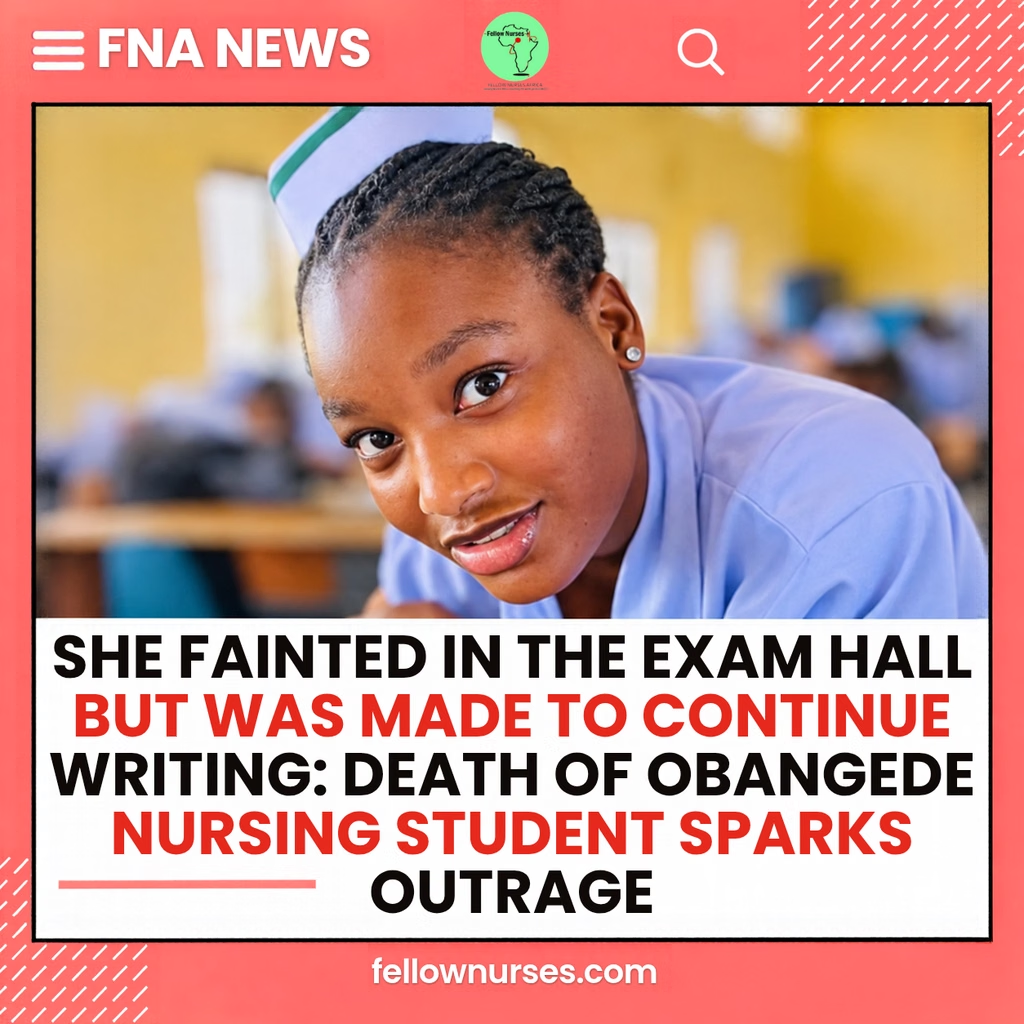
She Fainted in the Exam Hall but Was Made to Continue Writing: Death of Kogi Nursing Student Sparks Outrage
By FNA News Desk | 16 November 2026
The death of Adewumi Ayomide Elizabeth, a 20-year-old nursing student at the Kogi State College of Nursing Sciences, Obangede, has sparked outrage and renewed calls for accountability following reports that she collapsed during an examination but was made to continue writing despite being seriously ill.
Details of the incident obtained by Fellow Nurses Africa (FNA) paint a disturbing picture of a young woman battling a worsening illness while facing the demands of her academic examinations.
Elizabeth, who was preparing for her First Year, Second Semester Promotion Examination, reportedly fell ill on 8 November 2026, a day before the examinations commenced.
According to an account provided by one of her friends, she was rushed to the school’s sick bay for medical attention. However, the facility reportedly lacked essential medications and medical supplies, forcing her colleagues to purchase some of the items needed for her treatment.
Despite her condition, Elizabeth continued preparing for her examinations, which began on 9 November.
👉 Join Fellow Nurses Africa on WhatsApp
The friend said she was being managed with intravenous normal saline, but her health did not improve.
What happened next has become central to growing concerns about student welfare at the institution.
She fainted, but the examination continued
Elizabeth reportedly collapsed during one of her examinations after struggling with her illness.
Rather than being excused from the examination to receive further medical attention, her examination paper was allegedly brought to her so she could continue writing.
“During one of the examinations, she actually fainted,” her friend recounted.
“Yet, instead of allowing her to rest and receive urgent medical attention, her examination paper was still taken to her for her to continue writing.”
The account further revealed that the class representative pleaded with the examiner to allow Elizabeth to take the examination on another day because of her deteriorating health.
The appeal reportedly failed.
The circumstances have raised troubling questions about the treatment of sick students and the extent to which academic requirements are allowed to take precedence over medical emergencies.
How does a student collapse during an examination and still face pressure to complete the paper?
What emergency procedures are available when a student becomes critically ill during an academic assessment?
And should a nursing institution, where students are trained to recognise clinical deterioration and respond to emergencies, allow examination requirements to interfere with urgent medical attention?
From school sick bay to FMC Lokoja
As Elizabeth’s condition worsened, her mother reportedly arrived at the institution, after which she was taken to a general hospital.
She was subsequently referred to the Federal Medical Centre (FMC), Lokoja, where she was reportedly diagnosed with malaria and sepsis.
Sepsis is a life-threatening medical emergency that develops when the body’s response to an infection causes organ dysfunction. Without timely recognition and treatment, it can rapidly become fatal.
Sadly, Elizabeth did not survive.
Her death has left her colleagues grieving and intensified concerns about the healthcare arrangements available to students in nursing training institutions.
For her friends, what began as an illness shortly before an examination ended in an unimaginable tragedy.
“We have lost a student, a friend, and a life that mattered,” her friend said.
Former student breaks silence, demands justice
A registered nurse who identified themselves as a former student of the institution has also spoken out, calling for a comprehensive investigation into Elizabeth’s death and the institution’s approach to student welfare.
In a statement received by FNA, the former student criticised the normalisation of practices that allegedly place academic demands above students’ health.
“Are we saying that because certain practices existed before our admission, they should continue indefinitely?” the former student asked.
“Are we saying that because previous generations experienced the same treatment, the next generation must endure it?”
The statement questioned the reported practice of pressuring students to sit examinations regardless of their medical condition.
It also raised concerns about the adequacy of healthcare facilities within the institution and the treatment of students who become seriously ill during their training.
“Nursing is a profession built on humanity,” the former student said.
“We are taught to preserve life, protect human dignity, advocate for patients, recognise deterioration, respond to emergencies and provide compassionate care.”
The former student challenged the contradiction between the principles taught in nursing classrooms and the experiences reportedly faced by students when they themselves become patients.
“How do we teach compassion in the classroom and potentially fail to demonstrate it towards students who become patients themselves?”
Sick bay facilities and examination practices under scrutiny
The death has brought two major issues into focus: the standard of healthcare available to nursing students and the treatment of those who become medically unfit during examinations.
👉 Join Fellow Nurses Africa on WhatsApp The allegation that students had to purchase basic medical supplies for Elizabeth’s treatment raises concerns about the preparedness of the institution’s sick bay.
A nursing training institution should have clear arrangements for assessing sick students, recognising emergencies, accessing essential treatment and ensuring timely referral when a student’s condition exceeds the capacity of its healthcare facilities.
Equally concerning are the claims surrounding Elizabeth’s examination experience.
A student who collapses during an examination requires prompt medical assessment, not pressure to meet academic expectations.
Examination regulations are important, but they must make provision for medical emergencies, including the postponement of assessments when a student is unfit to participate.
For nursing students, who are expected to uphold patient safety and advocate for those in their care, such protection should be fundamental to the learning environment.
Calls for Kogi Government, NMCN to intervene
The incident has triggered demands for the Kogi State Government and relevant regulatory authorities to investigate the circumstances surrounding Elizabeth’s death.
In the statement received by FNA, the former student called on the Kogi State Commissioner for Health, the state governor, the Nursing and Midwifery Council of Nigeria (NMCN), the National Human Rights Commission and the Kogi State House of Assembly to take an interest in the matter.
The demands include an independent investigation into the medical care Elizabeth received, a review of the college’s sick bay facilities, an examination of the decisions taken during her illness and an assessment of policies governing examinations for medically unfit students.
The former student also urged current and former students to speak about their experiences and preserve relevant evidence.
“We are not asking for the destruction of an institution. We are asking for the protection of the people within it,” the statement read.
“We are not asking for the abolition of discipline. We are asking for discipline with humanity.”
The statement stressed that the pursuit of accountability should not become an excuse for personal attacks or unsubstantiated accusations.
A nursing school must practise what it teaches
Elizabeth’s death raises serious concerns that extend beyond one institution.
Nursing education is built around patient safety, compassion, clinical judgement and the protection of human life.
Students spend years learning to identify deteriorating patients, recognise medical emergencies and escalate concerns before preventable harm occurs.
Those principles should not end at the classroom door.
When students become ill, they deserve the same urgency, dignity and professional care they are being trained to provide to others.
Academic excellence and discipline remain essential to nursing education. However, neither should be pursued at the expense of appropriate medical care.
The reported circumstances surrounding Elizabeth’s illness demand a thorough examination of the institution’s healthcare arrangements and academic practices, with accountability for any shortcomings established.
A promising nursing career cut short at 20
At just 20 years old, Adewumi Ayomide Elizabeth was pursuing a career in a profession dedicated to saving lives.
Instead of continuing her training and preparing for the responsibilities of professional nursing, her family and colleagues are now mourning her death.
Her story has become a painful reminder of the importance of student welfare, particularly in institutions responsible for training future healthcare professionals.
The Kogi State College of Nursing Sciences and the relevant authorities now face important questions about the circumstances leading to her death and whether existing systems provide adequate protection for students experiencing medical emergencies.
For Fellow Nurses Africa, the central issue is clear: no examination should take priority over a medical emergency, and no student should be made to choose between protecting their health and progressing academically.
The circumstances surrounding Elizabeth’s death deserve an independent and transparent investigation, followed by appropriate action wherever failures are established.
A young life has been lost. Her family deserves answers, her colleagues deserve reassurance, and future nursing students deserve a learning environment where their health and safety are protected.
Fellow Nurses Africa extends its condolences to Elizabeth’s family, friends and colleagues.
FNA News will continue to follow developments surrounding the incident.
👉 Join Fellow Nurses Africa on WhatsApp
Fellow Nurses Africa is the independent voice of African nursing, we educate, inform and support nurses across Africa.

Kehinde Oluwatosin is one of the many editors here at Fellow Nurses Africa and fellownurses.com.
He is a registered nurse with a Master of Science degree in healthcare leadership from the University of Hull, United Kingdom. Kehinde is passionate about advancing the nursing profession across Africa. As Co-Founder of Fellow Nurses Africa, he plays a key role in shaping editorial direction, ensuring our content educates, informs, and empowers nurses continent-wide.
With expertise in leadership, patient flow, and healthcare operations, Kehinde brings valuable insights to nursing news, career development, and policy discussions. He is committed to amplifying the voice of African nurses and driving positive change in the profession.
 ✓
Did you know that we're the accredited ReMar NCLEX Training Centre in Nigeria with Prof. Regina Callion?
Prepare and pass your NCLEX-RN / NCLEX-PN with official ReMar Review curriculum, Regina Callion video lectures, Quick Facts, and dedicated clinical mentorship right here in Nigeria.