Nigeria’s Patient’s Bill of Rights Raises a Bigger Question: Who Protects Healthcare Workers?
FNA NEWS, 14th OF October, 2026
The alleged stabbing of a medical laboratory scientist at FMC Abeokuta, following an earlier doctors’ strike over security concerns, has renewed questions about workplace violence, staff protection and accountability in Nigeria’s hospitals.
👉 Join Fellow Nurses Africa on WhatsApp
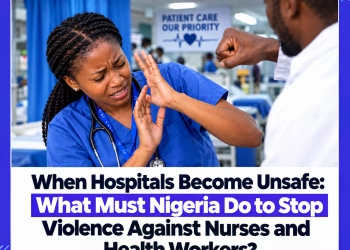
Healthcare workers enter hospitals to care for patients, manage emergencies and save lives. Yet, for some, the workplace has become a source of concern about their own safety.
The alleged stabbing of a medical laboratory scientist at the Federal Medical Centre (FMC), Idi-Aba, Abeokuta, Ogun State, has brought this concern into sharp focus. The incident triggered a 72-hour warning strike by healthcare workers and renewed calls for stronger security within the hospital.
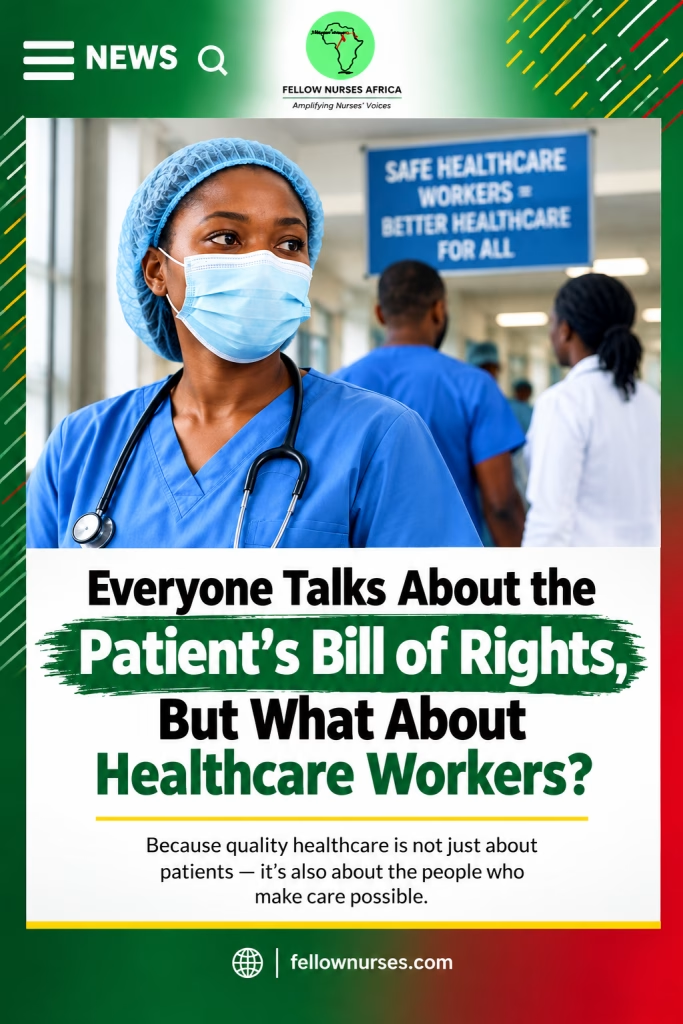
But the incident raises a question that extends beyond one hospital: while Nigeria continues to emphasise patients’ rights, how effectively are the rights and safety of healthcare workers being protected?
The question is particularly significant because the latest incident followed a separate five-day warning strike by resident doctors at the same facility in September over unresolved welfare and security concerns, including alleged assaults on healthcare workers.
Together, the two incidents have drawn attention to the need for practical, measurable safeguards against violence in healthcare facilities.
A stabbing incident followed by industrial action
Healthcare workers at FMC Abeokuta began a 72-hour warning strike on 12 October 2026 following the reported stabbing of medical laboratory scientist Lawal Toheeb Olasunkanmi by a patient’s relative.
The incident reportedly occurred on 11 October while the scientist was on duty. According to the Medical and Health Workers’ Union of Nigeria, the worker sustained stab wounds, including to the head, and was receiving treatment at the hospital.
The Joint Action Committee of health-sector unions condemned the reported attack and called for accountability, support for the injured worker and stronger security arrangements within the facility. The strike was scheduled to end at 8 a.m. on Thursday, 15 October.
The Federal Ministry of Health and Social Welfare also condemned the incident. The Minister of State for Health, Dr Iziaq Adekunle Salako, called for the arrest and prosecution of the alleged assailant in accordance with the law.
The ministry further urged hospital management to strengthen security and ensure that the injured worker received appropriate care and support.
As of the ministry’s statement on 12 October, the case remained subject to investigation and the alleged assailant had not been identified in the statement as having been arrested.
The incident is not an isolated reminder of the security challenges healthcare workers may face. In September, resident doctors at FMC Abeokuta embarked on a separate five-day warning strike, citing alleged assaults, inadequate security personnel, poor lighting and concerns about unrestricted access to the Emergency Treatment Room.
The Association of Resident Doctors called for improved access control, functional surveillance cameras, adequate security personnel and better lighting in vulnerable areas of the hospital.
Although the two strikes involved different groups of workers and separate incidents, their overlapping security concerns raise questions about the adequacy and implementation of protective measures within the facility.
The Patient’s Bill of Rights: What about healthcare workers?
👉 Join Fellow Nurses Africa on WhatsApp
Nigeria’s Patient’s Bill of Rights provides a framework for protecting patients’ interests in healthcare settings. These include access to relevant information, dignity, privacy, appropriate care and mechanisms for making complaints.
These protections are essential. Patients and their families must be able to ask questions, raise concerns about treatment and seek explanations when services fall short of expectations.
However, protecting patients does not require healthcare workers to accept abuse, intimidation or physical violence.
Healthcare professionals also have legitimate interests in personal safety, dignity, fair treatment and the ability to perform their duties without threats or assault. These interests are supported by existing legal and institutional protections, although they do not necessarily amount to a single, comprehensive national healthcare-worker bill of rights.
The distinction matters. A patient who believes that care has been delayed, a diagnosis has been mishandled or a member of staff has acted inappropriately should have access to a clear complaints process. Such concerns should be investigated fairly and addressed through established procedures.
Violence, however, is not an acceptable substitute for a complaint.
Equally, healthcare workers must remain accountable for their professional conduct. Respect for staff safety does not remove the obligation to provide appropriate care, communicate respectfully or respond to legitimate patient concerns.
A safe healthcare environment requires both sides to be protected by clear rules, fair processes and appropriate accountability.
Government has announced measures to protect health workers
The Federal Government has already acknowledged the need for stronger protection of healthcare workers.
On 5 August 2026, the Federal Ministry of Health and Social Welfare announced measures following a review by a ministerial committee examining the harassment and assault of health workers.
According to the ministry, the committee identified 18 reported incidents of assault, intimidation or harassment across federal tertiary health institutions during the preceding 12 months. The reported incidents involved patients, relatives, members of the public and security personnel.
The government directed federal tertiary health institutions to strengthen internal security, improve visitor identification and access control, enhance surveillance and establish violence-prevention teams.
The directive also required institutions to promptly report, investigate and document incidents of assault, threats and harassment. Affected workers were to receive appropriate institutional support, while serious cases were to be referred to relevant law-enforcement or other authorities.
The government further stated that the absence of a law dealing exclusively with violence against healthcare workers would not prevent action under applicable criminal, civil or administrative laws.
These measures represent an important policy commitment. However, their effectiveness depends on implementation.
The incidents reported at FMC Abeokuta make it important to establish which safeguards were already in place, whether identified security gaps had been addressed and what additional measures are now being introduced.
The available public statements do not, by themselves, establish whether the hospital had fully implemented the August directives before the reported stabbing.
What should hospitals do to protect healthcare workers?
👉 Join Fellow Nurses Africa on WhatsApp
Protecting healthcare workers requires more than condemning attacks after they occur. It requires a practical system for preventing violence, responding to threats and supporting affected staff.
Hospitals should conduct regular security assessments, particularly in emergency departments, laboratories, payment areas and other locations where staff may be exposed to confrontation.
Access to clinical areas should be controlled without creating unnecessary barriers to urgent care. Visitor identification, clear entry procedures, functional surveillance systems, adequate lighting and appropriately trained security personnel can help reduce risks and support investigations when incidents occur.
Hospitals also need clear procedures for reporting threats and assaults. Staff should know whom to contact, how to document an incident and what support is available. Reports should be taken seriously, investigated promptly and referred to the appropriate authorities when necessary.
Support must extend beyond physical treatment. Healthcare workers who experience violence may require psychological support, time to recover and assistance navigating institutional or legal procedures.
At the same time, hospitals should strengthen communication with patients and their families. Long waiting times, distressing news, overcrowding and uncertainty can increase tension, although none of these circumstances excuses violence. Clear explanations, accessible complaint channels and appropriate de-escalation procedures can help prevent some conflicts from escalating.
These interventions should be supported by measurable targets, designated responsibilities and regular reviews. Announcing a policy is only the first step; institutions must be able to demonstrate what has changed.
The cost of unsafe hospitals extends beyond staff
Workplace violence is not solely an employment or industrial-relations issue. It can affect the wider delivery of healthcare.
When staff members are injured, frightened or unable to work safely, hospitals may experience disruption, reduced workforce availability and strained relationships between workers and management.
Industrial action can also affect patients who depend on timely investigations, treatment and other essential services.
This creates a difficult situation in which patients may suffer from service interruptions while healthcare workers demand protection from conditions they consider unsafe.
The solution cannot be to dismiss staff concerns because patients need care. Nor can it be to overlook the consequences of industrial action for patients.
Hospital management, government authorities, healthcare unions and security agencies must work towards arrangements that protect staff while preserving access to essential services.
The goal should be to prevent violence before it occurs, respond fairly when it does and ensure that legitimate complaints can be resolved without threats or physical attacks.
Protecting healthcare workers is part of protecting patients
The debate over patients’ rights must not become a contest between patients and healthcare professionals. Both depend on a healthcare system that is safe, respectful and accountable.
Patients deserve appropriate treatment, clear communication and a fair process for resolving complaints. Healthcare workers deserve protection from violence, access to institutional support and the ability to carry out their duties without fear of physical assault.
Neither set of interests should be treated as less important.
The reported stabbing at FMC Abeokuta, following an earlier strike over security concerns, presents an opportunity to move beyond expressions of condemnation towards verifiable action.
Hospitals must strengthen prevention and response systems. Government authorities must monitor implementation of existing directives. Security agencies must investigate reported offences appropriately, and institutions must support workers who experience violence.
A hospital cannot fulfil its purpose if the people responsible for delivering care are left vulnerable to preventable harm.
Patients have rights. Healthcare workers have rights, too. Protecting both is essential to a safe and functional healthcare system.
👉 Join Fellow Nurses Africa on WhatsApp
Fellow Nurses Africa is the independent voice of African nursing, we educate, inform and support nurses across Africa.

Durowoju Abisola is a registered nurse, nurse writer and On-Air Correspondent at Fellow Nurses Africa (FNA), passionate about nursing leadership, health education and advocacy.
Through journalism, storytelling and content creation, she amplifies important conversations around nursing, healthcare and the experiences of nurses in Nigeria. She is committed to using her voice and professional knowledge to educate the public, challenge misconceptions and inspire the next generation of nurses.