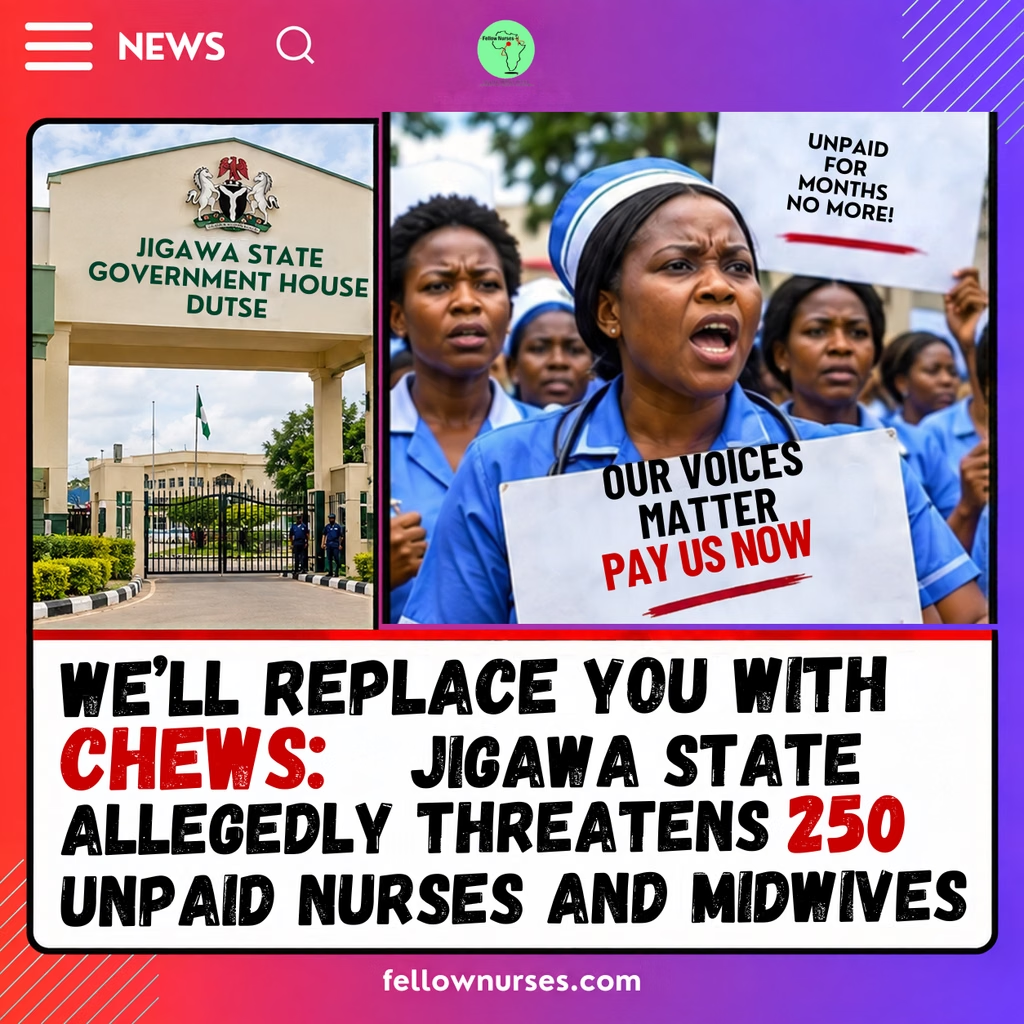
“We’ll Replace You with CHEWs”: Jigawa State Allegedly Threatens 250 Unpaid Nurses and Midwives
By FNA News, Dutse 23 September 2026
About 250 nurses and midwives working in primary healthcare facilities across Jigawa State say they have not received their July 2026 salaries and have raised concerns over different amounts reportedly paid to workers in August.
The workers also allege that they were warned during a meeting with a human resources official that Community Health Extension Workers (CHEWs) could be recruited and deployed to replace them if they continued to pursue their complaint.
The affected workers spoke to FNA on condition of anonymity, citing concerns about possible repercussions. FNA reviewed copies of their group complaint, appointment documents and an account of their subsequent meeting with the human resources office.
‘We worked in July. That month has not come’
The nurses and midwives said they were part of a group of about 250 workers initially engaged through an arrangement linked to GAVI support for primary healthcare services in Jigawa.
They said they initially received a monthly allowance of ₦70,000.
In April 2026, the workers said they were invited to complete the process of transitioning into the state workforce. They said they signed government appointment documents and had official personnel files opened.
👉 Join Fellow Nurses Africa on WhatsApp
According to the workers, their appointment letters indicate Grade Level 07.
Despite the transition, they said the ₦70,000 payment continued for some months.
The workers allege that they received no salary for July, despite continuing to report for duty.
August payments were also reportedly different. Some workers received approximately ₦111,000, while others received around ₦122,000.
The workers said they have not received a clear explanation for the difference.
“We are not asking for anything beyond what is written in the letters we signed,” one of the midwives, who asked to be identified as Aisha, told FNA. “We worked in July. That month has not come.”
Complaint followed by meeting
On 8 September 2026, representatives of the affected workers submitted a formal complaint concerning their outstanding salaries and employment terms.
Two days later, on 10 September, representatives of the group visited the human resources office of the Jigawa State Primary Health Care Development Agency (JSPHCDA) to follow up.
According to an account of the meeting seen by FNA, an official received the complaint and acknowledged receipt.
The workers say it was during this meeting that the possibility of replacing them with CHEWs was raised.
‘We’ll replace you with CHEWs’
According to the workers’ account, the official questioned why they had submitted the complaint without first informing their managers.
They said they were told they should appreciate the opportunity to work in Jigawa and were warned about escalating their concerns to senior government authorities.
The workers further alleged that the official referred to recruiting and training CHEWs who could be posted to their facilities in their place.
The remarks, according to the workers, left members of the group concerned that continuing to pursue their salary complaint could put their positions at risk.
The meeting ended without a resolution on the outstanding payments, according to the workers.
Ondo controversy puts the issue in the spotlight
The allegation comes as a similar professional dispute is unfolding in Ondo State, where the recent posting of CHEWs to general hospitals has drawn opposition from nurses and midwives.
The Ondo State Council of the National Association of Nigeria Nurses and Midwives (NANNM) has objected to the alleged deployment of non-nursing personnel to positions it says are intended for nurses and midwives. The association argues that healthcare workers should be deployed according to their professional training, qualifications and scope of practice.
The Ondo State Hospitals Management Board has maintained that the CHEW postings stand, while community health practitioners have defended the role of CHEWs in the health system.
The debate highlights an important principle in healthcare: different professional cadres have different training, competencies and scopes of practice.
CHEWs have an important role in community and primary healthcare. That role should not be diminished.
But neither should the training and responsibilities of nurses and midwives be blurred by using another cadre as a substitute for professional nursing or midwifery duties.
Where a post requires nursing or midwifery competencies, staffing decisions should reflect the qualifications and scope of practice required for that role.
Ultimately, this is about more than professional boundaries. It is about patient safety, appropriate staffing and ensuring that patients receive care from professionals trained for the duties they are expected to perform.
Jigawa still faces health-worker gaps
The issue is particularly significant in Jigawa, where the state’s 2026 Human Resources for Health Gap and Recruitment Plan identifies continuing workforce needs.
The plan projects a requirement for 605 nurses and midwives against 509 available personnel, leaving a gap of 96 workers in the category.
For rural communities, nurses and midwives remain central to antenatal care, skilled birth attendance, newborn care, health education and other essential services.
The workers want answers
The affected workers say their demands are straightforward: payment of their outstanding July salary, settlement of any outstanding August payments and clarity over the salary attached to their Grade Level 07 appointments.
They also want an explanation for the different amounts reportedly paid to workers who hold the same stated grade.
For many of them, the dispute is now about more than money.
It is about whether frontline health workers can raise concerns about their employment without fear, and whether professional roles will be respected as governments respond to healthcare workforce shortages.
The workers say they remain committed to their duties and want a resolution that allows them to continue serving patients and communities with confidence.
👉 Join Fellow Nurses Africa on WhatsApp
Fellow Nurses Africa is the independent voice of African nursing. We educate, inform, and support the nursing profession.

Charles Wealth is an accomplished healthcare administrator with decades of hands-on experience across various healthcare organizations in Nigeria and beyond. Known for his strategic leadership, operational excellence, and deep commitment to advancing the nursing profession, Charles brings a wealth of expertise to healthcare management, policy, and professional development.
As a co-founder and Editor at Fellow Nurses Africa, he plays a pivotal role in shaping content that educates, inspires, and unites nurses across the continent. His editorial vision focuses on amplifying the voices of nurses, highlighting best practices, addressing contemporary challenges in healthcare, and promoting professional growth within the nursing community.
With a strong background in healthcare administration, Charles is passionate about bridging the gap between clinical practice and effective leadership. He continues to contribute significantly to the development of robust healthcare systems and the empowerment of nurses through knowledge sharing and advocacy.