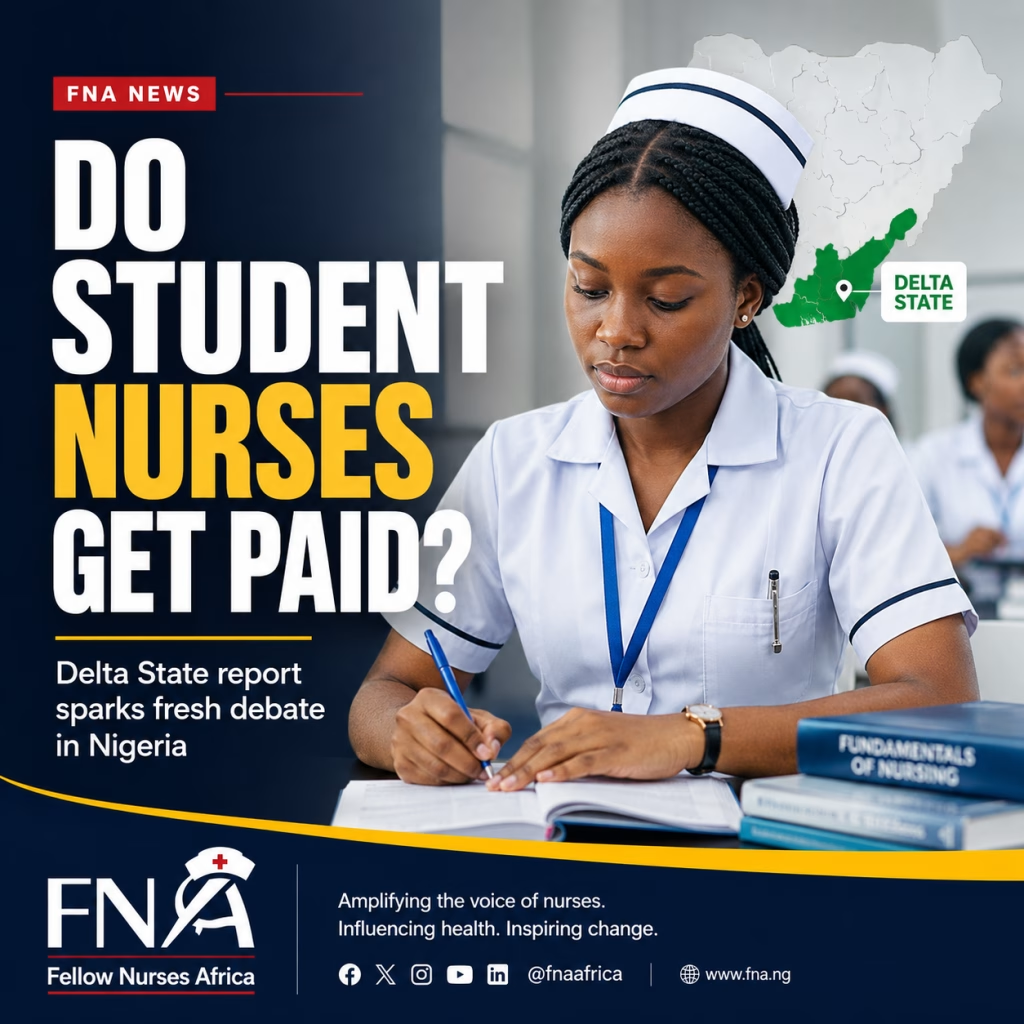
Do Student Nurses Get Paid? Delta State Report Sparks Fresh Debate in Nigeria
FNA NEWS,28th of August 2026
Reports of financial support for student nurses in Delta State have renewed a wider debate about whether governments should help fund the training of Nigeria’s future nurses.
👉 JOIN FNA NEWS https://whatsapp.com/channel/0029Vb5pewm8aKvTTHLmWn2L
For many student nurses in Nigeria, becoming a registered nurse comes with significant financial demands.
There are school fees, accommodation, transport, uniforms, textbooks and clinical requirements. Students must also balance demanding academic work with long hours of clinical training.
Against this background, reports that student nurses in Delta State receive financial support have attracted attention among nursing students and professionals online.
But while individual student accounts have helped bring the issue into the spotlight, the exact amount, eligibility requirements and payment structure of the reported Delta State support require clearer official confirmation.
The broader idea, however, is not new.
Government support for student nurses is not new
Financial support for health students has existed in different forms in Nigeria.
👉 JOIN FNA NEWS https://whatsapp.com/channel/0029Vb5pewm8aKvTTHLmWn2L
Research into health-worker training in the country has documented government-funded allowances for some nursing, midwifery and community health students.
Historical records have also documented cases in which student nurses were employed by state governments and received salaries or allowances during their training.
More recently, Yobe State approved a monthly allowance for student nurses and midwifery students. In 2022, the state announced a ₦10,000 monthly allowance for 167 student nurses. The programme was later expanded to include more students.
These examples show that supporting students during health-worker training is not an entirely new concept in Nigeria.
What about Delta State?
Delta State already has established mechanisms for supporting students.
The Delta State Bursary and Scholarship Board provides financial assistance to eligible indigenes studying in approved institutions through bursary and student-assistance programmes.
The state also provides funding for its Schools of Nursing in Warri, Agbor and Eku, as well as its Schools of Midwifery.
However, funding nursing institutions is different from paying individual students.
That distinction is important.
At present, reports from students provide an indication that some form of financial support may be available, but the public needs clear information from the relevant state authorities about the programme.
That should include who qualifies, how much students receive, how often payments are made and whether the support applies to all nursing students or only specific categories.
Why student nurse support matters
The cost of nursing education can place considerable pressure on students and their families.
For students from low-income households, the cost of travelling to clinical placements or paying for accommodation can become a serious barrier to completing training.
A structured allowance would not remove these challenges completely.
But it could provide meaningful support while students prepare for a profession that is essential to Nigeria’s healthcare system.
Nurses provide care across hospitals, primary healthcare centres, maternity units, emergency departments and communities.
Supporting their education can therefore be viewed as an investment in the future health workforce.
Other states could learn from the conversation
Nigeria’s shortage of healthcare workers has made workforce development an important policy issue.
States that invest in nursing education could consider whether financial assistance should form part of that investment.
Such programmes could be designed with clear eligibility requirements and transparent funding.
Governments could also consider linking sponsorship to opportunities for graduates to serve within the state’s healthcare system, where appropriate.
This could help students financially while also supporting efforts to retain trained nurses.
But sustainability is critical.
A stipend announced without reliable funding could create expectations that governments may struggle to meet.
For that reason, any state introducing such a programme should publish clear guidelines and maintain transparent payment systems.
A bigger question for Nigeria
The conversation surrounding Delta State goes beyond one state.
It raises a broader question about how Nigeria prepares and supports the healthcare workers it will need in the future.
Student nurses are still in training, but they represent the next generation of professionals who will care for patients across the country.
If governments want stronger health systems, investing in their education deserves serious consideration.
The question may therefore not simply be whether Delta State pays student nurses.
It may be:
How many more Nigerian states are willing to invest in the nurses of tomorrow?
👉 JOIN FNA NEWS https://whatsapp.com/channel/0029Vb5pewm8aKvTTHLmWn2L
- Fellow Nurses Africa is the independent voice of African nursing, we educate, inform and support nurses across Africa.*

Durowoju Abisola is a registered nurse, nurse writer and On-Air Correspondent at Fellow Nurses Africa (FNA), passionate about nursing leadership, health education and advocacy.
Through journalism, storytelling and content creation, she amplifies important conversations around nursing, healthcare and the experiences of nurses in Nigeria. She is committed to using her voice and professional knowledge to educate the public, challenge misconceptions and inspire the next generation of nurses.