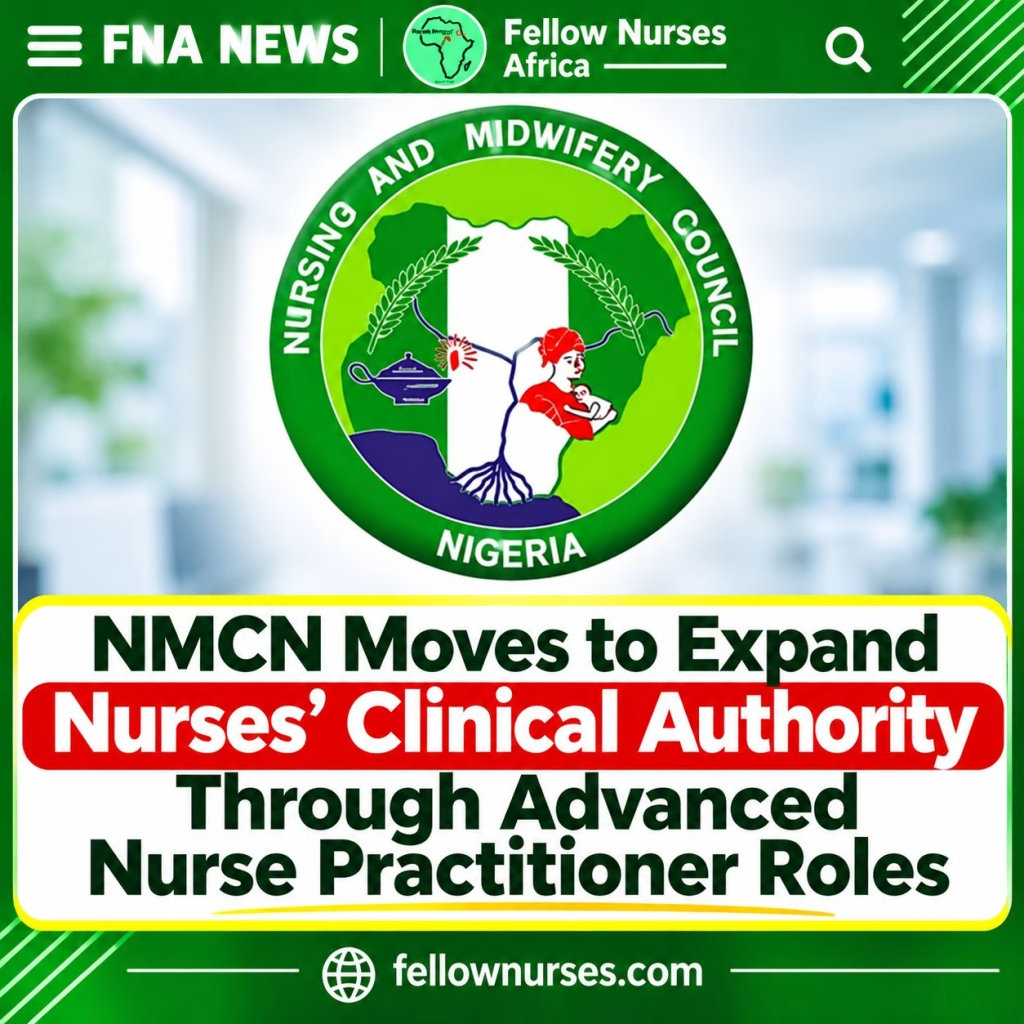
NMCN Moves to Expand Nurses’ Clinical Authority Through Advanced Nurse Practitioner Roles
FNA NEWS, 28th Of November, 2026
The Nursing and Midwifery Council of Nigeria (NMCN) is developing plans to introduce Advanced Nurse Practitioners (ANPs) as part of efforts to address healthcare manpower challenges, expand access to specialised care and reduce pressure on tertiary hospitals.
👉 Join Fellow Nurses Africa on WhatsApp
The proposed initiative is expected to equip qualified nurses with advanced clinical competencies, including patient assessment, interpretation of diagnostic investigations, management of selected health conditions and prescription of medications within approved legal limits.
The Registrar and Chief Executive Officer of the NMCN, Dr Ndagi Alhassan, disclosed this at the 3rd Institute of Nursing Research Nigeria Conference.
Speaking on “Advancing Evidence-Based Practice Through Higher Education and Skills: NMCN Plans for Advanced Nurse Practitioner Roles”, Alhassan explained that the initiative would strengthen healthcare delivery, particularly in rural and underserved communities.
According to him, the proposed advanced nursing roles could improve access to specialised services, reduce avoidable referrals and ease congestion in teaching hospitals.
NMCN outlines plans for advanced nursing practice
The Council’s proposed framework seeks to establish a structured pathway for nurses to acquire advanced clinical knowledge and specialised competencies.
Alhassan disclosed that the foundation for introducing advanced nursing practice in Nigeria was laid through legislative and ministerial approvals secured in 2022 under his predecessor, Dr Farouk Abubakar.
He added that the Council had engaged the National Universities Commission (NUC) and worked with nursing scholars to develop a concept note that would guide the proposed academic programmes.
Under the proposed arrangement, universities interested in offering the programmes would be required to establish appropriate academic and clinical training structures.
These would include qualified teaching personnel, adequate learning facilities and partnerships with hospitals to support practical training.
The Council also plans to develop national competency standards to guide the education, training and practice of Advanced Nurse Practitioners.
Other proposed measures include simulation-based training centres across Nigeria’s six geopolitical zones, an electronic skills laboratory and an e-library to support nursing education and professional development.
What the proposed Advanced Nurse Practitioner role means for healthcare delivery
👉 Join Fellow Nurses Africa on WhatsApp
Advanced Nurse Practitioners are nurses with additional education, specialised clinical training and competencies that allow them to undertake more complex aspects of patient care within a defined scope of practice.
Depending on the approved regulatory framework, their responsibilities may extend beyond conventional nursing duties to include advanced patient assessment, clinical decision-making, management of selected conditions and prescribing within authorised limits.
For Nigeria, the proposed introduction could provide an opportunity to strengthen healthcare services beyond tertiary institutions.
Primary and secondary healthcare facilities, particularly those in rural communities, often face challenges accessing specialised medical services. Developing advanced nursing roles could help bridge some of these gaps by making more skilled clinical services available closer to where patients live.
It could also support more efficient referral systems, allowing patients with conditions that can be managed within an authorised scope of practice to receive appropriate care without unnecessary transfers to tertiary hospitals.
However, the success of this model will depend on clearly defined professional boundaries, appropriate training, clinical supervision and effective collaboration among healthcare professionals.
NMCN calls for collaboration rather than professional rivalry
Alhassan emphasised that the proposed initiative was designed to strengthen healthcare delivery rather than create competition among health professionals.
He called for stronger collaboration between universities, hospitals and other relevant institutions to ensure that the proposed programmes meet the required academic and clinical standards.
This position is particularly important as healthcare delivery increasingly requires multidisciplinary collaboration.
Advanced nursing practice should be developed around patient safety, clearly defined responsibilities and complementary professional expertise.
For the initiative to achieve its objectives, stakeholders must establish clear guidelines on clinical responsibilities, prescribing authority, referral procedures, accountability and professional regulation.
Workforce shortages remain a major concern
👉 Join Fellow Nurses Africa on WhatsApp
The proposed introduction of Advanced Nurse Practitioners comes amid continuing concerns about Nigeria’s healthcare workforce, including nursing shortages, migration, poor workforce distribution and inadequate healthcare infrastructure.
At the conference, Alhassan disclosed that more than 36,000 candidates sat for the November nursing examination, compared with the previous range of approximately 18,000 to 20,000.
The increase followed expanded admission quotas across nursing training institutions.
However, he identified migration, inadequate infrastructure, funding limitations, poor workforce distribution and a shortage of qualified clinical supervisors as major challenges facing the profession.
These concerns highlight an important distinction: increasing the number of trained nurses does not automatically translate into improved staffing across healthcare facilities.
Employment opportunities, retention, adequate remuneration and equitable workforce distribution remain essential to addressing Nigeria’s healthcare manpower challenges.
👉 Join Fellow Nurses Africa on WhatsApp
Fellow Nurses Africa is the independent voice of African nursing, we educate, inform and support nurses across Africa.

Durowoju Abisola is a registered nurse, nurse writer and On-Air Correspondent at Fellow Nurses Africa (FNA), passionate about nursing leadership, health education and advocacy.
Through journalism, storytelling and content creation, she amplifies important conversations around nursing, healthcare and the experiences of nurses in Nigeria. She is committed to using her voice and professional knowledge to educate the public, challenge misconceptions and inspire the next generation of nurses.
 ✓
Did you know that we're the accredited ReMar NCLEX Training Centre in Nigeria with Prof. Regina Callion?
Prepare and pass your NCLEX-RN / NCLEX-PN with official ReMar Review curriculum, Regina Callion video lectures, Quick Facts, and dedicated clinical mentorship right here in Nigeria.