
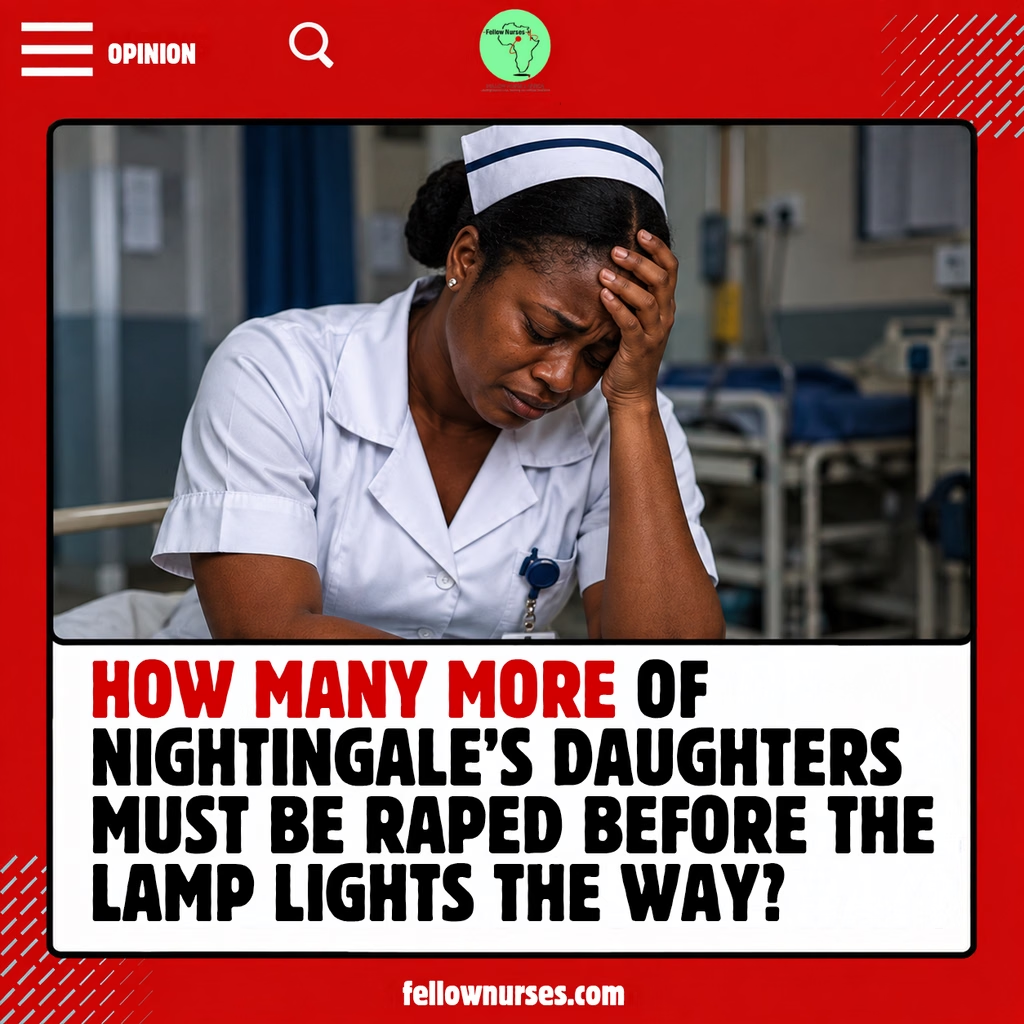
How Many More of Nightingale’s Daughters Must Be Raped Before the Lamp Lights the Way?
Kenny Oluwatosin RN Msc, for Fellow Nurses Africa
21st September, 2026.
There is something deeply unsettling about a nursing student being afraid to sleep.
These are young women being trained to care for patients at their most vulnerable. They learn how to monitor a dying patient, administer medicines, respond to emergencies and hold the hands of strangers in moments of fear.
Yet, for some, the simple act of returning to their hostel at night has become a risk in itself.
On Monday, students of the Taraba State College of Nursing Sciences in Jalingo took to the streets and blocked the entrance to their institution after an overnight attack on a female hostel located outside the college premises.
According to multiple reports, suspected hoodlums invaded the hostel, stole phones and other valuables and allegedly sexually assaulted a female student. The student was also reportedly seriously injured, including the loss of a finger. Police confirmed that the hostel was burgled but said they had not independently confirmed the rape allegation at the time of reporting.
For the students, however, the fear is not theoretical.
They say it is the second attack on student accommodation within two weeks.
And that is where this story becomes bigger than one hostel, one college or one terrible night.
👉 Join Fellow Nurses Africa on WhatsApp
It becomes a question about what we owe the young women we are training to care for the nation.
The Lamp That Was Meant to Light the Way
Florence Nightingale carried a lamp through the dark corridors of the Crimean War, becoming an enduring symbol of nursing, compassion and care.
More than a century later, the image remains powerful.
The lamp represents something larger than a profession. It represents the willingness to enter places of fear and uncertainty to care for another human being.
But what happens when the women carrying that legacy cannot find safety in their own rooms?
What happens when the people being trained to protect life are left wondering whether their own lives will be protected?
That is the uncomfortable question Nigeria must answer.
Because a lamp cannot light the way if those responsible for protecting its flame keep leaving the door open to danger.
This Is Not Just About Taraba
The tragedy in Jalingo comes against the backdrop of other disturbing cases involving nursing students.
In May 2026, the body of Wendy Achumba, a nursing student in Imo State, was discovered in her hostel room. Police later announced the arrest of two men allegedly linked to her rape and killing.
In June, 23-year-old nursing student Vivian Chilaka was found dead at her off-campus accommodation in Anambra State. Police subsequently arrested a man in connection with the killing.
These cases are different and should not be collapsed into one narrative. Each has its own circumstances, investigations and evidential questions.
But together, they raise a legitimate concern about the vulnerability of nursing students living away from the protection of their institutions.
The question is no longer simply: What happened?
It is also:
Why are so many nursing students living in environments where their safety can become an afterthought?
When the Classroom Ends, Who Takes Responsibility?
Nursing education does not happen only inside a classroom.
Students spend long hours in hospitals and clinical placements. They may begin early, finish late and travel between institutions, wards and accommodation.
Their training demands discipline, resilience and sacrifice.
👉 Join Fellow Nurses Africa on WhatsApp
But resilience should never become an excuse for institutional neglect.
A student should not have to be exceptionally brave simply to return home after a clinical shift.
Where accommodation is provided outside a secure campus, institutions and governments should be asking basic questions.
Is the area adequately lit?
Are entry points controlled?
Are there functioning security arrangements?
Can students summon help quickly?
Are there safe routes between clinical placements and accommodation?
What happens when students report an attack?
And, perhaps most importantly:
What changes after the first warning?
Closing the Stable Door After the Horse Has Bolted
Nigeria has become familiar with a painful cycle.
An incident occurs.
There is public outrage.
Officials visit.
Promises are made.
Statements are issued.
Then attention moves elsewhere.
Until the next tragedy.
That is not prevention.
It is crisis management.
The students protesting in Jalingo are not asking for luxury. They are asking for something more fundamental: to be able to study, sleep and live without becoming easy targets.
Reports indicate that the college has hostel facilities, while students and staff also live outside the institution. Students have raised concerns about the security of the accommodation available to them.
If students are being housed outside campus because available accommodation is insufficient, then safe accommodation must become part of educational infrastructure—not an optional extra.
A nursing college is not adequately equipped simply because it has classrooms, laboratories and lecture theatres.
Safety is part of the learning environment.
This Is Not a Women’s Safety Lecture
There is another conversation we need to have.
Whenever women face violence, society often tells them what they should have done differently.
Don’t walk alone.
Don’t return late.
Don’t live there.
Don’t trust strangers.
Keep your phone hidden.
Be careful.
Some of this advice may reduce risk in particular circumstances.
But it cannot become a substitute for institutional responsibility.
The answer to unsafe accommodation cannot simply be to teach young women how to live more cautiously inside unsafe environments.
We should not confuse risk management with protection.
A nursing student should not carry the burden of securing an entire hostel with her personal vigilance.
Security is a collective responsibility.
What Should Happen Now?
The response must move beyond condemnation.
1. Nursing institutions need safety audits
Every approved nursing institution should regularly assess the safety of its accommodation and surrounding environment.
This should include lighting, access control, security personnel, emergency communication systems and proximity to emergency services.
2. Existing accommodation should be properly used and secured
Where institutions have hostel capacity, governments and school authorities should examine why students remain in vulnerable off-campus accommodation.
Where additional accommodation is needed, investment should follow.
A hostel without adequate security is not a complete solution.
3. Student complaints must trigger action
If students report repeated attacks, those reports should not disappear into administrative files.
There should be a clear escalation pathway from student representatives to college management, government authorities and security agencies.
4. Security should be considered part of nursing education
Accreditation and institutional oversight should consider whether students have a reasonably safe environment in which to live and study.
The responsibility should not rest entirely on individual colleges.
Relevant professional and regulatory bodies should consider how student welfare and physical safety can be incorporated into institutional monitoring.
5. Investigations must be transparent and survivor-centred
Where allegations of rape or other violent crimes arise, victims must receive appropriate medical, psychological and legal support while investigations are conducted professionally.
The presumption of innocence must be respected, but so must the dignity and safety of survivors.
Justice and due process are not competing principles.
They are supposed to work together.
Nightingale’s Daughters Deserve Better
There is something almost paradoxical about the situation.
We ask nursing students to learn how to recognise danger in a patient’s condition.
We teach them to identify deterioration before it becomes fatal.
We train them to assess risk.
We tell them to act early.
We teach them that prevention is better than cure.
Yet, when it comes to their own safety, the system can sometimes wait until disaster has already happened.
Perhaps that is the lesson we need to confront.
We cannot keep teaching prevention in the classroom while practising reaction outside it.
Nightingale’s lamp was never simply a symbol of nursing.
It was a symbol of bringing light into places where there was darkness.
Nigeria’s nursing students deserve that light too.
They deserve institutions that listen when they raise alarms.
They deserve accommodation where security is designed into the environment rather than added after tragedy.
They deserve governments that see student safety as an investment in healthcare, not merely another item on an administrative checklist.
And they deserve to return from clinical placements with stories about what they learned—not stories about how they survived the night.
How Many More?
The question in Jalingo is not only about what happened on Monday.
It is about what happens next.
Will another attack be required before action is taken?
Will another student have to become a headline before an institution reviews its security?
Will another family have to bury a daughter before we decide that student accommodation is a matter of public safety?
How many more of Nightingale’s daughters must suffer before the lamp finally lights the way?
The nursing profession cannot continue to celebrate young women as the future of healthcare while leaving them vulnerable in the places where they are expected to learn.
They are being trained to save lives.
It is time we showed them that their lives matter too.
👉 Join Fellow Nurses Africa on WhatsApp
Fellow Nurses Africa is the independent voice of African nursing, we educate, inform and support nurses across Africa.

Kehinde Oluwatosin is one of the many editors here at Fellow Nurses Africa and fellownurses.com.
He is a registered nurse with a Master of Science degree in healthcare leadership from the University of Hull, United Kingdom. Kehinde is passionate about advancing the nursing profession across Africa. As Co-Founder of Fellow Nurses Africa, he plays a key role in shaping editorial direction, ensuring our content educates, informs, and empowers nurses continent-wide.
With expertise in leadership, patient flow, and healthcare operations, Kehinde brings valuable insights to nursing news, career development, and policy discussions. He is committed to amplifying the voice of African nurses and driving positive change in the profession.