Victoria Gowon at 80: Celebrating the Nurse Who Became Nigeria’s First Lady
By FNA News
22 August 2026
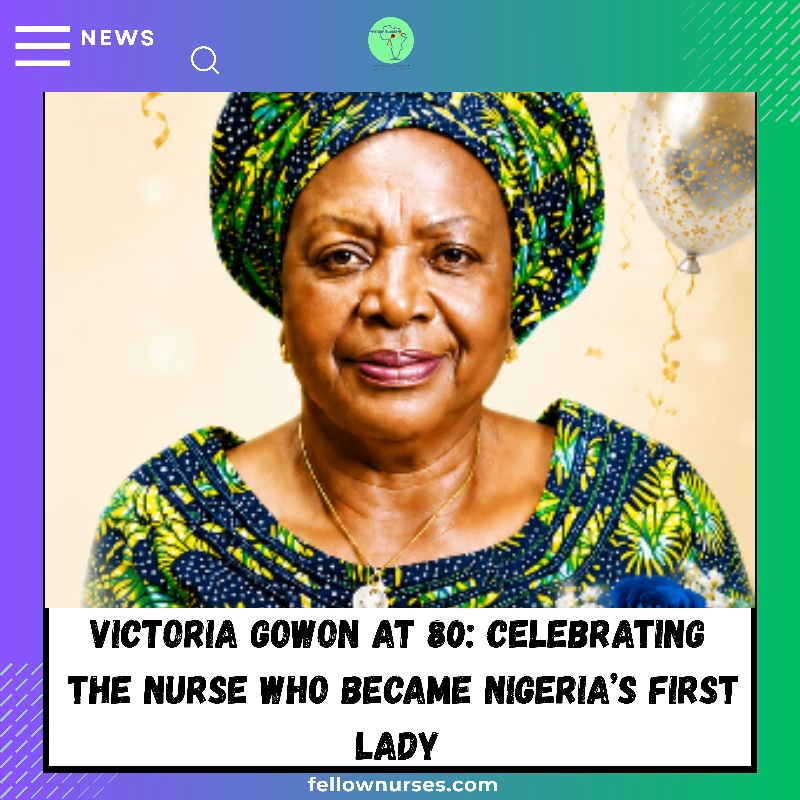
The Nigerian nursing community is celebrating Mrs Victoria Hansatu Gowon, a trained nurse and former First Lady of Nigeria, as she marks her 80th birthday.
Born on 22 August 1946 in Zaria, Victoria Gowon trained at the School of Nursing, University College Hospital, Ibadan, and qualified as a State Registered Nurse in July 1968. She married General Yakubu Gowon in 1969, while he was Nigeria’s Head of State, and served as First Lady until 1975.
Her story is unusual in Nigeria’s history: she was not simply the wife of a military Head of State. She was a nurse whose professional identity and interventions became part of the development of nursing in Nigeria.
A nurse at a pivotal moment in Nigeria’s history
Victoria Gowon entered nursing at a time when the profession was undergoing significant change.
Historical accounts indicate that Nigerian nurses faced concerns over pay disparities and working conditions compared with expatriate nurses during the Gowon administration. According to a biographical account of Victoria Gowon, she became aware of plans by nurses to embark on industrial action and brought the matter to the attention of her husband. The government subsequently acted on the concerns, including improvements to nurses’ pay.
That intervention has contributed to her enduring reputation within sections of the Nigerian nursing community as a figure who helped advance the status and welfare of nurses.
Her contribution to the profession also extended to the proper placement and recognition of nurses within the Scheme of Service, an important framework for determining professional structure, grading and career progression within the public service.
For a profession whose development has often depended on persistent advocacy for appropriate recognition, remuneration and career structures, such interventions remain significant.
From the nursing school to the First Lady’s office
Victoria Gowon’s transition from nursing to the country’s highest-profile public role occurred against the backdrop of the Nigerian Civil War.
Her husband became Head of State in 1966, and the couple married during the conflict in April 1969. Recent accounts based on General Gowon’s autobiography have provided further details about their relationship and Victoria’s life as a young nurse before she became First Lady.
Interestingly, her nursing background did not disappear when she entered public life.
The history of the University of Benin Teaching Hospital’s School of Nursing records that Victoria Gowon officially opened the school on 12 May 1973. The institution began with an initial intake of 22 nursing students and subsequently produced its first graduates with a 100 per cent success rate in the Nursing Council qualifying examination.
That episode provides another tangible connection between the former First Lady and the development of nursing education in Nigeria.
NMCN honours an octogenarian nurse
The Nursing and Midwifery Council of Nigeria (NMCN) has marked Mrs Gowon’s 80th birthday with a special congratulatory message.
In the message signed by Dr Ndagi Alhassan, Registrar/CEO of the Nursing and Midwifery Council of Nigeria, the Council extended its “warmest congratulations” to the former First Lady.
The Council described her life as one defined by grace and distinguished service to the nation, while specifically recognising her “immense contribution to nursing profession.”
It also acknowledged her role alongside General Yakubu Gowon during a critical period in Nigeria’s history, describing that period as one that demonstrated wisdom, courage and compassion.
The message is significant because it places her nursing identity alongside her national role, rather than viewing her legacy solely through the lens of her position as First Lady.
A legacy that goes beyond the title of First Lady
Victoria Gowon’s contribution to Nigerian nursing is particularly notable because it came from someone who understood the profession from within.
She entered nursing education as a young woman, qualified as a nurse and subsequently occupied a position from which she could draw attention to issues affecting nurses.
Her story also illustrates the influence that individual professional voices can have when they are able to reach decision-makers.
Today, many of the issues that Nigerian nurses continue to raise — professional recognition, appropriate remuneration, career progression, working conditions and representation — remain central to conversations about strengthening the health system.
Victoria Gowon’s legacy therefore offers more than a historical celebration. It provides an opportunity to reflect on the importance of professional advocacy and ensuring that nurses have a meaningful voice in decisions affecting their careers and the wider health system.
An enduring place in Nigerian nursing history
At 80, Victoria Gowon occupies a distinctive place in Nigeria’s history.
She is remembered as a former First Lady who lived through one of the country’s most turbulent periods. But for the nursing profession, she is also remembered as a nurse who used her position and influence to advance issues affecting her profession.
Her journey — from a nursing student in Ibadan to Nigeria’s First Lady, and later a figure recognised for her contribution to nursing — reflects the many ways nurses can influence society beyond the bedside.
As the NMCN celebrates her milestone birthday, the occasion is also a reminder that nursing’s history is shaped not only by institutions and policies, but by individuals who advocate for the profession and help move it forward.
Mrs Victoria Hansatu Gowon turns 80 today. For Nigerian nurses, her story remains a notable chapter in the history of a profession that continues to evolve.
Happy 80th birthday, Mrs Victoria Gowon.
Fellow Nurses Africa is the independent voice of African nursing, we educate, inform and support nurses across Africa.

Charles Wealth is an accomplished healthcare administrator with decades of hands-on experience across various healthcare organizations in Nigeria and beyond. Known for his strategic leadership, operational excellence, and deep commitment to advancing the nursing profession, Charles brings a wealth of expertise to healthcare management, policy, and professional development.
As a co-founder and Editor at Fellow Nurses Africa, he plays a pivotal role in shaping content that educates, inspires, and unites nurses across the continent. His editorial vision focuses on amplifying the voices of nurses, highlighting best practices, addressing contemporary challenges in healthcare, and promoting professional growth within the nursing community.
With a strong background in healthcare administration, Charles is passionate about bridging the gap between clinical practice and effective leadership. He continues to contribute significantly to the development of robust healthcare systems and the empowerment of nurses through knowledge sharing and advocacy.