
“Nigerian Critical Care System Needs to Be Put in ICU” — John Adeleye Raises Alarm Over Nursing Manpower Crisis
FNA NEWS, 19TH AUGUST 2026
Lagos, Nigeria
** Nigeria’s critical care services are facing a growing shortage of skilled nurses, with rising patient numbers, limited staffing and the continued migration of healthcare professionals putting additional pressure on hospitals.
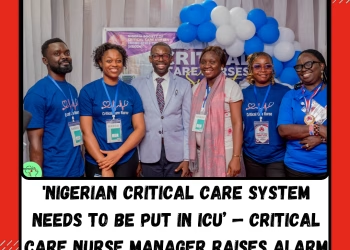
The warning came from John Adeleye, a Critical Care Nurse Manager at Evercare Hospital, Lagos, during the Critical Care Nurses Summit held at the Lagos University Teaching Hospital (LUTH) on 13 August 2026.
Adeleye said the shortage of critical care nurses was becoming increasingly difficult for hospitals to manage.
“In terms of manpower, we don’t have it. The numbers of patients are alarming, no staff.”
He said the situation was being made worse by the loss of nurses and other healthcare professionals to international migration, commonly referred to in Nigeria as the “Japa” syndrome.
“The little we have are being lost to Japa syndrome,” he said.
Critical care workforce under pressure
Critical care nursing requires specialised knowledge and skills because nurses working in intensive care environments care for patients who may require continuous monitoring, advanced interventions and life-support equipment.
A shortage of appropriately trained staff can place additional pressure on existing teams and make it more difficult for hospitals to provide consistent critical care.
Adeleye said the problem was not limited to public hospitals.
He argued that the private healthcare sector was also feeling the effects of the shortage and that improving Nigeria’s critical care workforce could not be left to government alone.
“Everybody is affected. Even the private sector, as we can’t leave it in the hands of the government alone.”
His comments point to a broader workforce challenge facing Nigeria’s health system: increasing demand for healthcare is occurring alongside the movement of experienced professionals to countries where better remuneration, working conditions and career opportunities may be available.
Call for investment in critical care training
Adeleye called for greater investment in specialised nursing education and workforce development.
He said government should consider sponsoring nurses to undertake critical care training, while hospitals and professional organisations should provide opportunities for nurses already working in the field to continue developing their skills.
“We need to build capacity, training. Government needs to sponsor people to come and study critical care. We need critical care continuous nursing education.”
Continuous professional education is particularly important in critical care, where nurses must maintain competence in areas such as patient monitoring, emergency response, infection prevention, ventilatory support and the management of critically ill patients.
Strengthening training capacity could also help create a larger pool of nurses able to work safely in intensive and high-dependency care settings.
Paediatric critical care faces an even greater challenge
Adeleye also drew attention to the challenges facing paediatric critical care.
While he described the manpower situation in adult critical care as concerning, he said the situation was even more difficult in paediatric critical care.
The shortage is significant because critically ill children can require highly specialised nursing care, with clinical decisions often needing to account for age, weight, developmental stage and rapidly changing physiological conditions.
Building capacity in paediatric critical care therefore requires not only more nurses, but nurses with appropriate specialist education and clinical experience.
Critical Care Nurses Summit focuses on empowered nurses
Adeleye made the remarks at the Critical Care Nurses Summit, organised by the Nigeria Society of Critical Care Nurses (NSCCN), Lagos State Branch.
The summit was held under the theme:
“Our Nurses, Our Future: Empowered Nurses Save Lives.”
The event brought together nursing and healthcare professionals to discuss issues affecting critical care practice and the future of the nursing workforce.
Among the speakers and senior healthcare stakeholders at the summit were Dr Kemi Ogunyemi, Special Adviser to the Lagos State Governor on Health, who delivered the keynote address, and Professor Adeyemo W. L. (FAS), Chief Medical Director of Lagos University Teaching Hospital.
The summit highlighted the central role nurses play in critical care and the need for stronger investment in professional development and workforce capacity.
Why Nigeria’s critical care workforce matters
The concerns raised at the summit extend beyond staffing numbers.
A functioning critical care system depends on a combination of appropriately trained personnel, adequate staffing levels, reliable equipment, effective leadership and continuous professional development.
For nurses, staffing shortages can also affect workload, professional development and the ability of teams to provide sustained care to critically ill patients.
Nigeria’s continuing loss of healthcare professionals through international migration has therefore become an important workforce issue for both public and private healthcare providers.
Addressing the problem will require more than recruitment alone. It will also require measures to train more specialist nurses, retain experienced professionals, improve working environments and create sustainable career pathways in critical care.
A need for coordinated action
Adeleye’s call for government and private healthcare providers to work together reflects the scale of the challenge.
Government investment remains important for expanding specialist training and strengthening the health workforce. However, hospitals, professional organisations and other healthcare institutions also have a role to play in developing staff and creating environments in which experienced nurses can build long-term careers.
The message from the LUTH summit was clear: Nigeria cannot strengthen critical care services without strengthening the nurses who provide much of that care.
As demand for critical care continues to place pressure on hospitals, investment in specialist nursing education, continuous professional development and workforce retention will be central to building a more resilient critical care system.
Fellow Nurses Africa is the independent voice of African nursing, we educate, inform and support nurses across Africa.

Durowoju Abisola is a registered nurse, nurse writer and On-Air Correspondent at Fellow Nurses Africa (FNA), passionate about nursing leadership, health education and advocacy.
Through journalism, storytelling and content creation, she amplifies important conversations around nursing, healthcare and the experiences of nurses in Nigeria. She is committed to using her voice and professional knowledge to educate the public, challenge misconceptions and inspire the next generation of nurses.