Has the Autism Spectrum Become Too Broad? What the New Debate Means for Families and Healthcare
*FNA NEWS, 22nd of AUGUST,2026
*LAGOS, NIGERIA
A new debate among autism researchers is questioning whether the broad definition of autism could contribute to misdiagnosis. But experts and autism organisations say the discussion must be handled carefully, particularly as many people still face barriers to diagnosis and support.
A fresh debate about autism is putting one word under the microscope: spectrum.
On 4 August, Professor Dame Uta Frith, a leading autism researcher at University College London, published an editorial asking whether the modern definition of autism has become too broad to remain clinically useful.
Frith argues that autism now covers a very wide range of people and that the expansion of the diagnosis may contribute to confusion and possible misdiagnosis. Her paper, published in Psychological Medicine, calls for greater precision in how autism is defined and diagnosed. (University College London)
The argument has generated a response from the autism community.
The UK’s National Autistic Society said that increasing numbers of people seeking assessment can also reflect greater awareness and understanding of autism. It cautioned that proposed autism subtypes remain theoretical and could create new problems if introduced without sufficient evidence. (National Autistic Society)
So, what is actually changing in the autism conversation?
https://whatsapp.com/channel/0029Vb5pewm8aKvTTHLmWn2L
What does the autism spectrum mean?
Autism is a neurodevelopmental condition that can affect communication, social interaction and behaviour.
But there is no single way autism looks.
The World Health Organization describes autism as a diverse group of conditions related to brain development. It says the abilities and support needs of autistic people can vary considerably, with some people living independently and others requiring substantial lifelong support. (World Health Organization)
That variation is why clinicians use the term autism spectrum.
It does not simply mean that one person has “a little autism” while another has “a lot”.
Rather, people can have very different combinations of characteristics, strengths, difficulties and support needs.
The challenge is determining where the boundaries of that spectrum should sit.
Why is autism diagnosis receiving so much attention?
The number of people identified as autistic has increased substantially over recent decades.
Frith’s new editorial points to several possible contributors, including greater awareness, reduced stigma, broader interpretation of diagnostic criteria, increased self-identification and the influence of social media. (Cambridge University Press)
But a rise in diagnoses does not automatically mean that autism itself has suddenly become more common.
https://whatsapp.com/channel/0029Vb5pewm8aKvTTHLmWn2L
Better recognition can increase the number of people receiving a diagnosis.
People who may previously have been overlooked can now reach assessment, including some adults who were not identified during childhood.
The WHO estimates that about one in 127 people worldwide had autism in 2021, while also warning that prevalence remains unknown in many low and middle income countries. (World Health Organization)
That distinction is important.
More diagnoses can reflect better recognition. They can also raise questions about diagnostic practice. The numbers alone cannot tell us which explanation accounts for the increase.
The concern about misdiagnosis
Frith’s argument focuses largely on diagnostic precision.
Autism does not have a single blood test or scan that can independently confirm a diagnosis. Assessment involves looking at a person’s developmental history, behaviour and characteristics against established clinical criteria.
This means clinical judgement matters.
Frith argues that the very broad range of people now receiving an autism diagnosis may make it harder to determine what they have in common and whether different groups may require different approaches. (University College London)
But there is another side to the issue.
For some people, particularly those diagnosed later in life, finally receiving an autism diagnosis can provide an explanation for difficulties they have experienced for years.
Reducing unnecessary diagnoses is important.
So is preventing people who genuinely are autistic from being overlooked.
The answer cannot simply be to diagnose fewer people.
It should be to improve the quality and accessibility of assessment.
What about late diagnosis?
One of the most important changes in the autism conversation is the growing recognition of people diagnosed later in life.
Some people reach adulthood without ever being assessed.
Others may have spent years adapting their behaviour to fit social expectations. The term masking is often used to describe efforts to hide or compensate for autistic characteristics.
These experiences have helped expand understanding of how autism can present.
But they also create a challenge for clinicians.
A diagnosis should not be based simply on whether someone recognises themselves in an autism-related social media post or online checklist.
Personal experiences can be valuable clues. They are not, by themselves, a clinical diagnosis.
A proper assessment should consider the person’s developmental history and current functioning, while also considering other possible explanations for their difficulties.
Why this debate matters in Africa
For African healthcare systems, the conversation may look very different.
In countries where specialist developmental services are limited, the more immediate problem may not be too many diagnoses.
It may be too few diagnoses.
The WHO says autism prevalence is unknown in many low and middle income countries. It also highlights persistent barriers to healthcare, inclusion and support for autistic people around the world. (World Health Organization)
This creates an important question for African health systems:
How many people are being missed because they never reach an appropriate assessment service?
Limited specialist services, cost, stigma, misinformation and poor awareness can all affect whether families seek help.
In some communities, developmental differences may also be misunderstood as poor parenting, bad behaviour or a spiritual problem.
That can delay professional assessment and support.
For Africa, therefore, improving diagnostic accuracy should happen alongside improving access to diagnosis.
The two goals are not opposites.
What should nurses know?
Nurses are often among the healthcare professionals who interact with children and families regularly.
This places nurses in an important position to notice developmental concerns, provide accurate information and guide families towards appropriate assessment.
But recognising a possible developmental concern is not the same as diagnosing autism.
A nurse should avoid labelling a child based on a single behaviour.
Instead, concerns should be documented appropriately and referred through the relevant clinical pathway when further assessment is needed.
Communication with parents also matters.
Families need information that is factual, respectful and free from blame.
They should not be told that autism is caused by poor parenting, nor should they be encouraged to rely on unverified treatments or online diagnoses.
And what about vaccines?
The autism debate has often been accompanied by misinformation about vaccines.
The scientific evidence does not support a causal link between vaccination and autism.
The WHO continues to identify autism as a diverse neurodevelopmental condition and states that its causes involve multiple factors. (World Health Organization)
For healthcare professionals, this distinction is important.
Families deserve honest answers to difficult questions. But those answers should be based on the best available evidence, not social media claims or anecdotal stories.
So, has the autism spectrum become too broad?
There is no settled scientific answer to that question.
Professor Dame Uta Frith’s new editorial has reopened an important discussion about diagnostic boundaries, heterogeneity and the possibility of misdiagnosis. Her proposal deserves examination and further research.
But it should not be interpreted as proof that autism is being widely misdiagnosed.
Nor should rising diagnosis rates automatically be treated as evidence that autism itself is becoming more common.
The National Autistic Society has argued that increased diagnosis can also reflect greater awareness and understanding, while warning that proposed autism subtypes are not currently established clinical tools. (National Autistic Society)
For healthcare professionals, the most useful response may therefore be neither alarm nor dismissal.
https://whatsapp.com/channel/0029Vb5pewm8aKvTTHLmWn2L
It is better evidence, better assessment and better access to care.
The bigger question for Africa
Perhaps the most important question for African healthcare systems is not simply whether the autism spectrum is too broad.
It is whether the healthcare system is equipped to recognise the people who need help and to provide that help once they are identified.
That means investing in professional training, developmental screening, specialist assessment, family education, research and inclusive services.
It also means listening to autistic people and their families when designing those services.
Autism is not a single experience.
And neither should the healthcare response be.
The debate over the autism spectrum may continue. But one principle should remain constant: every diagnosis should lead to better understanding, appropriate support and care that reflects the needs of the individual.
*Fellow Nurses Africa is the independent voice of African nursing, we educate, inform and support nurses across Africa.*
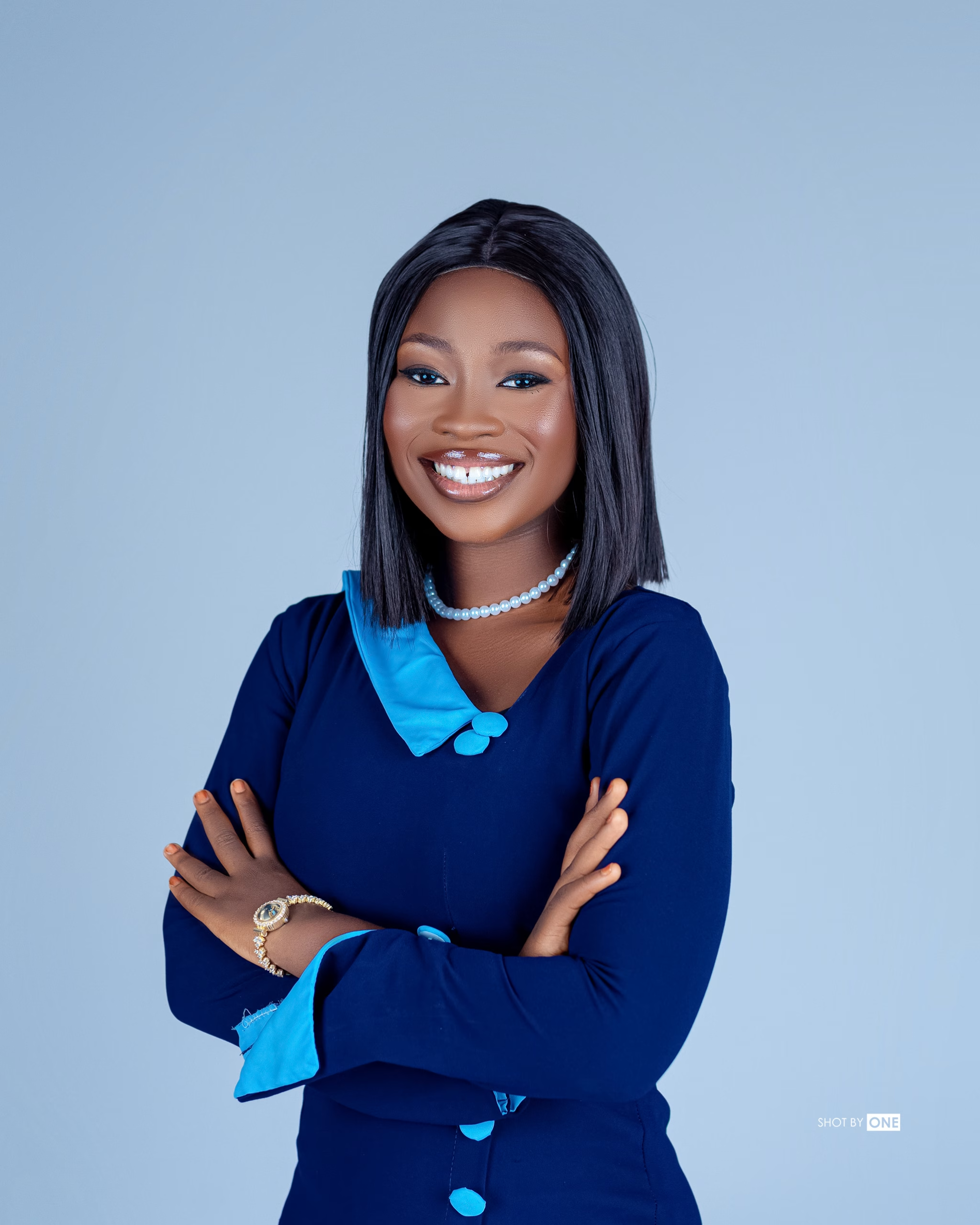
Durowoju Abisola is a registered nurse, nurse writer and On-Air Correspondent at Fellow Nurses Africa (FNA), passionate about nursing leadership, health education and advocacy.
Through journalism, storytelling and content creation, she amplifies important conversations around nursing, healthcare and the experiences of nurses in Nigeria. She is committed to using her voice and professional knowledge to educate the public, challenge misconceptions and inspire the next generation of nurses.