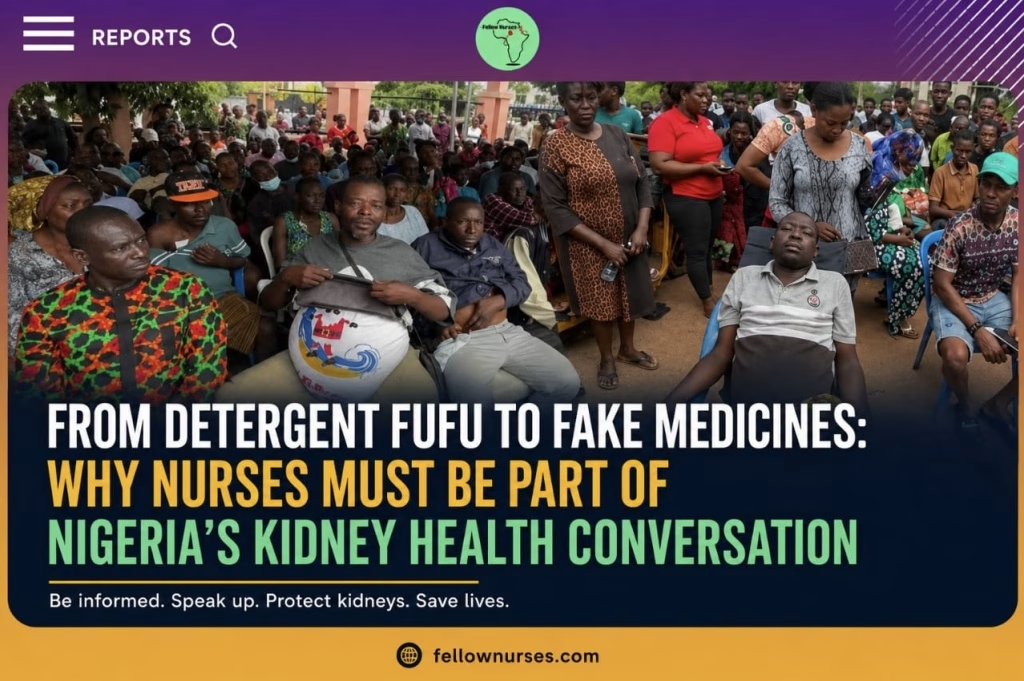
From ‘Detergent Fufu’ to Fake Medicines: Why Nurses Must Be Part of Nigeria’s Kidney Health Conversation
FNA NEWS, 24th OF AUGUST, 2026
LAGOS, NIGERIA.
More than 500 kidney patients reportedly gathered in Enugu seeking help with treatment costs. As social media fills with claims about contaminated food, adulterated medicines and toxic substances, nurses have a critical role in separating evidence from fear and helping Nigerians understand what really puts their kidneys at risk.
The images from Enugu have raised an uncomfortable question about the state of kidney health and healthcare access in Nigeria.
More than 500 people living with kidney related illnesses reportedly gathered at the Enugu State University Teaching Hospital, Parklane, seeking assistance with treatment costs, particularly dialysis. Among those reportedly present was a 13-year-old boy whose mother said she had sold virtually everything she owned to sustain his dialysis treatment for five years. (The Guardian Nigeria)
The gathering has since generated widespread discussion about kidney disease, but another conversation has been unfolding alongside it.
👉 Join our Whatsapp channel Here
What exactly are Nigerians being exposed to through the food they eat and the products they consume?
Across social media and recent public health investigations, Nigerians have encountered disturbing reports of food being processed, preserved or enhanced with substances that were never intended for human consumption.
There have been reports of cassava being soaked in detergent or bleach during fufu processing, meat being cooked with paracetamol to make it tender, grains being preserved with dichlorvos commonly associated with the insecticide Sniper fruits being artificially ripened with calcium carbide, and Sudan IV dye being used to intensify the colour of palm oil and pepper. Reports have also raised concerns about the use of toxic substances in fish preservation and other food handling practices. (The Guardian Nigeria)
These reports are disturbing.
But they also require something that social media does not always provide: careful interpretation of evidence.
For nurses, this distinction is particularly important,the problem is bigger than ‘detergent fufu’
The phrase “detergent fufu” has become one of the most recognisable examples of alleged food adulteration in Nigeria.
And there is now scientific work investigating the issue. A study published in 2026 assessed commercially processed fufu samples in Rivers State for detergent residues and microbial contamination, demonstrating that the concern is sufficiently serious to warrant scientific investigation. (Science Publishing Group)
But fufu is only one part of a much larger food safety conversation.
In 2025, reporting on a Senate investigation into Nigeria’s food chain highlighted several alleged practices involving chemical misuse. These included cassava soaked in detergent or Hypo, meat treated with paracetamol, grains preserved with Sniper, fruits ripened using calcium carbide, and palm oil and pepper coloured with Sudan IV. (The Guardian Nigeria)
Research on food adulteration in the region has also documented consumer reports involving substances such as Sudan dyes and other adulterants in different food products. (Wiley Online Library)
👉 Join our Whatsapp channel Here
The issue, therefore, is not simply whether Nigerians should be afraid of fufu.
It is whether unsafe chemical practices are entering the food chain and whether the systems designed to prevent them are strong enough.
Sniper on beans and stockfish is not just an internet rumour
One of the most important distinctions in this conversation is between a claim circulating online and a warning issued by a regulatory authority.
In June 2024, NAFDAC warned Nigerians against using dichlorvos, commonly known by the brand name Sniper, to preserve food. The agency specifically described the practice as hazardous and warned of potentially severe health consequences. (NAFDAC)
This matters because dichlorvos is an insecticide, not a food preservative.
Its presence in discussions about preserving grains, beans, stockfish or crayfish should therefore concern healthcare professionals and consumers alike.
The public should not have to guess whether a chemical used to kill insects is safe to put on food.
It is not enough to say that a substance is effective at keeping insects away.
A chemical can be effective against pests and still be dangerous to humans,That is why food safety regulation exists.
From stockfish to palm oil: the colour, smell and appearance problem
Some forms of food adulteration are driven by preservation,others are driven by appearance.
Food sellers operate in a competitive market, and consumers often make purchasing decisions based on colour, freshness, texture and appearance.
That creates opportunities for unscrupulous operators to manipulate food products to make them appear more attractive.
Reports from the Senate investigation raised concerns about Sudan IV, an industrial dye, being used to intensify the colour of palm oil and red pepper. (The Guardian Nigeria)
Research on food adulteration has similarly identified Sudan dye as a reported adulterant associated with palm oil. (Wiley Online Library)
This is why “it looks fresh” or “the colour is very bright” cannot be treated as proof of food quality.
Sometimes, the very characteristic that attracts the consumer may be the result of adulteration.
And then there is the issue of chemical ripening
The use of calcium carbide to accelerate fruit ripening has also featured prominently in Nigeria’s food safety debate.
Calcium carbide is an industrial chemical, and reports from the Senate investigation identified its use in artificially ripening fruits as a concerning practice. (The Guardian Nigeria)
Again, the important point for healthcare professionals is not to turn every naturally ripe fruit into a health scare.
The concern is deliberate exposure to substances that are not authorised for food use.
The public needs to understand the difference.
What about paracetamol in meat?
Another disturbing claim involves the use of paracetamol tablets to tenderise meat.
This has been reported in coverage of the Senate investigation and has also appeared in research examining food-adulteration practices reported by consumers. (The Guardian Nigeria)
But this is where nurses must be particularly careful with language.
Paracetamol itself is a legitimate medicine.
It does not become a poison simply because a viral post mentions it.
The concern is the deliberate and inappropriate introduction of a pharmaceutical product into food preparation.
A medicine should be used for an appropriate clinical indication, at an appropriate dose and through an appropriate route.
Putting tablets into food to change its texture is not a recognised food-processing method.
This is an important health-education message because patients may hear “paracetamol is in meat” and incorrectly conclude that the medicine itself is universally dangerous.
The problem is misuse.
What does any of this have to do with kidney disease?
This is where the conversation becomes particularly important for nurses.
Kidney disease has many causes.
Diabetes and hypertension are major contributors to chronic kidney disease, while infections, genetic conditions, cardiovascular disease, certain medications and environmental toxins can also play a role. KDIGO’s kidney health work emphasises the importance of addressing multiple risk factors, including environmental toxins, rather than reducing kidney disease to one cause. (KDIGO)
Therefore, we should not look at the Enugu gathering and conclude:
“These people developed kidney failure because they ate detergent contaminated fufu or Sniper treated beans.”
There is currently no evidence presented with the reported gathering that establishes such a causal relationship for those individual patients.
That would be irresponsible,but the opposite conclusion would also be problematic.
We should not dismiss concerns about toxic exposure simply because kidney disease has multiple causes.
Potential exposure to harmful chemicals is a legitimate public health issue and deserves proper investigation.
The question is not whether every viral allegation is true.
The question is whether Nigeria has adequate surveillance, enforcement, testing and public education to identify and prevent genuine food-safety threats.
This is where nurses come in
Nurses occupy a unique position in this conversation because they are often among the healthcare professionals closest to patients and communities.
A nurse in a primary healthcare centre may be the person checking a patient’s blood pressure every few months.
A nurse may be caring for a patient with diabetes who has never had a conversation about kidney complications.
A nurse may discover that a patient regularly takes over-the-counter medicines without professional guidance.
Another patient may be using herbal preparations.
Someone may be purchasing medicines from an unregulated source.
Another person may be worried that a particular food has damaged their kidneys because of something they saw on social media.
Each encounter presents an opportunity for evidence based health education.
KDIGO’s clinical guidance supports risk assessment and early detection of chronic kidney disease, while its broader prevention work highlights the importance of addressing environmental and social risk factors alongside conventional medical risks. (KDIGO)
Nurses therefore have a role that extends beyond administering medication or monitoring vital signs.
Nurses are educator, advocates and health communicators.
And increasingly, they are also required to help patients navigate an environment saturated with medical misinformation.
We need to stop turning health education into fear
There is a danger in the way these stories spread.
A video showing someone allegedly adding chemicals to food can receive millions of views within hours.
People begin forwarding lists of “foods you should never eat”.
Someone claims that a particular medicine causes kidney failure.
Another says a particular fruit is poisonous.
Another recommends a “kidney detox” to reverse the damage.
Fear replaces evidence.
For nurses, this is an opportunity to do something different.
We should teach people how to ask better questions.
Is the claim from a credible regulatory agency?
Has the substance actually been detected in the food?
Is there scientific evidence supporting the claim?
Is the reported exposure known to cause harm at the level and route involved?
Has a healthcare professional assessed the patient?
And perhaps most importantly:
Are we confusing a possible risk with a proven cause?
These questions can prevent health education from becoming health misinformation.
Medication safety is also kidney safety
The conversation about fake medicines belongs here too.
Nigeria continues to face challenges involving substandard and falsified medicines, and NAFDAC maintains public alerts concerning products that may pose risks to patients. (NAFDAC)
For nurses, medication history should therefore go beyond the medicines documented on a prescription sheet.
Patients should be encouraged to disclose over-the-counter medicines, herbal products and supplements they use.
They should also be encouraged to obtain medicines through legitimate channels and to avoid products whose source, ingredients or regulatory status cannot be established.
This becomes particularly important for people who already have kidney disease because impaired kidney function can alter how some medicines are handled by the body.
Medication decisions in these patients require greater care, not less.
The Enugu patients are more than a headline
It would be easy for the story of more than 500 kidney patients gathering in Enugu to become another viral moment.
It should not.
Behind the number are patients who need treatment.
There are parents trying to keep their children alive.
There are families struggling with the financial consequences of chronic disease.
There are healthcare professionals working within a system where access to kidney replacement therapy remains challenging.
And there is a country that needs to have a serious conversation about prevention, early detection, food safety, medication safety and healthcare financing.
The answer is not to frighten Nigerians into avoiding every food mentioned in a viral post.
Nor is it to dismiss legitimate concerns about chemical exposure.
The answer is evidence.
Nurses must be part of the conversation
The public needs nurses who can say, food adulteration is a serious concern,some chemicals have no place in food preservation or processing, unsafe medicines can harm patients.
But no, we cannot automatically attribute every case of kidney disease to a viral list of contaminated foods.
That balance is essential.
Nigeria needs stronger food safety enforcement and surveillance. It needs better public education. It needs responsible reporting. It needs affordable access to kidney care. And it needs healthcare professionals who can translate complex evidence into information that ordinary people can understand.
Nurses are uniquely positioned to do this.
The conversation that began with images of hundreds of kidney patients in Enugu should therefore not end with another WhatsApp list of “poisonous foods”.
👉 Join our Whatsapp channel Here
It should lead to a much more important conversation about how we prevent kidney disease, how we protect Nigerians from unsafe food and medicines, how we detect illness early, and how we ensure that patients who eventually need dialysis are not forced to choose between treatment and survival.
Because kidney health does not begin when a patient arrives at a dialysis centre.
It begins much earlier in the community, in primary healthcare, in food safety, in medication, counseling, in early screening and in every health conversation where a nurse has the opportunity to prevent harm.
And that is why nurses must be part of Nigeria’s kidney health conversation.
Fellow Nurses Africa is the independent voice of African nursing, we educate, inform and support nurses across Africa.

Durowoju Abisola is a registered nurse, nurse writer and On-Air Correspondent at Fellow Nurses Africa (FNA), passionate about nursing leadership, health education and advocacy.
Through journalism, storytelling and content creation, she amplifies important conversations around nursing, healthcare and the experiences of nurses in Nigeria. She is committed to using her voice and professional knowledge to educate the public, challenge misconceptions and inspire the next generation of nurses.