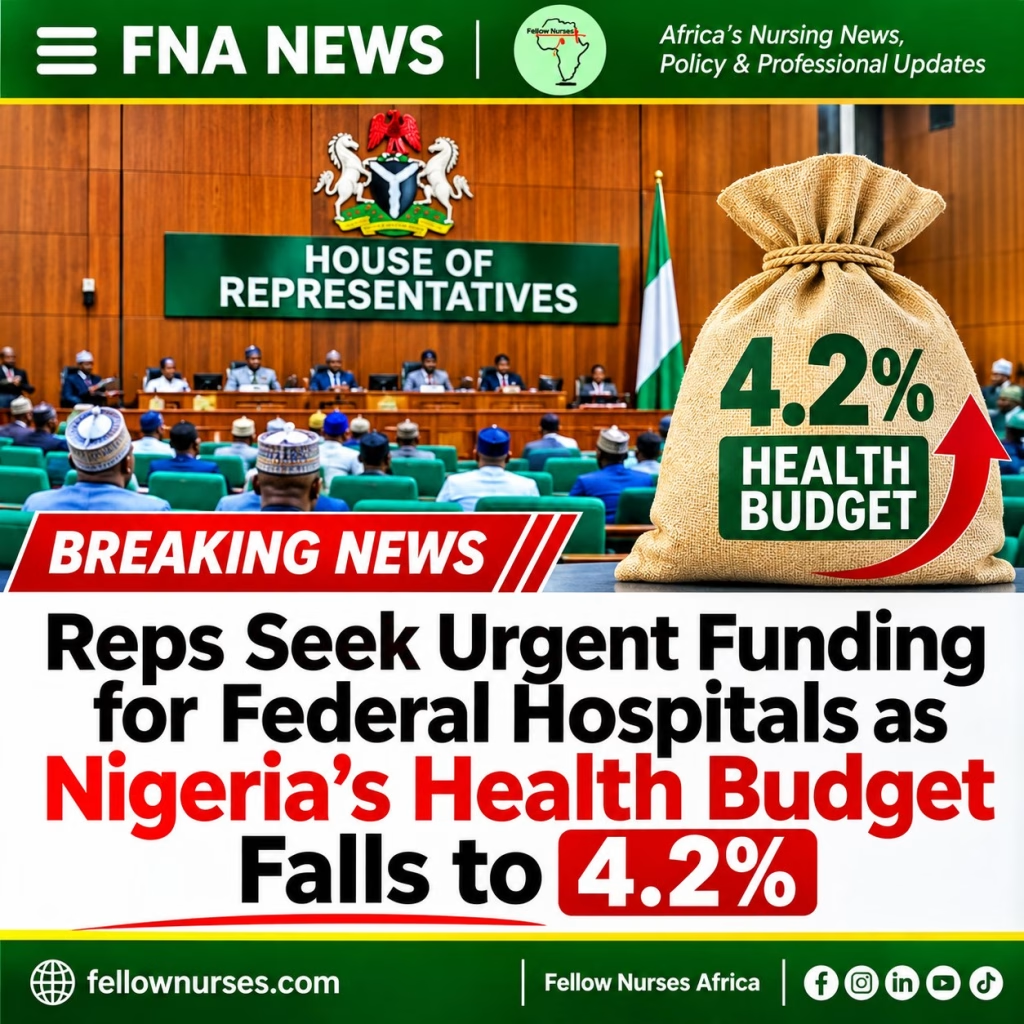
Reps Seek Urgent Funding for Federal Hospitals as Nigeria’s Health Budget Falls to 4.2%
FNA NEWS, 13th OF NOVEMBER, 2026
The House of Representatives has called on the Federal Government to urgently increase funding for federal teaching hospitals, Federal Medical Centres (FMCs), the National Hospital Abuja and other tertiary healthcare institutions across Nigeria.
👉 Join Fellow Nurses Africa on WhatsApp
The lawmakers warned that inadequate budgetary allocations, poor infrastructure, shortages of medical equipment and insufficient healthcare personnel are weakening the capacity of public hospitals to deliver quality specialist healthcare.
The call followed a motion of urgent public importance moved by Hon. Dr Patrick Umoh, Chairman of the House Committee on Health Institutions, during plenary on Wednesday.
Umoh, who represents the Ikot Ekpene/Essien Udim/Obot Akara Federal Constituency of Akwa Ibom State, drew attention to the financial difficulties confronting federal tertiary healthcare institutions and called for stronger government investment in the sector.
Nigeria’s Health Budget Remains Below Abuja Declaration Target
👉 Join Fellow Nurses Africa on WhatsApp
Presenting the motion, Umoh expressed concern over Nigeria’s declining health sector allocation, noting that the proposed 2026 federal health budget represents approximately 4.2 per cent of total government expenditure.
This remains significantly below the 15 per cent health funding commitment made by African Union member states under the 2001 Abuja Declaration.
The lawmaker also highlighted concerns about the release and utilisation of approved capital funds.
According to figures cited during the motion, only about 30 per cent of the health sector’s capital appropriation for 2023 was released, while approximately 15.06 per cent of the 2024 capital allocation was reportedly released and utilised.
He further stated that only ₦36 million was reportedly released from the ₦218 billion appropriated for the Federal Ministry of Health’s 2025 capital expenditure.
The funding challenges, he argued, have contributed to deteriorating hospital infrastructure, inadequate medical equipment, insufficient bed spaces, unreliable electricity supply and increasing operational costs.
Poor Funding Threatens Specialist Healthcare Delivery
Umoh warned that the consequences of inadequate funding extend beyond hospital infrastructure to the quality, availability and affordability of healthcare services.
Federal tertiary institutions play a critical role in providing specialised medical services, training healthcare professionals and conducting medical research.
However, many of these facilities continue to struggle with overcrowding, delayed treatment, inadequate diagnostic equipment and poor maintenance of existing infrastructure.
The lawmaker noted that these challenges have forced some Nigerians to seek medical attention in private hospitals or travel abroad for specialised healthcare services.
He also raised concerns about the continued migration of doctors, consultants, nurses and other skilled healthcare professionals, warning that the loss of experienced personnel further weakens the capacity of public hospitals.
The motion also referenced the recently reported Ebola case in Nigeria, highlighting the importance of adequately equipped tertiary healthcare institutions in responding to public health emergencies.
Reps Demand Increased Funding and Improved Welfare for Healthcare Workers
👉 Join Fellow Nurses Africa on WhatsApp
Following the debate, the House urged the Federal Government to substantially increase budgetary allocations to federal teaching hospitals, Federal Medical Centres, the National Hospital Abuja and other tertiary healthcare institutions in the 2027 Supplementary Appropriation Bill and subsequent budgets.
The lawmakers also called for a dedicated tertiary healthcare infrastructure revitalisation programme to rehabilitate existing facilities, expand hospital capacity and provide modern medical equipment.
On workforce challenges, the House urged the Federal Ministry of Health and Social Welfare to conduct a comprehensive assessment of staffing requirements across federal tertiary institutions.
It further called for an adequately funded recruitment and retention programme, alongside improved welfare packages, specialist allowances, professional development opportunities and other incentives to discourage healthcare professionals from leaving public hospitals.
The lawmakers also urged the Federal Ministry of Finance and the Office of the Accountant-General of the Federation to ensure timely and adequate releases of approved budgetary allocations, particularly capital and overhead funds.
They stressed the need for dedicated funding for essential hospital operations, including electricity, water supply, equipment maintenance and medical consumables.
The House unanimously adopted the motion and mandated its Committee on Health Institutions to engage relevant ministries, the Budget Office of the Federation and hospital managements to develop a sustainable funding and infrastructure revitalisation framework.
The committee is also expected to monitor implementation and submit periodic reports to the House.
FNA Views: Healthcare Funding Must Translate into Better Patient Care
Nigeria’s healthcare funding challenge is not simply a question of how much money appears in the national budget. It is also about whether approved funds are released on time, properly utilised and translated into measurable improvements in healthcare delivery.
For nurses and other healthcare professionals working in public hospitals, inadequate funding often becomes a daily operational challenge. Insufficient equipment, poorly maintained facilities, inadequate staffing and limited access to essential medical supplies can affect their ability to deliver safe and effective care.
The consequences ultimately extend to patients, who may experience delayed treatment, limited access to specialist services and increased financial pressure when public facilities cannot adequately meet their healthcare needs.
Equally important is the relationship between healthcare infrastructure and workforce retention. Improving salaries and welfare packages is necessary, but healthcare professionals also need functional equipment, adequate staffing, safe working environments and opportunities for professional development.
The House of Representatives’ intervention therefore raises an important question: will the proposed funding improvements translate into tangible changes within Nigeria’s public hospitals?
Beyond legislative resolutions, Nigerians need transparent budget implementation, effective monitoring and accountability for public healthcare expenditure.
Adequate healthcare funding should not remain a recurring political promise. It must become a measurable investment in healthcare workers, hospital infrastructure and, ultimately, the lives of patients.
👉 Join Fellow Nurses Africa on WhatsApp
Fellow Nurses Africa is the independent voice of African nursing, we educate, inform and support nurses across Africa.

Durowoju Abisola is a registered nurse, nurse writer and On-Air Correspondent at Fellow Nurses Africa (FNA), passionate about nursing leadership, health education and advocacy.
Through journalism, storytelling and content creation, she amplifies important conversations around nursing, healthcare and the experiences of nurses in Nigeria. She is committed to using her voice and professional knowledge to educate the public, challenge misconceptions and inspire the next generation of nurses.
 ✓
Did you know that we're the accredited ReMar NCLEX Training Centre in Nigeria with Prof. Regina Callion?
Prepare and pass your NCLEX-RN / NCLEX-PN with official ReMar Review curriculum, Regina Callion video lectures, Quick Facts, and dedicated clinical mentorship right here in Nigeria.