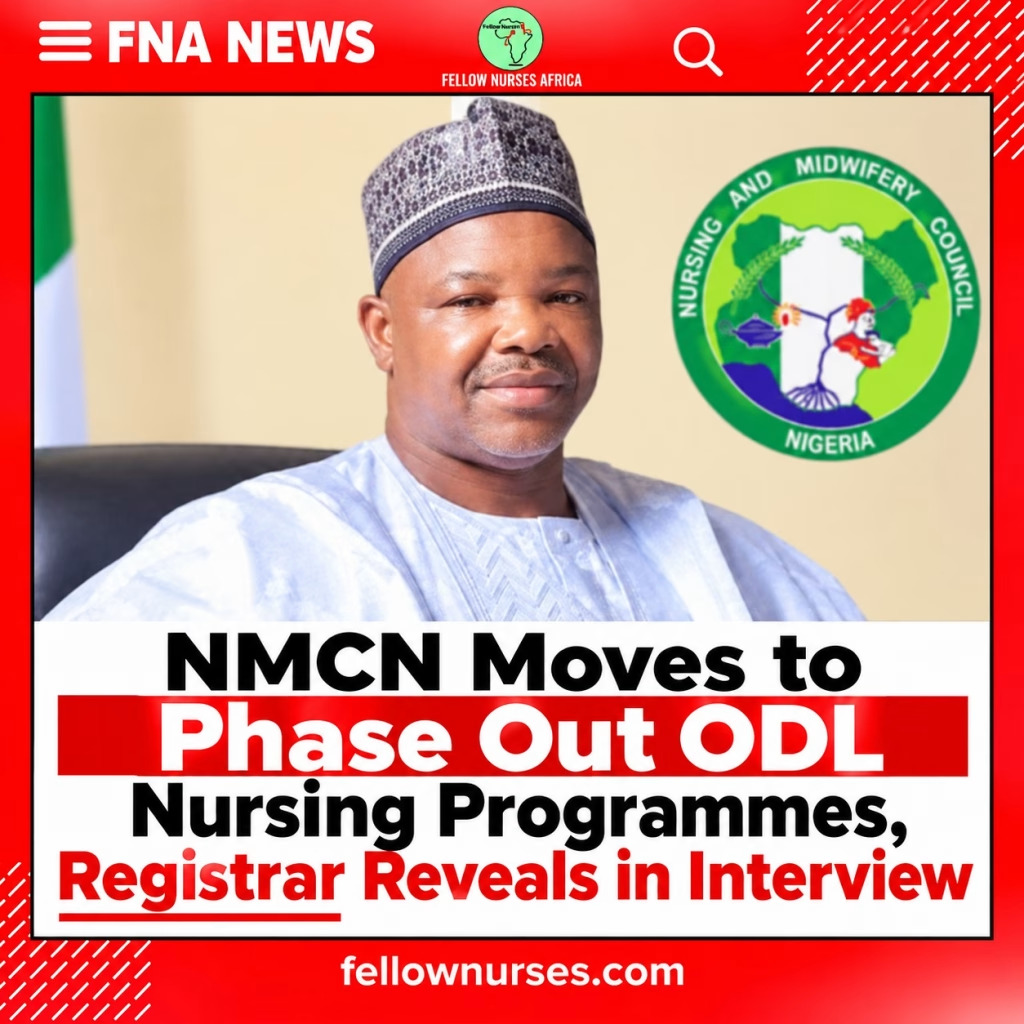
NMCN Moves to Phase Out ODL Nursing Programmes, Registrar Reveals in Interview
The Nursing and Midwifery Council of Nigeria says it plans to phase out online and Open and Distance Learning models for basic nursing education, citing concerns over inadequate hands-on clinical training.
👉 Join Fellow Nurses Africa on WhatsApp
The Nursing and Midwifery Council of Nigeria (NMCN) has disclosed plans to phase out Open and Distance Learning (ODL) models for basic nursing education as part of broader efforts to strengthen nursing training standards across the country.
The Council’s Registrar and Chief Executive Officer, Dr Ndagi Alhassan, disclosed this in an interview published on November 26, 2026.
According to Alhassan, the decision is driven by concerns that online and distance learning models cannot adequately provide the practical exposure and hands-on clinical experience required to prepare competent nurses.
He explained that the Council is also placing greater emphasis on training resources, institutional accreditation and compliance with established nursing education standards.
The proposed phase-out forms part of a wider regulatory reform agenda that includes a moratorium on establishing new nursing training institutions and mandatory resource verification before institutions can increase admission quotas or introduce additional programmes.
Why NMCN Is Reconsidering Online Nursing Education
👉 Join Fellow Nurses Africa on WhatsApp
Nursing is a practice-based profession that requires more than theoretical knowledge. Clinical competence develops through supervised patient care, practical demonstrations, simulation and repeated exposure to real healthcare environments.
The Council’s position reflects concerns that programmes delivered primarily through online or distance learning may not provide sufficient opportunities for these essential experiences.
While digital learning can support theoretical instruction, nursing education requires structured clinical placements and access to properly equipped skills laboratories.
The Registrar also disclosed that the Council is developing a central electronic library and an e-skills laboratory to strengthen access to learning resources and practical demonstrations.
Additionally, the Federal Government plans to establish large simulation centres in six states. These facilities are expected to support both nursing students and practising healthcare professionals who require practical training.
However, the effectiveness of these reforms will depend on their implementation, accessibility and the ability of training institutions to provide adequate clinical placements.
The Diploma and HND Question: What Does the Future Hold?
Beyond the ODL debate, the Registrar’s interview has also brought renewed attention to the longstanding concerns surrounding diploma qualifications, HND holders and academic progression in nursing.
During the interview, Alhassan addressed the transition towards the BNSc as the entry qualification and the position of nurses who already hold diploma qualifications.
He explained that diploma-qualified nurses can continue to practise, but their career progression within the public service is limited compared with that of degree holders.
According to him, degree-qualified nurses can progress to the position of Director of Nursing Services, while diploma holders have more restricted advancement opportunities.
The Council, he said, has provided opportunities for diploma holders to return to school and obtain degree qualifications to improve their career prospects.
On the HND-to-degree dichotomy, the Registrar described it as a national issue and disclosed that the Federal Government is working towards addressing the disparity.
He added that programmes are being developed to provide affected graduates with opportunities to attain comparable academic and professional standing.
However, questions remain about the accessibility of these programmes, their admission requirements, the recognition of existing qualifications and the practical implications for nurses who may not have the financial or institutional support to pursue further education.
For many nurses, academic progression is not simply about obtaining another certificate. It also affects career mobility, professional recognition and opportunities within the public healthcare system.
A Wider Nursing Education Reform Agenda
👉 Join Fellow Nurses Africa on WhatsApp
The proposed ODL phase-out is only one aspect of the Council’s broader efforts to strengthen nursing education and professional regulation.
Other measures disclosed by the Registrar include:
- A moratorium on establishing new nursing training institutions to consolidate standards in existing institutions.
- Mandatory resource verification before increasing student admission quotas or introducing additional programmes.
- Unannounced inspections of suspected illegal training institutions.
- Improved access to electronic learning resources and practical skills demonstrations.
- Plans for large simulation centres in six states.
- Stronger enforcement against unlicensed nursing practice and illegal training institutions.
Alhassan also disclosed that the Council has 143 cases involving illegal establishment of institutions and other forms of misconduct before the Economic and Financial Crimes Commission (EFCC) and the Independent Corrupt Practices and Other Related Offences Commission (ICPC).
These measures reflect a regulatory focus on improving the quality of nursing education, protecting professional standards and strengthening public confidence in nursing practice.
FNA View: Diploma Nurses Should Begin Their Transition to BNSc as Nursing Moves Towards a Unified Entry Qualification
The proposed phase-out of ODL models for basic nursing education should also be viewed within the broader conversation about the future of nursing education and professional advancement in Nigeria.
One of the important long-term goals of nursing reforms should be to establish a more unified entry qualification, strengthen professional recognition and create a clearer career progression pathway for nurses.
For diploma-qualified nurses, this should be a moment to consider their academic progression seriously.
Rather than waiting until further regulatory changes make the transition more complicated, diploma nurses who intend to obtain a Bachelor of Nursing Science (BNSc) degree should begin exploring the available, duly approved ODL programmes and other recognised pathways.
Obtaining a degree is not simply about adding another qualification to one’s credentials. It can improve opportunities for career progression, academic advancement, leadership positions and participation in the evolving professional landscape.
The broader objective should be to move the profession forward collectively, not create unnecessary divisions between nurses based on their entry qualifications.
A stronger nursing profession requires a workforce that is adequately trained, professionally recognised and provided with equitable opportunities for advancement.
Our message to diploma nurses is simple: Do not postpone your academic progression. Start exploring your BNSc options now, verify that your chosen programme is currently recognised by the NMCN, and take deliberate steps towards securing your place in the future of the profession.
The goal should be a nursing workforce that advances together, with stronger educational standards, clearer career pathways and a more unified professional identity.
👉 Join Fellow Nurses Africa on WhatsApp
Fellow Nurses Africa is the independent voice of African nursing, we educate, inform and support nurses across Africa.

Durowoju Abisola is a registered nurse, nurse writer and On-Air Correspondent at Fellow Nurses Africa (FNA), passionate about nursing leadership, health education and advocacy.
Through journalism, storytelling and content creation, she amplifies important conversations around nursing, healthcare and the experiences of nurses in Nigeria. She is committed to using her voice and professional knowledge to educate the public, challenge misconceptions and inspire the next generation of nurses.
 ✓
Did you know that we're the accredited ReMar NCLEX Training Centre in Nigeria with Prof. Regina Callion?
Prepare and pass your NCLEX-RN / NCLEX-PN with official ReMar Review curriculum, Regina Callion video lectures, Quick Facts, and dedicated clinical mentorship right here in Nigeria.